
Sous vide is one of those kitchen categories that looks more intimidating than it really is. The core promise is simple: hold food at a precise water temperature long enough that it cooks evenly from edge to centre. No panic over overcooking a steak by two minutes, no dried-out chicken breast, no...
Sous vide is one of those kitchen categories that looks more intimidating than it really is. The core promise is simple: hold food at a precise water temperature long enough that it cooks evenly from edge to centre. No panic over overcooking a steak by two minutes, no dried-out chicken breast, no guessing whether the middle is done while the outside races ahead. But the product pages don't explain it plainly. They throw around 0.1°C precision, app control, stainless steel housings, and dramatic photos of perfect salmon fillets as if the machine itself is the trick. It isn't. The trick is controlled temperature over time.
This article isn't a hands-on review. It's an editorial look at what home sous vide cookers actually are in 2026, how immersion circulators differ from each other, what wattage and water capacity really mean, which features are useful versus decorative, and who this category honestly suits. If you're wondering whether a roughly $100 to $130 circulator like the CharMeter or KitchenBoss is enough, or whether you should be looking higher at something like an Anova or Breville Joule, this is the plain-English version.
Quick snapshot
| Product | Price (CAD) | Form factor | AI engine / Core mechanism | Best for |
|---|---|---|---|---|
| CharMeter WiFi Sous Vide Cooker ISV-100W | ~$100 | Side-clamp immersion circulator | 1000W heater + app control via RoastTrackt | Budget-conscious home cooks, quieter kitchens |
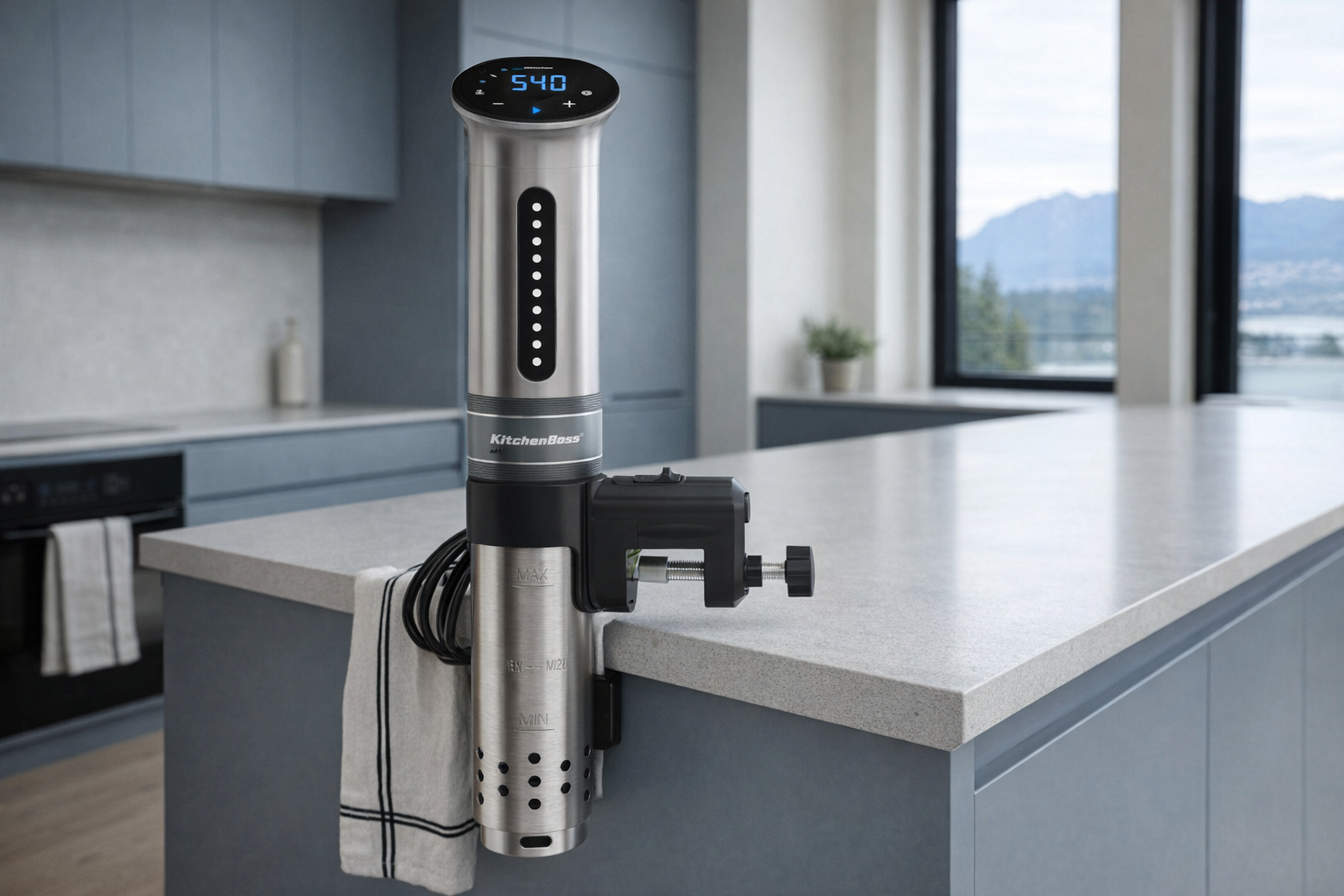
| KitchenBoss WiFi Sous Vide Cooker 1100W | ~$130 | Side-clamp immersion circulator | 1100W heater + KitchenBoss app + 16L/min circulation | Buyers wanting more power and stronger build for mid-budget money |
Pro tip: Evaluate a sous vide cooker the way you'd evaluate a rice cooker or kettle, not a "smart kitchen revolution." What matters is stable temperature, enough power for your water volume, a clamp that fits your pot, and controls you won't hate using at 7 p.m. on a Tuesday.
What counts as a "sous vide cooker" in 2026
For this guide, a home sous vide cooker is an immersion circulator: a stick-shaped appliance that clamps onto a pot or container, heats the water, and circulates it so the whole bath stays at the same temperature. That's different from a countertop oven, a slow cooker, or a pressure cooker with a vague sous vide mode. The real category is narrower than the marketing suggests: if it doesn't actively circulate water and hold a precise target temperature, it's not really the same thing.
1. Budget-stable circulators. These are the practical middle of the market: enough power to be useful, enough precision to matter, and app features that are nice to have rather than the whole reason to buy. The CharMeter WiFi Sous Vide Cooker ISV-100W and KitchenBoss WiFi Sous Vide Cooker 1100W both sit here. This is the tier most home cooks should look at first. The machines are not glamorous, but they can be entirely sufficient if your batches are normal-sized and your expectations are sane.
2. Premium convenience models. This is where shoppers start comparing the mid-budget field to names like Breville Joule or Anova Pro. The reason people pay more is usually not that the food becomes magically better. It's that you may get a more polished app, stronger long-term support, a more refined form factor, or a more confidence-inspiring build. That's a reasonable reason to spend more; it's just not the same as needing to spend more. A lot of marketing in this space quietly relies on buyers confusing "nicer product" with "better cooking physics."
3. Faux-sous-vide kitchen gadgets. This is the category worth avoiding. Plenty of appliances now claim a sous vide function because the term has become shorthand for precision cooking. But if the device doesn't clearly behave like an immersion circulator, with temperature control and moving water, you're shopping a different tool. For most home kitchens, a real circulator clipped to a stock pot is the more honest design.
That split matters because the biggest mistake people make isn't buying a bad unit. It's buying the wrong type of device for the way they cook. If you're planning to do weeknight steaks, chicken breasts, and the occasional salmon fillet, a mid-budget circulator can make perfect sense. If you think you need a prestige brand because the internet talks about sous vide like it's a hobbyist cult, slow down. For most households, this is just precise hot water.
The 2 products, separated by what they actually are
CharMeter WiFi Sous Vide Cooker ISV-100W — the value-first mid-budget pick
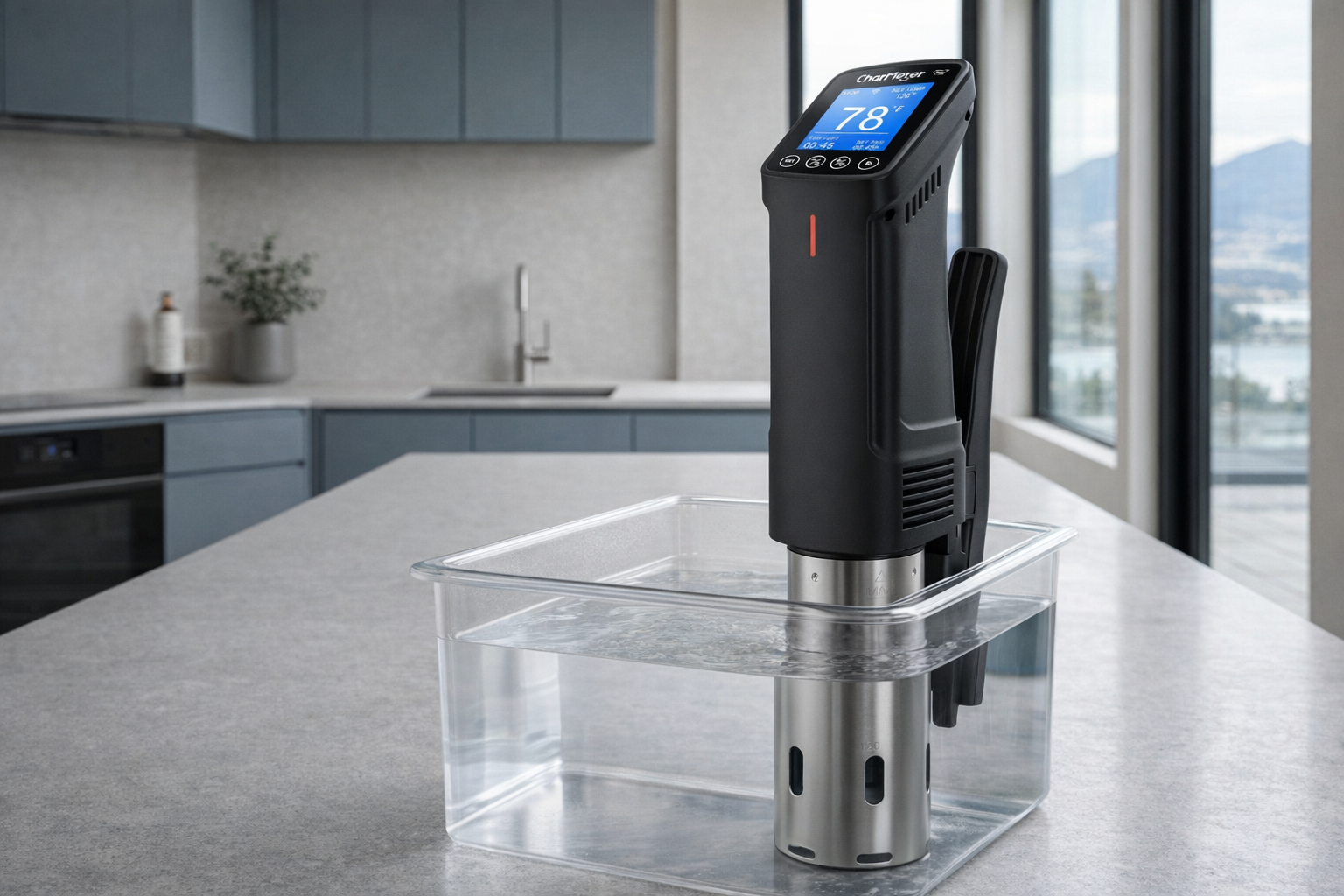
At roughly $100 CAD, the CharMeter WiFi Sous Vide Cooker ISV-100W is the kind of product that makes the category easier to recommend. It gives you the core things that actually matter: 1000W of heating power, 0.1°C stated temperature accuracy, a 77–210°F range, a 99-hour timer, app control through RoastTrackt, and a claimed capacity of up to 20 liters of water. It also claims operation under 40dB, which is not nothing in a kitchen where some circulators can become an annoying constant whirr during a long cook.
The honest read is that CharMeter looks well positioned for people who want sous vide without turning it into a gear hobby. A 1000W circulator is generally the right neighbourhood for a typical home setup, especially if you're heating something like a 12L bath rather than trying to brute-force a huge cooler full of cold water. In plain terms: it should handle dinner-sized batches sensibly, but don't expect miracle heat-up times if you start with a giant container and fridge-cold water. The app and 14 preset recipes are useful if you're new, though presets are never a substitute for understanding time and temperature. That's true of every brand, not just this one.
📺 Watch: CharMeter in a real product demo
- Best for: Budget-conscious home cooks who want a real immersion circulator with WiFi, quiet operation, and enough power for normal family-size cooking.
- Full explainer: CharMeter WiFi Sous Vide Cooker ISV-100W on Celmin · Directory: product page
KitchenBoss WiFi Sous Vide Cooker 1100W — the stronger all-rounder in the same lane
The KitchenBoss WiFi Sous Vide Cooker 1100W is the anchor product here because it sits in the most interesting part of the market: the zone where buyers want something better than bare-minimum budget gear, but don't necessarily want to jump into premium-brand pricing. At around $130 CAD, it adds a little more headroom with 1100W of power, app control through the KitchenBoss app, a 40–90°C temperature range, and a circulation system built around a brushless DC motor rated at 2900r/m with 16L/min water flow. It also uses SUS304 stainless steel construction, which is the kind of practical spec that's more meaningful than flashy marketing language.
The reason KitchenBoss is worth highlighting is that it's a more honest upgrade than many "premium-looking" kitchen gadgets. The extra 100W over a 1000W unit won't transform your life, but it does push the product in the right direction for larger water baths or faster recovery after you add cold food. If you're cooking in something around the 12L range, both this and the CharMeter should be in the workable zone; if you edge bigger, the KitchenBoss starts to make more sense. The stronger stated circulation at 16L/min also matters because sous vide isn't just heating — it's even heating. Good water movement helps prevent temperature pockets. That's an unglamorous spec, but it's one of the more important ones.
📺 Watch: KitchenBoss overview
There's also a style of buyer this fits especially well: someone cross-shopping against better-known names and wondering if a mid-budget unit is a compromise. Sometimes it is, sometimes it isn't. KitchenBoss does not need to beat a Breville Joule at polish to be a sensible buy. It just needs to give you dependable heat, stable circulation, tolerable noise, and controls that aren't maddening. On paper, it makes a solid case. The category isn't complicated enough to justify paying twice as much unless you specifically value the premium extras.
- Best for: Buyers who want a bit more heating power, stronger circulation, and a stainless-heavy build without jumping straight into premium-brand pricing.
- Full explainer: KitchenBoss WiFi Sous Vide Cooker 1100W on Celmin · Directory: product page
How the sous vide mechanism actually works
The basic physics here are straightforward, and understanding them makes the whole category much less mysterious.
1. Wattage is really about water volume and patience.
When you see 1000W or 1100W, don't treat it like bragging rights. Treat it like a clue about how quickly the machine can bring a given amount of water up to temperature and how well it can hold that temperature once food goes in. A realistic home rule of thumb is that 1000W heats a 12L tank well, while 800W can start to feel sluggish on larger batches. That's why the mid-budget segment tends to cluster around 1000W and above. The difference between 1000W and 1100W is not dramatic, but it is real. More power helps with larger containers, colder starting water, and recovery after adding a bag of fridge-cold meat.
2. Heating time is measurable, not mystical.
For the kinds of temperatures many people use — say 57°C for a steak — a reasonable heat-up window is often in the 5 to 15 minute range, depending on starting water temperature, water volume, and the power of the circulator. If you fill a large pot with very cold tap water in January, especially in colder parts of the country, expect the longer end. If you start with warm water and a moderate bath, expect the shorter end. This matters because app scheduling sounds fancier than it is: much of the convenience comes from planning around preheat time, not from the app itself being magical.
3. Circulation matters as much as the heating element.
A sous vide machine does two jobs: heat the water and move the water. Without circulation, you can get warmer and cooler pockets in the bath. That's why the KitchenBoss listing calling out 16L/min flow and a 2900r/m brushless DC motor is more than spec-sheet filler. It's telling you how aggressively the unit keeps the bath even. The CharMeter doesn't list a flow rate in the supplied dossier, but it does position itself around stable control and quiet operation. In practice, if a circulator can maintain the target temperature accurately and keep water moving well enough, that's the real win. Fancy branding doesn't change that.
4. Precision claims are useful, but context matters.
A stated 0.1°C accuracy sounds impressive, and it is helpful, especially for lower-temperature cooking where consistency matters. But don't get hypnotized by decimals. For most home cooking, the difference between a stable, sensible machine and an unstable, annoying one matters more than whether one brochure says 0.1°C and another says something similarly tiny. A decent circulator holding close to target for an hour or two is doing the job.
5. App control is convenience, not the essence of the category.
Both of the products here are WiFi-enabled, with the CharMeter using RoastTrackt and the KitchenBoss using its own app. That can be genuinely handy if you want to start preheating from another room, monitor time, or use built-in recipe guidance. But the category is still mainly about controlled water temperature. If the app disappears, a good circulator should still be a useful kitchen tool. That's a more grounded way to think about "smart" features.
The three questions worth asking before you buy
- How much water do I realistically plan to heat?
If you're mostly cooking a couple of steaks, chicken breasts, or salmon portions in a stock pot or modest container, a 1000W machine like the CharMeter is probably enough. If you want more headroom for bigger batches, the 1100W KitchenBoss is the safer bet. The important thing is matching the heater to the container, not buying on prestige alone. - Do I want convenience features, or do I just want stable results?
WiFi apps, presets, and scheduling are nice. They're not the heart of sous vide. What actually changes dinner is precise heat and decent circulation. If you hate fiddly apps, don't overpay just because the product page makes remote control sound essential. - Am I comfortable with the safety and workflow of low-temperature cooking?
Sous vide is safe when time and temperature are handled correctly, but it asks for a little respect. Pasteurization at low temperatures depends on holding food long enough, not just hitting a number briefly. That means you do need to follow reliable cooking tables. The plastic-bag anxiety also gets overstated: food-grade polyethylene bags are generally considered safe below 82°C, which covers common sous vide use. The bigger risk is usually sloppy process, not the existence of the bag.
Where each one genuinely fits
| If this sounds like you... | ...buy this |
|---|---|
| Want to try real sous vide without spending too much | CharMeter WiFi Sous Vide Cooker ISV-100W (~$100) |
| Want a bit more power and stronger circulation for the money | KitchenBoss WiFi Sous Vide Cooker 1100W (~$130) |
| Mostly cook in a roughly 12L setup and care about noise | CharMeter |
| Want the more confidence-inspiring motor and stainless-heavy build | KitchenBoss |
| Expect premium app polish and brand familiarity above all else | Consider stepping up to a Breville Joule or Anova-tier option |
| Just want "sous vide mode" on another appliance | Skip it and buy a real immersion circulator instead |
The honest recommendation for most people is simple: CharMeter if price matters most and your batches are ordinary, KitchenBoss if you want the stronger all-round spec sheet without leaving the mid-budget range. That's the practical middle of the category.
Got Questions About Sous Vide Cookers? Let's Clear Things Up.
Is this a hands-on review?
No. This is an editorial category explainer built around two current products in our catalog. The goal is to explain how immersion circulators work, what the listed specs imply, and how to think about the category before spending money.
What does a sous vide cooker actually do?
It heats and circulates water to a precise temperature, then holds that temperature long enough to cook sealed food evenly. That's why steak, chicken, eggs, and fish are common uses. The machine isn't "smart cooking" in some abstract sense. It's controlled water temperature plus time.
Is 1000W enough for home sous vide?
Usually, yes. For a typical home setup, 1000W heats a 12L tank well and is a sensible baseline. Where lower-power machines start to frustrate people is larger containers or colder starting water. If you regularly cook bigger batches, the 1100W KitchenBoss is the more comfortable choice.
How long does it take to heat up?
A realistic window for getting water to around 57°C is 5 to 15 minutes, depending on how much water you're heating, how cold it starts, and the unit's power. That spread sounds wide because it is. Winter-cold tap water and a big container are different from lukewarm water in a smaller pot.
Are the bags safe?
For common sous vide temperatures, the usual concern is overblown. Food-grade PE bags are generally considered safe below 82°C, which is above many standard sous vide cooking temperatures. The more important issue is using proper food-safe bags and following good handling practices. The machine isn't the sketchy part; sloppy kitchen habits are.
Is sous vide safe at low temperatures?
Yes, but only if you respect time as much as temperature. Pasteurization is not just about reaching a number briefly. It's about holding food at the right temperature long enough. That means recipes and safety tables matter, especially with poultry. If you treat sous vide like "set it low and hope," you're using it badly.
Are WiFi apps actually useful, or just fluff?
A bit of both. They can help with remote monitoring, timers, recipe presets, and preheating schedules. That's genuinely convenient. But the app is not what makes food turn out well. Stable heating and circulation do. If the app is terrible but the machine holds temperature properly, you still have a useful circulator. If the app is beautiful but the hardware is mediocre, you've bought the wrong thing.
What's the best fit for buyers in Canada?
For this market, price discipline matters because imported kitchen gadgets can climb quickly once shipping or retailer variation enters the picture. In the current mid-budget lane, the CharMeter at about $100 CAD is the value play, and the KitchenBoss at about $130 CAD is the better all-rounder if you want extra headroom. Unless you know you care about premium-brand polish, those are the more grounded starting points.
Which one is the Celmin pick?
For pure value, CharMeter WiFi Sous Vide Cooker ISV-100W is easier to like. For the better-balanced buy overall, KitchenBoss WiFi Sous Vide Cooker 1100W is the stronger recommendation. The extra power, stated 16L/min circulation, and stainless-heavy construction push it into the more sensible "buy once, stop thinking about it" position.
Where should I verify the latest details and pricing?
Check the live listings and current product pages before buying: CharMeter · KitchenBoss. Listings can change, app support can evolve, and prices in this category move around more than the marketing copy admits.
If you're building a smarter home in Canada and want honest comparisons of gadgets worth considering — plus the ones worth skipping — Celmin covers the full catalog without the marketing theater. More comparisons, reviews, and buyer guides at https://celmin.ca.
Discussion
Sign up or sign in to join the conversation.