
Canadian grill season is brutally short. You get a handful of weekends between the last frost and the first September rain where the patio actually feels like a room. Then you invite people over, buy good meat, light the charcoal — and lose the cookout to two failures that have nothing to do with...
Canadian grill season is brutally short. You get a handful of weekends between the last frost and the first September rain where the patio actually feels like a room. Then you invite people over, buy good meat, light the charcoal — and lose the cookout to two failures that have nothing to do with your marinade.
The first failure is doneness. The second is the grate — last week's carbon welded to the bars and a wire brush you no longer trust near food.
Both problems are solvable without becoming a competition pit master. One tool reads internal temperature instead of guessing from the clock. The other scrubs warm grates without turning your wrist into a torque wrench. This field guide teaches the mechanics first — internal temperature versus time, carryover heat, probe placement, and why wire bristles became a health story — then maps two products against those realities: the MEATER Plus and a cordless electric grill brush.
Internal temperature beats the clock
Recipes lie kindly. "Four minutes per side" assumes your grill runs the same temperature as the test kitchen and your steaks are the same thickness as the photograph. Time is a proxy for doneness. Temperature is doneness.
Carryover cooking is the concept most home cooks underestimate. Meat does not stop cooking when it leaves the heat. A thick ribeye at 125°F (52°C) internal in the centre can climb five to ten degrees during a proper rest as heat equalizes from the hot exterior inward. Pull at the number on the chart, not five degrees past it, and you still overshoot medium-rare into medium. Pull too early without measuring, and you cut into a cold centre. The fix is not a better timer. It is knowing the curve.
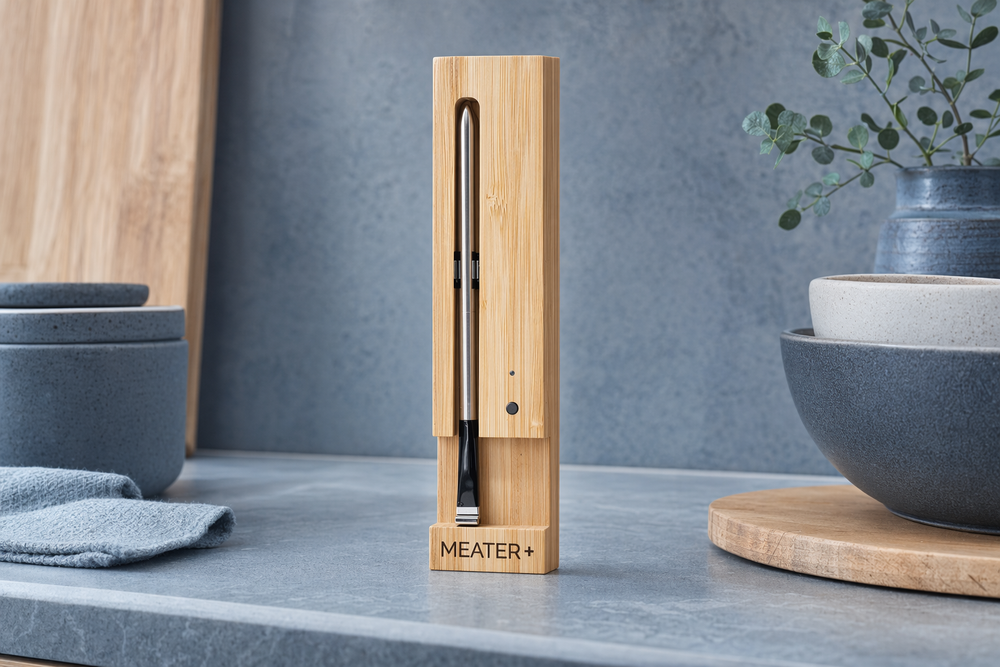
Probe placement matters as much as the number. The MEATER Plus and any serious probe measure at the tip — the thinnest, fastest-cooking part of the meat. For a steak, that means the geometric centre of the thickest section, parallel to the grate, away from bone and fat pockets that read hotter or cooler than the muscle you are eating. For a whole chicken, the deepest part of the breast without touching bone. For a pork shoulder, the centre mass away from the bone channel. A probe sitting in fat or against metal tells you a story about the wrong neighbourhood.
Target temperatures (pull before rest, approximate):
| Protein | Pull temp (°F) | Pull temp (°C) | Rested target |
|---|---|---|---|
| Beef steak (medium-rare) | 125–130 | 52–54 | ~130–135°F / 54–57°C |
| Beef burger (medium) | 155–160 | 68–71 | ~160°F / 71°C |
| Pork chop (medium) | 140–145 | 60–63 | ~145°F / 63°C |
| Chicken breast | 155–160 | 68–71 | ~165°F / 74°C (safe minimum) |
| Pork shoulder (pulled) | 195–203 | 90–95 | Collagen breakdown zone |
These are starting points, not religion. Your grill, your taste, your carryover window. The point is that a single instant-read poke at serving time misses everything that happened in the last forty minutes — the stall in a smoker, the hot zone on the left side of the kettle, the moment the ambient temperature dropped because someone opened the lid to "check."
Wireless probes exist so you stop opening the lid. Every peek costs heat and extends cook time. A probe that stays embedded samples continuously. The app maps internal and ambient readings against a target curve and estimates finish time. That estimate is imperfect — physics is messy — but it beats guessing from a recipe written for a different continent.
Grate cleaning and the wire bristle problem
Clean grates are not vanity. Carbon buildup insulates bars from metal-to-meat contact, which is where sear happens. Old grease turns rancid and flavours everything you cook next. And the brush you have used since 2018 may be the most dangerous tool in the drawer.
Canada has seen repeated news coverage of ingested wire bristles from cheap manual grill brushes — single strands that detach, stick to the grate, transfer to food, and end up in throats or intestines. Enough households switched to wood scrapers, nylon pads, or coil brushes that the category itself became suspect. Metal bristles are not automatically evil; cheap construction and neglected replacement schedules are. But the anxiety is rational.
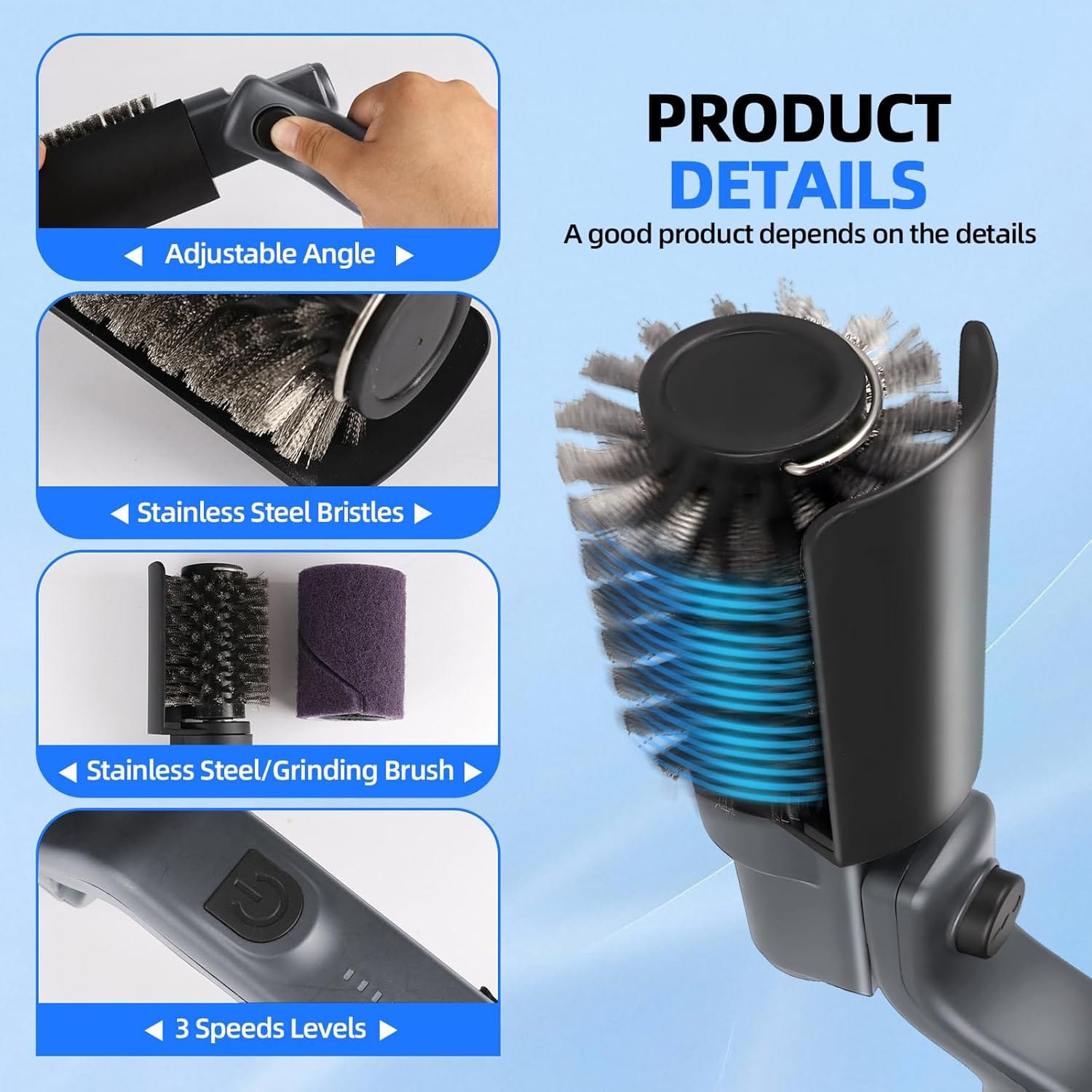
Cordless electric grill brushes are a newer answer: rechargeable lithium, spinning stainless coils on a rotating drum, three speed settings, and an adjustable head that reaches under bar grates without yoga poses. They convert battery wattage into scrubbing torque the way a powered toothbrush converts motor spin into plaque removal — scaled up and made less delicate.
The honest limitation: electric brushes excel at maintenance, not archaeology. If you skipped cleaning all season, no handheld spinner replaces a proper burn-off, degreaser soak, or scraper session first. Weekly grillers who clean while grates are still warm report five-minute cleanups. Once-a-summer users who expect factory shine in one pass return disappointed.
Warm versus cold grates is physics, not marketing. Grease polymerizes as it cools. Warm residue yields; cold residue cements. Spinning bristles need purchase on the surface. On cold, glazed carbon they skitter and feel weak. On warm grates five to fifteen minutes after you kill the flame, they bite. That timing window is where the electric brush earns its counter space.
At a glance: MEATER Plus vs electric grill brush
| MEATER Plus | Cordless Electric Grill Brush | |
|---|---|---|
| Job | Continuous internal + ambient temperature monitoring | Post-cook grate scrubbing |
| When it matters | Roasts, thick steaks, smokers, rotisserie | Weekly maintenance after ordinary cooks |
| Power | Rechargeable probe + AAA-powered dock relay | USB rechargeable lithium (~90+ min runtime) |
| Range | Up to ~165 ft via dock (real-world shorter through metal) | Cordless — no extension cord across the patio |
| Key feature | Dual sensors (tip + ambient), app guides and alerts | 3 speeds, adjustable angle head |
| Honest limitation | Too thick for thin cuts; Bluetooth struggles through closed lids | Heavy carbon needs burn-off first; bristles wear over seasons |
| Price (CAD) | ~$130–150 | ~$45–55 |
| Deep dive | Living with MEATER Plus | Living with the electric brush |
Neither row picks a winner. One protects the food. One protects the grate. Most serious weekend grillers eventually want both — or neither, if they grill thin chicken twice a year and never clean until Labour Day.
MEATER Plus: the probe that stays in the roast
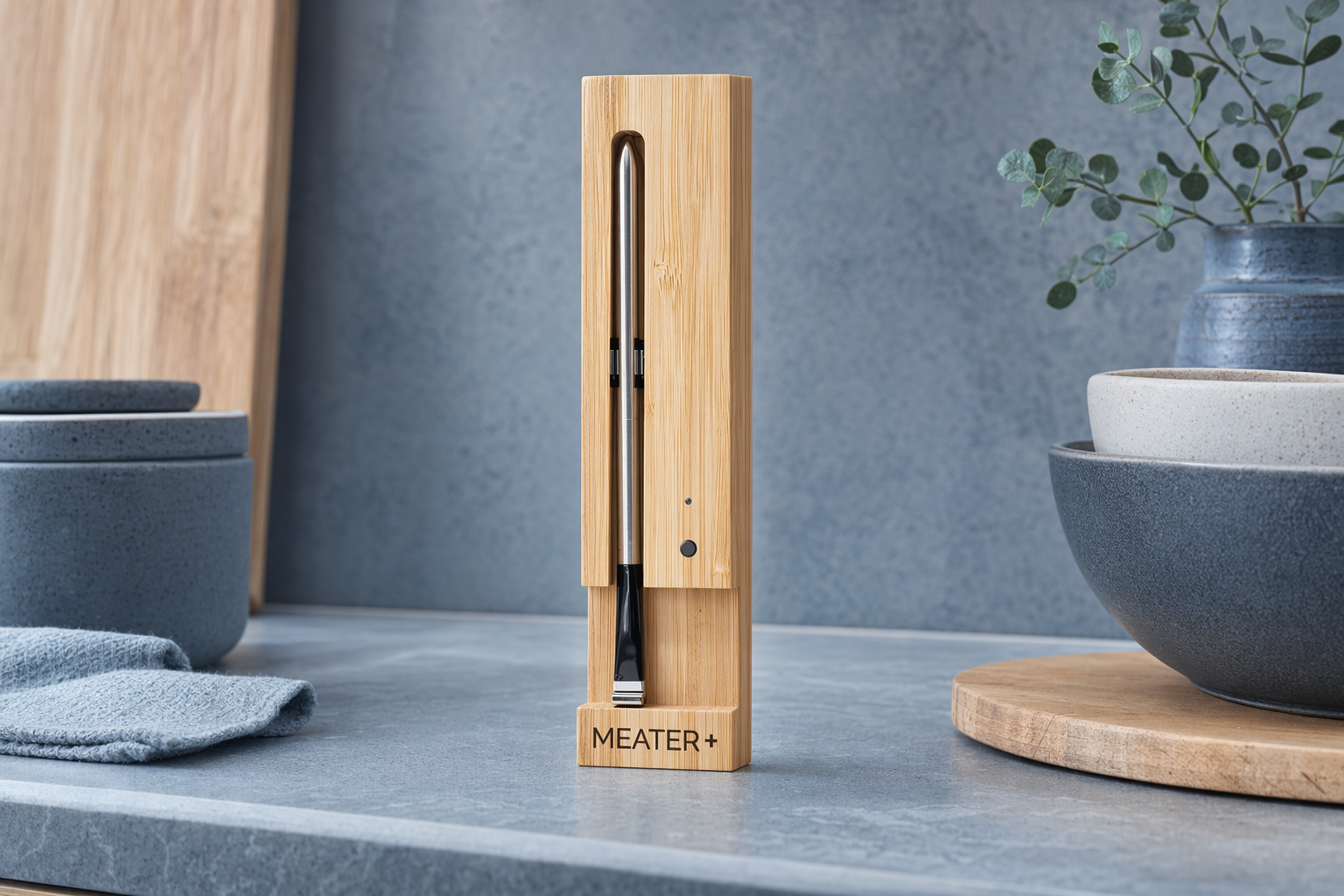
The MEATER Plus is the wireless probe that largely delivered on the promise for home cooks. A single stainless probe measures internal temperature at the tip and ambient heat near the handle — data that matters in smokers and ovens alike. Bluetooth relays to your phone through a charging dock that acts as a range extender. The app estimates cook time, alerts you before dinner crosses from perfect to plywood, and integrates a rest timer so carryover becomes part of the plan instead of a surprise.
At roughly $130–150 CAD on Amazon.ca (list near $150; holiday sales are common), it costs more than a wired two-probe ThermoPro setup. Believers say the wire-free rotisserie moment alone justifies the premium. Sceptics prefer simplicity and half the price.

Dual sensors are not a gimmick. The internal tip tells you when you are done. The ambient sensor near the handle tells you why you are behind schedule — stall detection in a smoker, a lying oven dial, a cold zone on the left third of the kettle. Canadian BBQ season is short; wasted hours on a stalled brisket hurt.
Bluetooth range is where expectations collide with physics. The 165 ft claim is laboratory-adjacent. Metal grill lids, oven walls, and water vapour attenuate signal. The charging block must sit near the cooker with line-of-sight to your phone. Many satisfied owners keep an old tablet on the patio as a dedicated relay. Expect reliable monitoring on the deck or in the kitchen with the door open. Expect intermittent silence through walls and closed smoker lids unless you add MEATER's Wi-Fi block or accept a relay device.
Probe geometry is the other honest constraint. The MEATER Plus is wider than a wired thermocouple and needs roughly 5 cm (2 in) of meat depth for correct sensor placement. Fine for turkey breast, thick striploin, pork butt. Tricky for skinny chicken breasts, wings, and fish fillets. Keep an instant-read for thin proteins and verification during your first few cooks.
Who it fits: smoking or roasting large cuts where opening the lid hurts results; rotisserie cooks tired of cable tangles; turkey, prime rib, and thick steak a few times a year; anyone willing to keep a phone or tablet near the cooker as a Bluetooth relay.
Who should look elsewhere: mostly grilling thin chicken, wings, or fish; expecting flawless monitoring through closed metal from across the house without Wi-Fi block; tight budget — wired probe plus instant-read costs half as much; unwilling to charge the probe before cooks.
For insertion depth, app workflows, and long-term reliability patterns, read our MEATER Plus honest buyer guide.


Cordless electric grill brush: scrubbing without the wrist tax
The Upgraded Electric Grill Brush is part of a newer category: hold a button, press spinning stainless bristles against the grates, let motor torque do the scraping. Three speed settings cover light touch-ups and aggressive carbon passes. The adjustable angle head reaches under bars on deep kettle grills without contortion. USB charging means no proprietary dock and no extension cord across a wet patio.
At ~$45–55 CAD depending on promotions, it undercuts professional grill cleaning services and the long-term cost of a neglected grate that rusts through because nobody maintained it.

Time saved is the loudest praise in buyer feedback. Post-BBQ cleanup drops from twenty minutes of manual scrubbing to five for ordinary cooks on gas grills with standard rod grates. Buyers with arthritis or shoulder issues call out the ergonomic win explicitly — the motor replaces shoulder torque.
Friction points are predictable. Heavy carbon from months of neglect still needs chemistry or fire first. Bristles wear after one to two seasons of weekly use — inspect monthly and replace when coils deform or shed. Long high-speed sessions warm the handle; budget 10–15 minute limits before the unit feels hot. Spinning bristles throw grease droplets — start on speed 1, accept that patios get messy, or lay down a drop cloth.
Cast iron seasoning is a philosophy question. Lower speeds and lighter passes preserve seasoning if you treat it as sacred. Aggressive speed-3 scrubbing strips buildup — which may be what you want on neglected grates and not what you want on a carefully maintained pan. Know your maintenance religion before you press the button.
Who it fits: weekly grillers on gas or charcoal who clean while grates are warm; households replacing an old wire brush they no longer trust; anyone with limited grip strength who still wants a clean grate; maintenance-minded cooks, not restoration archaeologists.
Who should look elsewhere: cleaning once or twice a year only — invest in burn-off and scraper instead; absolute bristle anxiety — pair wood scraper with low-speed passes or skip metal entirely; expecting flat-top mirror finish on neglected commercial plates without chemicals.
The electric grill brush honest buyer guide covers bristle safety, batch-to-batch USB connector differences, and seasonal deep-clean tactics we will not repeat here.
The workflow that ties them together
These tools shine in sequence, not in isolation. Here is the cookout rhythm that prevents both failures:
Before you light:
- Charge the MEATER probe if the app shows low battery — dead probe first use frustrates.
- Place the MEATER charging dock near the grill with line-of-sight to where your phone will sit.
- Inspect the electric brush head for bent or shedding bristles. Replace if needed.
- Preheat with the lid down. Let ambient stabilize before trusting ambient readings.
During the cook:
- Insert the probe into the thickest section, minimum depth met, away from bone.
- Select protein and target in the app. Trust the curve, not the recipe clock.
- Keep the lid closed. Peek through the app, not through metal.
- Pull at the pull temperature, not the finished temperature. Rest on a board, probe still in if you want to watch carryover.
After the cook:
- Rest meat. Serve guests. Kill the flame.
- While grates are warm — not glowing — run the electric brush speed 2–3 across bars.
- Wipe with a damp cloth. Oil lightly if cast iron is your religion.
- When grates are cool, cover the grill. Brush goes back on charge.
Between seasons: burn-off if carbon became geology, replace worn brush heads, and verify MEATER accuracy against an instant-read before the first big cook.
The probe protects the food you worked for. The brush protects the surface that food touches next weekend.
Who should skip both
Thin-protein grillers and once-a-summer cooks do not need this toolkit — instant-read plus timer, or a manual brush, covers those jobs. Bluetooth refusers, zero-bristle absolutists, and tight budgets should stick with wired probes, wood scrapers, or basic tools instead.
Frequently asked questions
Does the MEATER Plus work in a smoker?
Yes — that is one of its best use cases. Ambient sensor helps with stall detection and fire management. Place the dock relay outside the smoker with line-of-sight, accept that closed metal shortens Bluetooth range, and consider a patio tablet as hub.
Is the electric brush safe on porcelain-coated grates?
Use lower speeds and avoid aggressive pressure. Porcelain chips from impact and heavy abrasion, not from gentle warm maintenance. If your coating is already flaking, fix the grate before scrubbing harder.
Can wire bristles still end up in food with an electric brush?
Coiled stainless bundles are generally more secure than cheap single-strand manual brushes, but no metal brush is zero-risk. Inspect the head monthly. Replace when bristles deform or shed. Visually check the grate before cooking regardless of brush type.
MEATER Plus or a wired probe?
Choose MEATER if you cook roasts, smokers, or rotisserie often and will use a relay device. Choose wired if you mostly oven-roast near an outlet, grill thin cuts, or want half the price and zero app dependency.
How warm should grates be for the electric brush?
Warm enough that grease yields — typically five to fifteen minutes after you kill the flame. Not incandescent. Not stone cold the next morning. Warm maintenance beats cold archaeology every time.
The bottom line
Canadian grill season fails in two quiet ways: meat cooked by clock instead of temperature, and grates cleaned by guilt instead of habit. The MEATER Plus earns its place by sampling internal and ambient heat continuously, predicting finish time, and keeping the lid closed. The cordless electric brush earns its place by making five-minute warm cleanup realistic enough that you actually do it — without the wrist workout or bristle anxiety of the brush in your junk drawer.
Learn the temperatures. Place the probe correctly. Clean while warm. Budget for brush head wear and MEATER holiday sales. Then read both deep dives if you want the full ownership picture — or just light the grill and trust the numbers this weekend.


Discussion
Sign up or sign in to join the conversation.