
Electric salt and pepper grinders are one of those small kitchen categories that somehow got more confusing than they needed to be. On the surface, they're simple: you press a button or tilt the grinder, seasoning comes out, dinner continues. But once you start comparing them, the important diffe...
Electric salt and pepper grinders are one of those small kitchen categories that somehow got more confusing than they needed to be. On the surface, they're simple: you press a button or tilt the grinder, seasoning comes out, dinner continues. But once you start comparing them, the important differences are not the ones the product photos obsess over. The real differences are in the grinding mechanism, the burr material, how the thing is powered, and whether the design actually makes seasoning easier when you're holding a hot pan with one hand and a spoon with the other.
This article isn't a hands-on review. It's an editorial look at what actually separates electric salt and pepper grinders from each other — how burr grinding differs from blade chopping, why ceramic matters more than a flashy finish, why grind consistency matters more for pepper than for salt, and which style of grinder makes sense for different kitchens. If you've been staring at dozens of near-identical listings and wondering whether any of them are meaningfully different, this is the plain-English version.
Quick snapshot
| Product | Price (CAD) | Form factor | AI engine / Core mechanism | Best for |
|---|---|---|---|---|
| CIRCLE JOY Gravity Electric Salt and Pepper Grinder Set | ~$42 | Gravity-tilt grinder set | Ceramic grinding core, battery-powered | People who want true one-handed seasoning |
| Gaivis Electric Salt and Pepper Grinder Set Rechargeable | ~$33 | Rechargeable grinder set | Ceramic grinding core, USB-C charging | Buyers who care more about charging convenience than tilt gimmicks |
Pro tip: Evaluate an electric grinder the way you'd evaluate a coffee grinder, not a countertop decoration. Uniform grinding, durable burr material, and sane charging matter more than whether the LED is blue.
What counts as an "electric salt & pepper grinder" in 2026
For this guide, an electric salt and pepper grinder is a motorized seasoning mill that crushes salt crystals or peppercorns through an adjustable grinding mechanism rather than requiring manual twisting. That sounds obvious, but the category gets muddled because some products are basically convenience tools, some are just manual mills with a motor added on top, and some are genuinely better designed around everyday cooking.
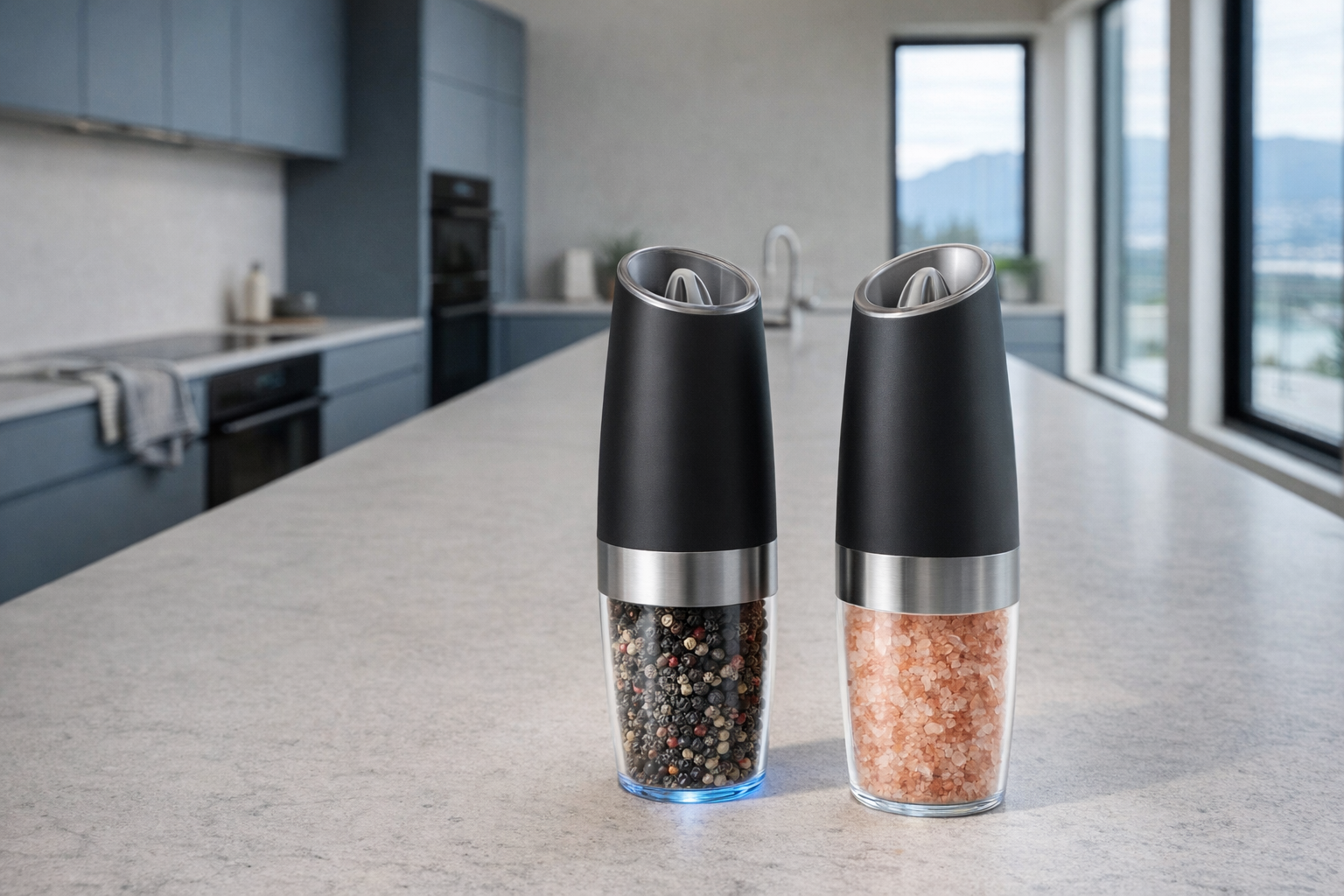
1. Tilt-first convenience grinders. These are built around the idea that seasoning should happen with one hand and almost no thought. You flip or tilt the grinder and it starts. The CIRCLE JOY Gravity Electric Salt and Pepper Grinder Set sits squarely here. This style makes the most sense when you're cooking actively — stirring a sauce, turning meat, plating with one hand. The trade-off is usually battery dependency, and sometimes a bit more bulk. Still, as a kitchen UX idea, tilt-to-grind is more honest than many "smart" kitchen features. It solves a real problem.
2. Rechargeable everyday grinders. These focus less on the novelty of gravity activation and more on reducing the annoyance of ownership. The Gaivis Electric Salt and Pepper Grinder Set Rechargeable fits here. The main pitch is not that it reinvents seasoning, but that it swaps disposable batteries for USB-C charging, gives you external coarseness adjustment, and tries to be easier to live with long term. That's a sensible direction. For many households, charging occasionally is preferable to stocking 8 AAA batteries per set just to keep two grinders alive.
3. Mechanism-first grinders. This is the conceptual sub-category that matters most, even when listings don't present it clearly. The real split is burr-style grinding versus blade-style chopping, and then ceramic versus stainless grinding surfaces. Both products in this guide use a ceramic grinding core, which is a good sign. A proper grinder should crush with controlled spacing, not just hack at spices randomly. That's especially important for pepper. Salt is more forgiving. Pepper is not. If you understand this sub-category, you understand most of the category.
The 2 products, separated by what they actually are
CIRCLE JOY Gravity Electric Salt and Pepper Grinder Set — the convenience-first tilt pick
At about $42 CAD, the CIRCLE JOY Gravity Electric Salt and Pepper Grinder Set is the clearest expression of what people usually mean when they say they want an electric grinder: no twisting, no button mashing, just flip it and grind. According to the listing, it uses gravity-activated one-handed operation, an adjustable coarseness system, a ceramic grinding core, a 135ml capacity, and a bright blue LED light to show where the seasoning is landing. That is a practical feature set, even if the blue LED is more dramatic than necessary.
The reason this product stands out is not that it has more advanced grinding tech than the category at large, but that it makes the use case obvious. If you're seasoning food while moving around a stove, gravity activation is a genuinely better interface than a two-handed manual mill. That's especially true when one hand is greasy or occupied. The downside is the power setup: the set reportedly uses 8 AAA batteries per set, which is the sort of detail that matters more after six months than on day one. That's the tax you pay for convenience here. Still, the ceramic grinding core is the right call for a salt grinder, and the 135ml hopper is large enough that you shouldn't be refilling constantly. This is a narrow product, but it knows its job.
📺 Watch: CIRCLE JOY in a real kitchen-style setup
- Best for: Cooks who want true one-handed seasoning and care more about tilt convenience than rechargeable power.
- Full explainer: CIRCLE JOY Gravity Electric Salt and Pepper Grinder Set on Celmin · Directory: product page
Gaivis Electric Salt and Pepper Grinder Set Rechargeable — the more practical power choice
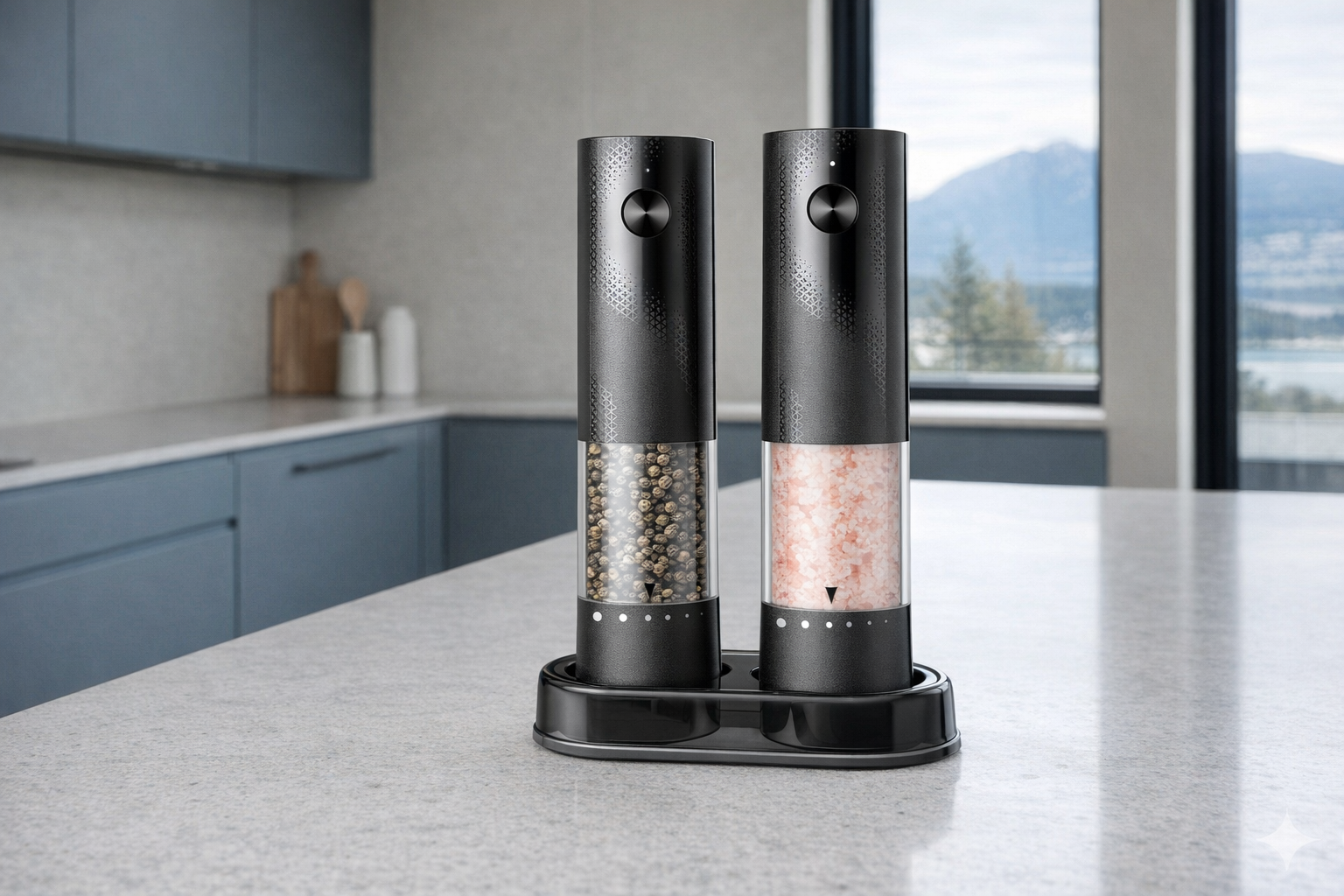
The Gaivis Electric Salt and Pepper Grinder Set Rechargeable comes in at roughly $33 CAD and, on paper, is the more grounded option for people who like the idea of electric grinders but don't want to deal with a drawer full of batteries. It uses USB-C charging, has a 6-level external coarseness adjustment, a 100ml hopper, a ceramic grinding core, and a built-in LED light. The listing also claims a full charge lasts up to 2 months, with a 5-minute quick charge for a full meal. That's the kind of ownership detail that matters more than a slick lifestyle photo.
What's appealing here is that the design seems to focus on friction reduction rather than novelty. External coarseness adjustment means you don't need to handle the grinding outlet to change texture, which is cleaner and more sensible. USB-C is simply better than proprietary charging, and usually better than replaceable batteries unless you strongly prefer swappability. The smaller 100ml hopper means slightly more frequent refilling than the CIRCLE JOY's 135ml, but that is not a serious drawback unless you season aggressively every day. The more important point is that Gaivis appears to be solving the boring part of the category: keeping the grinders powered without being annoying. That's a more mature design priority than many listings manage.
📺 Watch: Gaivis overview
- Best for: Buyers who want electric grinding convenience with less battery waste and a cleaner long-term ownership story.
- Full explainer: Gaivis Electric Salt and Pepper Grinder Set Rechargeable on Celmin · Directory: product page
How the grinding mechanism actually works
This is the part most listings glide past, because "electric" sounds more exciting than "grinding geometry." But the grinding geometry is the whole story.
Burr-style grinding vs blade chopping. A proper spice grinder should use a burr-like crushing mechanism that forces peppercorns or salt crystals through an adjustable gap. That produces more controlled particle sizes. A blade-style grinder, by contrast, hacks ingredients into an uneven mix of dust and boulders. For pepper, that unevenness matters a lot. Fine pepper hits fast and sharp; larger cracked pieces release aroma and heat differently, and over time. If your grinder produces both powder and chunks in the same turn, your seasoning becomes harder to predict. That's why burr logic matters here, even if these products are sold as dinner-table accessories rather than precision tools.
Why ceramic matters, especially for salt. Salt is rough on metals. Not all stainless components fail quickly, but ceramic is the safer and more category-appropriate choice because it doesn't corrode the way metal parts can when exposed repeatedly to salt. Both products here use a ceramic grinding core, and that's a meaningful spec, not filler. For pepper-only grinders, stainless can be fine. For a product explicitly marketed for both salt and pepper, ceramic is the more honest material choice. It also helps explain why cheaper generic grinders with vague "metal core" wording deserve a bit of skepticism.
Grind adjustment is not cosmetic. The CIRCLE JOY listing notes adjustable coarseness, while Gaivis specifies 6 levels of external coarseness adjustment. That difference matters. Adjustability determines whether you can go from a fine finishing salt effect to a more visible coarse crack, or from a finer pepper dusting to a steak-friendly grind. External adjustment is usually the more user-friendly approach because it avoids touching the business end of the grinder. It sounds minor until you've got oily hands and don't want to fumble with a greasy base.
Power design shapes the whole ownership experience. These products do the same basic job, but they live differently. The CIRCLE JOY uses replaceable batteries — 8 AAA batteries per set — which gives you easy swap-in power if the set dies during dinner, but also creates ongoing battery cost and clutter. Gaivis uses USB-C, which is cleaner for most modern kitchens and easier if you're already charging phones, headphones, and other small appliances that way. The listing's 5-minute quick charge for a full meal is a smart pitch because it addresses the real fear around rechargeable tools: the moment they die when you need them. This is the kind of detail that should affect a buying decision more than the finish colour.
LED lights are nice, but not the reason to buy one. Both products include lighting. CIRCLE JOY specifically calls out a bright blue LED light, and Gaivis includes a built-in LED light for dim environments. That's useful over a dark skillet or for low-lit dining, but it's not a core performance feature. A bad grinder with a nice light is still a bad grinder. Treat LEDs as a bonus, not a justification.
The three questions worth asking before you buy
- Do I actually need one-handed operation, or do I just like the idea of it?
If you cook often with one hand occupied — stirring, plating, holding a pan handle — gravity activation is genuinely useful. That's where the CIRCLE JOY makes sense. If your grinder mostly lives on a dining table or gets occasional use, rechargeable convenience may matter more than tilt theatrics. - Am I grinding pepper, salt, or both — and do I care about consistency?
If you're buying this mostly for pepper, grind uniformity matters more than many people realize. Pepper flavour changes noticeably with particle size. A cleaner, more controlled grind gives more predictable results. Salt is less sensitive here; it's still useful to adjust texture, but salt's flavour is not transformed by particle size in the same way pepper's is. That makes burr quality and adjustment especially important if pepper is your main concern. - Which power system will annoy me less after six months?
This is the least glamorous question and probably the most important one. If replacing AAA batteries sounds fine, the CIRCLE JOY's interface may win you over. If you'd rather plug in a USB-C cable every so often and be done with it, the Gaivis is the cleaner choice. Neither answer is universally correct. One is just more likely to fit your kitchen habits.
Where each one genuinely fits
| If this sounds like you... | ...buy this |
|---|---|
| You cook actively and want the easiest possible one-handed seasoning motion | CIRCLE JOY Gravity Electric Salt and Pepper Grinder Set (~$42) |
| You hate disposable batteries and want a more practical everyday setup | Gaivis Electric Salt and Pepper Grinder Set Rechargeable (~$33) |
| You mostly care about burr material for salt use | Either one — both use ceramic grinding cores |
| You want external coarseness control and easier cleanup around adjustments | Gaivis Electric Salt and Pepper Grinder Set Rechargeable (~$33) |
| You want a slightly larger hopper | CIRCLE JOY Gravity Electric Salt and Pepper Grinder Set (135ml vs 100ml) |
| You just want a manual mill and don't care about electric convenience | Skip category |
Got Questions About Electric Salt & Pepper Grinders?
Is this a hands-on review?
No. This is an editorial explainer comparing the category through two products in our catalog. The goal is to explain what specs actually matter — grinding mechanism, ceramic vs metal, tilt vs rechargeable power — not to replace real-world product testing.
Do electric grinders use burrs or blades?
The good ones should behave more like burr grinders than blade choppers. In plain terms, you want a mechanism that crushes ingredients through an adjustable gap for more even particle size. Blade-style chopping is less controlled and more likely to create a messy mix of powder and large fragments. For pepper, that inconsistency is noticeable in flavour and aroma.
Why does grind uniformity matter more for pepper than for salt?
Because pepper is not just "pepper." Different particle sizes release flavour differently. Fine pepper can taste sharper and more immediate, while coarser pepper tends to be more aromatic and slower to open up. Salt texture matters too, but salt's core flavour is much less tied to particle size. That's why a mediocre grinder is more likely to disappoint you with pepper than with salt.
Is ceramic really better than stainless steel?
For a grinder that will handle salt, ceramic is usually the safer bet. Salt can be tough on metal over time, and ceramic doesn't have the same corrosion concern. That doesn't make every stainless component bad, but a ceramic grinding core is a very good sign in this category. Both products here use ceramic, which is exactly what you'd want to see.
Are gravity grinders actually better, or just gimmicky?
Sometimes gimmicks solve real problems. Gravity activation is one of those cases. If you regularly season food while your other hand is busy, tilt-to-grind is honestly useful. If you mostly season at the table or don't mind two-handed tools, it's less transformative. Useful feature, yes. Universal necessity, no.
Should I choose USB-C or AAA battery power?
Usually USB-C is the more practical modern choice, especially if you dislike disposable batteries. The Gaivis looks stronger on that front. But replaceable batteries still have one advantage: if the grinder dies unexpectedly, you can swap batteries immediately rather than wait for a charge. The CIRCLE JOY is better if you value that kind of no-downtime simplicity and don't mind the battery upkeep.
Are these worth buying in Canada, or are they just cheap Amazon clutter?
They can be worth buying, but only if you're solving an actual annoyance. If twisting a manual grinder is not a problem in your kitchen, then no, this category is easy to skip. If you cook often, season with one hand, or are tired of inconsistent cheap mills, an electric grinder can be a small but legitimate quality-of-life upgrade. Just keep the expectations sane: this is a convenience tool, not a kitchen transformation.
Which one is the Celmin pick?
For most people, the more broadly sensible choice is Gaivis Electric Salt and Pepper Grinder Set Rechargeable because USB-C charging, 6-level external adjustment, and a claimed up to 2 months per charge make for a cleaner ownership story at about $33 CAD. The more distinctive product is the CIRCLE JOY Gravity Electric Salt and Pepper Grinder Set, and it's the one to buy if one-handed, flip-to-grind use is the whole point for you. That's the sharper use case. Gaivis is the safer general recommendation.
Where should I verify the latest details before buying?
Links: CIRCLE JOY · Gaivis. Check the current listing for pricing, bundled accessories, and whether the charging or battery details have changed. Small kitchen gadgets get revised quietly all the time.
If you're building a smarter home in Canada and want honest comparisons of gadgets worth considering — plus the ones worth skipping — Celmin covers the full catalog without the marketing theater. More comparisons, reviews, and buyer guides at https://celmin.ca.



Discussion
Sign up or sign in to join the conversation.