
The SEEDEEM Smart Toaster 2 Slice Touch Control sits in a slightly odd but increasingly common corner of the kitchen market: the everyday appliance that has been given a screen, presets, and just enough memory to sound "smart." It is still a 2-slice toaster, not a Wi-Fi-connected cooking plat...
The SEEDEEM Smart Toaster 2 Slice Touch Control sits in a slightly odd but increasingly common corner of the kitchen market: the everyday appliance that has been given a screen, presets, and just enough memory to sound "smart." It is still a 2-slice toaster, not a Wi-Fi-connected cooking platform. But compared with the old lever-and-dial model many people grew up with, this one clearly aims to make toast more predictable, especially if your household cycles between bagels, frozen waffles, gluten-free bread, and whatever slightly-too-thick artisanal loaf is on the counter this week.
This is not a hands-on review. Nothing here is based on personally using the toaster. The goal is simpler: explain what the SEEDEEM Smart Toaster 2 Slice Touch Control actually is, what the listed features likely mean in real kitchens, and whether its touch controls and presets are genuinely useful or just decoration. If you are staring at the product page wondering whether a ~$60 CAD toaster with a colour display is clever or silly, this is the calmer breakdown.
📺 Watch: SEEDEEM Smart Toaster 2 Slice Touch Control in context
Quick snapshot
| Question | What the SEEDEEM Smart Toaster 2 Slice Touch Control actually is |
|---|---|
| Category | Kitchen & Dining |
| Made by | SEEDEEM |
| Typical price | ~$60 CAD (listing at the time of writing — verify current pricing) |
| Rating signal | 4.5/5 on the source listing |
| Best for | Small households, apartment kitchens, people who want more control than a basic dial toaster gives |
| Skip if | You want a 4-slice toaster, dislike touch panels, or prefer simple mechanical appliances with fewer parts to fail |
Pro tip: Buy this toaster for its presets and countdown display, not because the word "smart" appears in the name. If those two things do not sound useful in your morning routine, a cheaper mechanical toaster is probably the more honest buy.
What the SEEDEEM Smart Toaster 2 Slice Touch Control actually is
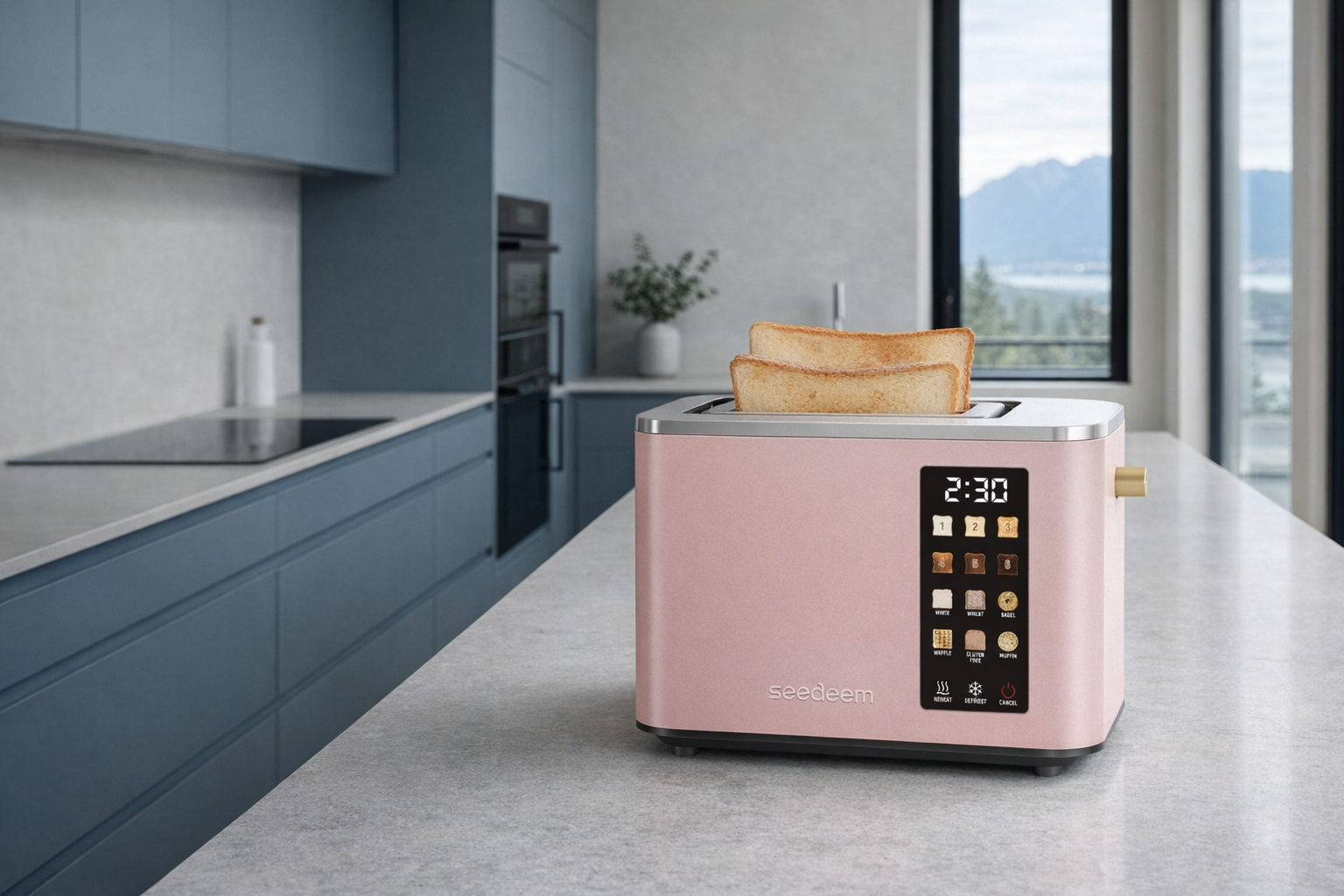
In plain English, this is a 2-slice countertop toaster with a digital interface instead of the usual browning dial and small row of buttons. Its main pitch is control: pick the bread type, choose one of 6 shade settings, and use functions like defrost or reheat with a colour LCD showing the countdown. That does not make it "smart" in the way a smart speaker or smart oven is smart. It makes it a more guided toaster — one that tries to reduce guesswork.
Smart 2-slice toaster with touch control screen and color LCD display. Features 6 shade settings, 6 bread selections (white, wheat, bagel, waffle, gluten-free, muffin), defrost and reheat functions, memory function, and 900W power. Stainless steel finish with 1.4-inch extra-wide slots and removable crumb tray.
The most useful way to think about it is as a step up from a classic budget toaster like the BLACK+DECKER 2-Slice Toaster, which typically gives you a browning knob, a few basic buttons, and a lot of trial and error. The SEEDEEM adds more explicit modes and a display, which should make it easier to repeat yesterday's result. That is a more practical kind of "smart" than many kitchen gadgets claim, even if it also means more electronics in a heat-heavy appliance.
Key features at a glance
- Touch control panel with a color LCD countdown display
- 6 shade settings for lighter to darker browning
- 6 bread selections: white, wheat, bagel, waffle, gluten-free, and muffin
- Defrost, reheat, and cancel functions
- Memory function that remembers the last settings used
- 900W power
- 1.4-inch extra-wide slots for thicker bread items
- Stainless steel finish, removable crumb tray, and cord storage
How the SEEDEEM Smart Toaster 2 Slice Touch Control actually works
Mechanically, this is still doing the same core job as any toaster: heating elements brown the outside of bread while the slots hold it in place until the cycle ends. What changes here is the control layer. Instead of turning a vague numbered dial and hoping "4" means the same thing for white bread and a frozen waffle, you are selecting more specific inputs on the touch panel.
That matters because different bread products really do behave differently. A bagel wants more emphasis on the cut side. A frozen waffle needs thawing and browning. Gluten-free bread often toasts differently from standard wheat bread, sometimes needing extra time or a second pass in cheaper machines. The SEEDEEM's listed 6 bread selections suggest that the toaster adjusts heat pattern or cycle timing depending on what you choose. The product page does not spell out the exact internal logic, so it is safest to read this as preset optimization rather than magic.
There are really three useful pieces to the system:
- Bread-type presets. These are the toaster's attempt to account for common breakfast items without making you guess. White, wheat, bagel, waffle, gluten-free, and muffin cover a wider spread than many basic 2-slice models.
- Shade control. The 6 shade settings give you the browning level on top of the bread-type selection. In theory, this means "bagel, shade 3" should be more repeatable than a generic toaster's single dial.
- Support functions. Defrost, reheat, and cancel are the practical extras. Defrost is particularly relevant in real households, because a lot of bread in Canada spends time in the freezer. Reheat is also more useful than it sounds if breakfast gets interrupted.
The memory function is arguably the most quietly sensible feature here. If one person in the house always wants wheat toast at shade 2 and another wants bagels darker, remembering the last setup removes one little morning annoyance. That is not glamorous technology, but it is the kind of convenience that can actually matter at 7:15 a.m.
The 900W power rating also tells you something important: this is not a giant high-output family toaster. It is positioned as a compact everyday model for one or two people. For a 2-slice machine, 900 watts is normal territory, but it also means you should evaluate it like a weekday breakfast tool, not a brunch machine for six guests.
A realistic "day in the life" with SEEDEEM Smart Toaster 2 Slice Touch Control
Because this is an informational explainer, the examples below are based on what the listed features imply, not on direct testing.
- Morning. You drop in two slices of standard sandwich bread, tap the white preset, choose a middle shade, and see a countdown on the LCD. The main advantage here is not speed; it is knowing roughly how long is left instead of standing there waiting for the pop.
- Late morning. Someone wants a frozen waffle. Rather than manually guessing with a second cycle, you use waffle plus defrost. That should be more predictable than a basic lever toaster that treats everything like room-temperature bread.
- Afternoon. A half bagel goes in for a snack. The bagel selection is one of the strongest signs this toaster is trying to be useful rather than merely flashy, because bagels are one of the most common things that cheaper toasters handle unevenly.
- Evening. You reheat a muffin or another bread item without overbrowning it, then pull the removable crumb tray for a quick cleanup. That small maintenance detail matters because toaster crumbs become burnt-smell problems fast if ignored.
Who the SEEDEEM Smart Toaster 2 Slice Touch Control is actually for (and who it isn't)
Great fits
- Apartment dwellers with limited counter space who still want more control than a bargain-bin toaster offers.
- Couples or solo households making breakfast for one or two people, not four all at once.
- People who rotate between bread types — especially bagels, waffles, muffins, and gluten-free bread — and are tired of guessing.
- Parents making quick weekday breakfasts who want a visible countdown and easy presets rather than a confusing dial.
- Anyone replacing an old inconsistent toaster and looking for a modest upgrade without jumping to a full toaster oven.
Poor fits
- Big families that need four slices going at once; a 2-slice toaster will feel slow no matter how nice the screen is.
- Minimalists who hate touch controls and want an appliance that can be operated half-asleep with one physical lever and one knob.
- People who mostly toast very oversized artisan bread that exceeds even the 1.4-inch extra-wide slots.
- Buyers who distrust electronics near heat and crumbs and prefer simpler appliances with fewer failure points.
- Anyone hoping "smart" means app control or automation. There is no indication this is a connected appliance; it is a digital toaster, not a networked one.
Practical trade-offs
Touch controls vs. simple knobs
The touch panel is the defining feature, and it cuts both ways. On the positive side, a digital interface can make functions clearer: bread type, shade, reheat, cancel, countdown. That is easier to read than some cheap toasters where the labels are tiny and the dial is vague.
The downside is that touch surfaces are not always as forgiving as physical controls in a kitchen. Fingers may be damp, the panel may attract smudges, and some people simply prefer the certainty of a clicky button. A toaster is one of the few appliances used when people are half awake, so simplicity still matters. If your ideal toaster is one you never think about, a classic mechanical model may age better.
Capacity and slot size
The listed 1.4-inch extra-wide slots are a meaningful spec, because they expand what a small toaster can reasonably handle. Bagels, thicker sandwich bread, waffles, and English-muffin-like items all benefit from wider slots. That makes the SEEDEEM more flexible than the cheapest narrow-slot machines.
Still, wide is not the same thing as huge. Thick hand-cut bakery slices or very long sourdough pieces can still be awkward in a 2-slice toaster. This is an appliance for ordinary breakfast formats, not a guarantee that every rustic loaf in the farmers' market will fit cleanly.
Cleaning, durability, and long-term expectations
The good news is that SEEDEEM lists the basics that matter: a removable crumb tray and cord storage. The crumb tray is the practical one. It makes routine cleaning easier, and regular cleaning is not optional with toasters unless you enjoy a lingering burnt smell.
The more cautious point is durability. A toaster with a colour display and touch controls has more complexity than a simple lever model. That does not automatically make it unreliable, but it does mean you are buying electronics in a warm, crumb-filled environment. At roughly $60 CAD, this should be evaluated as a modest convenience appliance, not a lifetime heirloom. That is still perfectly reasonable — just keep expectations sensible.
Where the SEEDEEM Smart Toaster 2 Slice Touch Control fits in a modern kitchen
This toaster makes the most sense in a kitchen built around small, quick breakfast appliances, not around full-size cooking gear. Think of it as part of a weekday breakfast station alongside a Nespresso Vertuo, a Keurig K-Mini, an electric kettle, or a compact air fryer. Its job is narrow but useful: make common toasted foods a bit more predictable without taking over the counter.
It also fits well in homes where the main oven is overkill for simple morning food. A toaster oven can do more, but it is slower, bulkier, and often more annoying for basic toast. The SEEDEEM occupies the opposite lane: less versatile than a toaster oven, but faster to operate and easier to live with if all you need is bread, bagels, waffles, or muffins browned with less guesswork.
If your kitchen already leans toward app-connected gear, this toaster will not really join that ecosystem. There is no sign here of Alexa, Google Home, or app integration. That is not a flaw. For a toaster, being self-contained is often the more honest design. You press the control, it heats the bread, and that is the whole story.
The buying decision, in plain terms
Before buying, three questions usually get you to the right answer:
- Do you actually want presets for different foods, or are you happy with one browning dial? If you mostly toast the same supermarket bread every day, the SEEDEEM may be more interface than you need.
- Will a 2-slice format work in your household? If mornings involve multiple people eating at once, no touch display will compensate for limited capacity.
- Are you comfortable trading some mechanical simplicity for better feedback and repeatability? The countdown screen, bread modes, and memory can be genuinely useful, but only if you value them more than the simplicity of an old-school toaster.
If those answers are mostly yes, this looks like a sensible small upgrade; if not, a plain mechanical toaster is probably the smarter purchase.
Got Questions About the SEEDEEM Smart Toaster 2 Slice Touch Control? Let's Clear Things Up.
Is this a hands-on review?
No. This is an informational explainer based on the product listing and the broader toaster category. The goal is to translate the feature list into real-kitchen expectations, not to replace a direct long-term test.
What does "smart" mean here?
In this case, "smart" appears to mean touch controls, a color LCD countdown display, presets, and memory, not internet connectivity. There is nothing in the supplied listing that suggests app control, Wi-Fi, or voice-assistant integration. Treat it as a digitally controlled toaster, not a connected smart-home device.
Is 900W enough for a 2-slice toaster?
For a compact 2-slice model, 900W is within normal range and should be adequate for everyday toasting tasks. It does not suggest unusually high power, but it also does not raise any obvious red flags for this size class. Real performance still depends on heating design and calibration, which is why settings and presets matter.
Will it fit bagels and thicker bread?
According to the listing, it has 1.4-inch extra-wide slots, which should help with bagels, waffles, muffins, and thicker sliced bread. That is one of the more practically useful specs here. It still will not turn a 2-slice toaster into a universal bakery machine, so very oversized artisan slices may remain hit-or-miss.
Is the memory function actually useful?
For the right household, yes. If you tend to repeat the same setup — say wheat at shade 3, or bagel with a certain browning level — memory removes one repetitive step. It is a small convenience, but it is exactly the kind of small convenience that can justify a minor upgrade.
Where can I verify the current listing or buy it?
The current retailer link provided is the Amazon Canada listing for the product. You can verify the latest price, availability, photos, and any updated product details here: SEEDEEM Smart Toaster 2 Slice Touch Control on Amazon Canada.
What does it cost in Canada?
At the time of writing, the listed price is ~$60 CAD. Pricing on small kitchen appliances changes often with coupons, sales, and seasonal promotions, so it is worth checking the live listing before buying.
Where is the Celmin Directory listing for this product?
For a catalog-style view of the same product — structured specs, pros and cons, similar picks, and FAQ — see SEEDEEM Smart Toaster 2 Slice Touch Control on Celmin Directory.
If you're building a smarter home in Canada and want honest explainers on gadgets worth considering — plus the ones worth skipping — Celmin covers the full catalog without the marketing theater. More reviews, comparisons, and buyer guides at https://celmin.ca.
Discussion
Sign up or sign in to join the conversation.