
The Revolution Cooking 2-Slice High-Speed Smart Toaster sits in a strange but increasingly real category: the premium countertop appliance that tries to do one ordinary kitchen job much faster, with more control, and with a lot more electronics. It is still a 2-slice toaster. But unlike a che...
The Revolution Cooking 2-Slice High-Speed Smart Toaster sits in a strange but increasingly real category: the premium countertop appliance that tries to do one ordinary kitchen job much faster, with more control, and with a lot more electronics. It is still a 2-slice toaster. But unlike a cheap lever-and-dial model, this one adds what Revolution calls InstaGLO 2.0 heating, bread-specific toasting programs, sensors that adjust in real time, a full-colour touchscreen, and Wi‑Fi features that push it well past the usual toaster brief. The basic promise is simple: more even toast, less waiting, and fewer burnt bagels because somebody guessed wrong on a dial.
This is not a hands-on review. Nothing here is based on personally using the appliance in a real kitchen. The goal is narrower and, frankly, more useful for many buyers: explain what the Revolution Cooking 2-Slice High-Speed Smart Toaster actually is, how this style of high-speed heating differs from a traditional coil toaster, and whether that difference is meaningful enough to justify a roughly $450 CAD countertop purchase.
📺 Watch: Revolution Cooking 2-Slice High-Speed Smart Toaster in context
Quick snapshot
| Question | What the Revolution Cooking 2-Slice High-Speed Smart Toaster actually is |
|---|---|
| Category | Smart Kitchen |
| Made by | Revolution |
| Typical price | ~$450 CAD (listing at the time of writing — verify current pricing) |
| Rating signal | 4.4/5 on the source listing |
| Best for | People who toast daily, design-conscious kitchens, households that switch between bread types often |
| Skip if | You want a basic toaster, dislike touchscreens on appliances, or do not care whether toast is ready a bit faster |
Pro tip: If you are considering this toaster, evaluate it like a premium espresso machine or designer kettle, not like a $40 replacement toaster. The case only makes sense if toast quality, speed, and interface genuinely matter in your routine.
What the Revolution Cooking 2-Slice High-Speed Smart Toaster actually is
In plain English, this is a high-end 2-slot toaster that tries to fix the two big annoyances of normal toasters: slow warm-up and vague browning control. Traditional coil toasters usually work by heating resistive elements until they glow, then hoping the dial setting roughly matches your bread, room temperature, and starting bread condition. The Revolution model claims a more precise approach. Instead of relying on that old mechanical guesswork, it uses fast-heating elements, sensors, and software presets so the machine can respond to the food you put in it rather than simply blasting away for a fixed time.
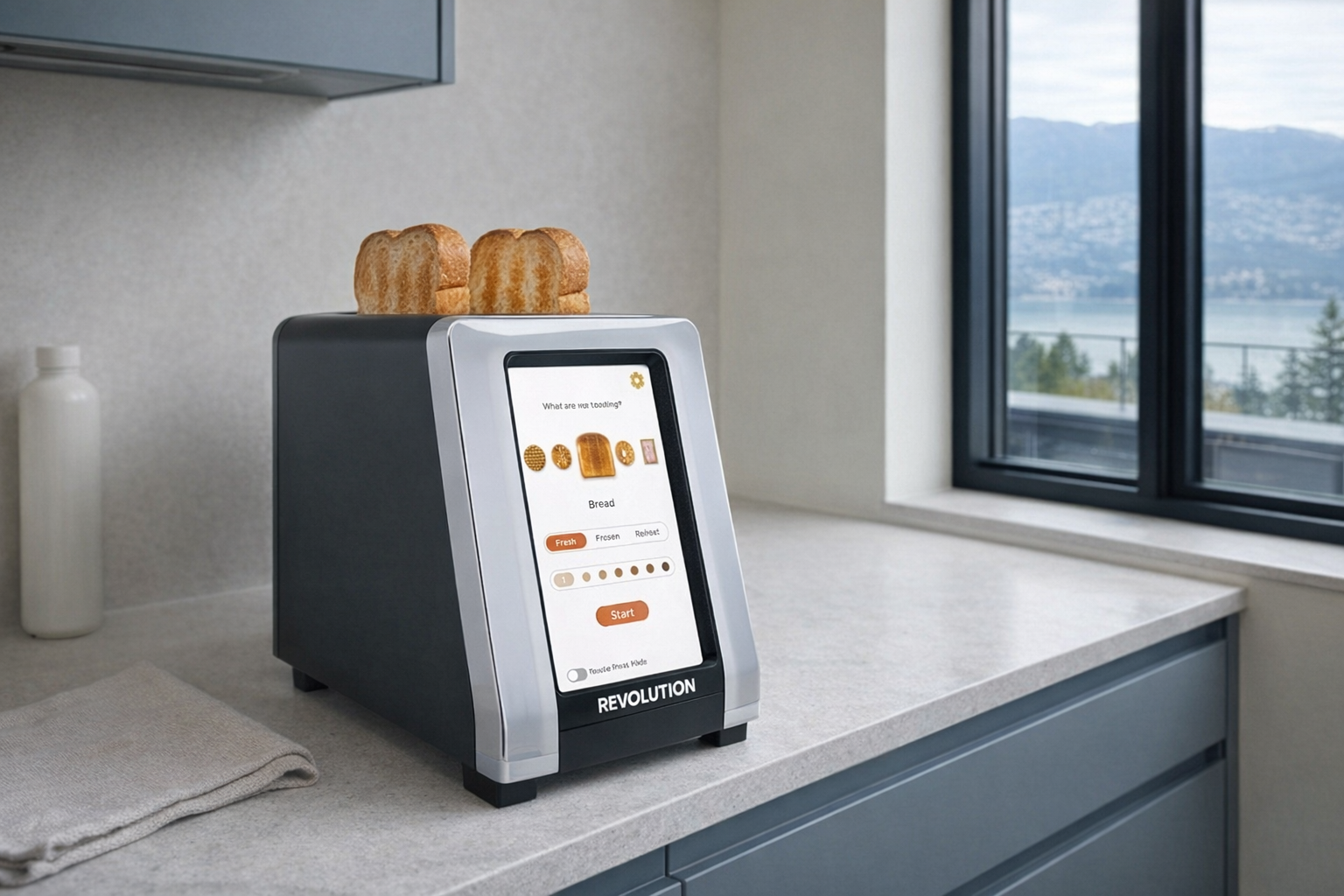
InstaGLO 2.0 technology reaches full heat in just 2 seconds, searing the outside to lock in flavor. Toasting algorithms for dozens of bread types with sensors that adjust in real time. Full-color touchscreen with Wi-Fi connectivity.
That last part is what separates it from a premium conventional toaster such as the Breville Die-Cast 2-Slice Smart Toaster. Breville's model is better known, generally cheaper, and still gives you nicer control than a bargain-bin toaster, but it remains a more traditional approach with mechanical-style heating logic and a simpler interface. The Revolution Cooking 2-Slice High-Speed Smart Toaster is trying to be more like a small computer-controlled cooking appliance. Whether that is clever or excessive depends entirely on how often you make toast and how annoyed you are by inconsistency.
Key features at a glance
- InstaGLO 2.0 heating that reportedly reaches full heat in 2 seconds
- Toasting algorithms for dozens of bread types with sensors adjusting in real time
- Full-colour touchscreen designed to get results in 3 taps
- Wi‑Fi connectivity for clock updates, weather display, and crumb tray reminders
- Extra-wide slots intended for thicker slices and bagels
- 2-slice form factor for smaller households or kitchens that do not need a 4-slot model
How the Revolution Cooking 2-Slice High-Speed Smart Toaster actually works
The useful way to think about this toaster is not “smart home toaster,” but “sensor-guided radiant heating appliance.” Revolution's marketing language often gets framed around induction-style speed, but for buyers the practical point is this: the toaster is built to get hot almost immediately, then modulate the process using software and sensor input rather than relying on an old-school timer and a numbered dial.
A normal budget toaster wastes part of your wait time just getting the heating elements up to temperature. That lag is one reason the first batch in the morning can behave differently from later batches. According to the listing, the Revolution Cooking 2-Slice High-Speed Smart Toaster reaches full heat in 2 seconds. If accurate, that is the heart of the product. Fast heat-up means browning can start sooner and more predictably. It also means the machine may spend less time slowly drying bread before it actually toasts the outside. That distinction matters because good toast is a balancing act: you want a browned exterior and a still-soft interior, not a dry cracker with colour.
There are really three layers to how it appears to work:
- Rapid heating. InstaGLO 2.0 is the speed layer. The machine reaches toasting temperature very quickly instead of slowly ramping up like a conventional coil toaster.
- Bread-type logic. The touchscreen asks what you are toasting. Bread, bagel, and thicker specialty slices do not absorb heat the same way, so the toaster uses preset algorithms rather than one universal timer.
- Real-time sensing. The listing says sensors adjust during toasting. That suggests the machine is not just starting a cycle and waiting; it is actively checking and correcting as it goes.
That is a more honest design than many “smart” kitchen appliances, which often add Wi‑Fi and an app but do not change the underlying cooking process at all. Here, the software seems connected to the core function. The touchscreen and Wi‑Fi are secondary. The real value, if the product delivers on its premise, is the interaction between rapid heat and active control.
The extra-wide slots matter more than they sound. Precision toasting falls apart if the appliance only works well with thin supermarket bread. A premium toaster needs to cope with sourdough, raisin bread, bagels, and thick artisan slices without jamming or scorching one side. The listing specifically calls out thick slices and bagels, which suggests Revolution knows this is not just a “toast bread #3” appliance. It is designed for the way people actually buy bakery products now.
A realistic "day in the life" with Revolution Cooking 2-Slice High-Speed Smart Toaster
Because this is an informational explainer, here is the likely rhythm based on the listed features and how this category typically behaves, not a tested account.
- Morning. You drop in two cold slices of sourdough, tap the bread type on the touchscreen, choose your browning level, and the toaster starts almost immediately rather than spending several seconds warming up. That quick-start behaviour is the main reason this appliance exists.
- Midday. Someone makes a bagel and selects the appropriate program instead of guessing with the same setting used for sandwich bread. The extra-wide slots and bread-specific logic are meant to reduce the usual “burnt edge, pale middle” problem that thick bakery items often create in a regular toaster.
- Afternoon. The screen shows clock and weather information while idle, which is more decorative than essential, but it does mean the appliance acts a bit like a countertop display rather than a dead metal box. Wi‑Fi also reportedly handles auto-setting the clock and crumb tray reminders.
- Evening. A frozen or denser bread item goes in, and the sensors are supposed to adjust in real time instead of blindly following a fixed timer. That is exactly the sort of situation where software control can make more sense than a mechanical slider, assuming the presets are well tuned.
Who the Revolution Cooking 2-Slice High-Speed Smart Toaster is actually for (and who it isn't)
Great fits
- People who toast something every morning and are tired of babysitting settings for different breads.
- Households that buy thick-cut sourdough, bagels, brioche, or bakery bread rather than only standard sandwich loaves.
- Design-conscious renovators who do not mind paying more for a countertop appliance that looks modern and feels more precise.
- Busy parents or professionals who value shaving even small bits of waiting out of breakfast prep.
- Buyers choosing a premium gift for someone obsessed with kitchen gadgets and daily breakfast rituals.
Poor fits
- Anyone who makes toast once a week and would get identical life value from a basic toaster.
- People who actively dislike touchscreens on appliances and want physical controls that still work the same way 10 years from now.
- Small-space kitchens where every plugged-in appliance needs to justify itself on utility alone.
- Shoppers hoping Wi‑Fi means deep app control or some larger smart-home automation payoff; this is still just a toaster.
- Budget-focused buyers who would rather put $450 CAD toward a better coffee machine, air fryer, or stand mixer.
Practical trade-offs
Speed versus actual daily value
The big sell here is speed. Reaching full heat in 2 seconds sounds impressive because it is impressive, at least conceptually. But the honest question is whether faster toast changes your life enough to matter. For some households, yes: breakfast is a repetitive routine, and shaving friction from repetitive routines is exactly where premium appliances earn their keep. For others, waiting a little longer for toast is not a real problem. If you are buying this mainly because the technology sounds cool, that excitement may fade faster than the toaster heats up.
Interface and long-term simplicity
The touchscreen is central to the experience. Revolution says you can get results in 3 taps, which sounds reasonable, and a visual interface does make bread-type selection clearer than a mystery dial. But touchscreens have trade-offs. They can be more intuitive in year one and more annoying in year seven if the panel ages poorly or if you just want to shove down a lever and move on. A toaster should not require mental overhead before coffee. This model may reduce guesswork, but it also adds interface dependency.
Maintenance and crumbs
Crumb tray reminders are useful because many people forget crumb trays exist until smoke appears. Still, reminders do not eliminate cleaning. A premium toaster with extra-wide slots, fast heating, and a touchscreen still lives in the same crumb-heavy reality as every other toaster. Thick bread sheds more. Bagels scatter seeds. Sugary breads can get messy fast. So even with Wi‑Fi reminders, treat this like a high-performance appliance that will want regular upkeep, not a maintenance-free kitchen computer.
Where the Revolution Cooking 2-Slice High-Speed Smart Toaster fits in a modern kitchen
This toaster makes the most sense in a kitchen that already leans premium and routine-driven. Picture it beside a Breville Barista Express, a Fellow Stagg EKG kettle, or a KitchenAid mixer: appliances chosen not because they are the cheapest way to perform a task, but because the owner repeats that task constantly and cares about how it feels. That is the lane.
It fits especially well in kitchens where breakfast is structured but varied. One person wants bagels, another wants thick sourdough, another wants lighter white bread. A conventional toaster can do all of that badly or inconsistently. The Revolution Cooking 2-Slice High-Speed Smart Toaster is clearly built for that kind of switching. The software layer exists to reduce friction across different bread types, not to make toast social-media ready.
As a “smart home” product, though, it is relatively light. The Wi‑Fi features listed are practical but modest: auto-setting the clock, showing weather, and crumb tray reminders. That is fine. Frankly, it is probably better than pretending a toaster needs elaborate automation scenes. This is not something that needs to talk to Google Home, Alexa, or Apple Home to justify itself. Its case rises or falls on bread quality and speed.
The buying decision, in plain terms
Three questions usually make this toaster decision easier:
- Do you actually care about toast precision, or do you just want toast? If almost any browned bread is acceptable, a much cheaper toaster is the rational move.
- Will the touchscreen help your household, or annoy it? If selecting bread type visually sounds useful, this product makes more sense. If you want a lever and a dial forever, it does not.
- Is fast heat-up worth premium money in your routine? If breakfast is daily, rushed, and varied, the value argument gets stronger. If toast is occasional, it gets weak very quickly.
If those answers lean yes, the Revolution Cooking 2-Slice High-Speed Smart Toaster is a sensible luxury. If not, buy a good conventional toaster and spend the difference elsewhere.
Got Questions About the Revolution Cooking 2-Slice High-Speed Smart Toaster? Let's Clear Things Up.
Is this a hands-on review?
No. This is an informational explainer based on the product listing, stated features, and the broader behaviour of premium toaster designs. It is meant to clarify what the toaster is claiming to do, not replace real long-term testing.
Does this toaster really use “smart” features for the actual toast, or just for the screen?
Based on the listing, the smart part is not only the display. The core claim is that sensors and toasting algorithms adjust in real time for different bread types, which suggests the software is tied directly to browning control. The Wi‑Fi extras like weather and clock updates are secondary.
How is it different from a normal coil toaster?
The main difference is speed and control. Traditional toasters generally rely on slower-heating elements and simpler timing-based behaviour, while this model says it reaches full heat in 2 seconds and uses sensors plus presets for dozens of bread types. That should, in theory, improve consistency, especially with thick bread and bagels.
Is the Wi‑Fi actually necessary?
Not for the core act of making toast, based on the listed features. Wi‑Fi is there for auto-setting the clock, weather information, and crumb tray reminders. The more important technology appears to be the heating system and sensing, not internet connectivity.
Can it handle thick bread and bagels?
According to the listing, yes. Revolution specifically says the slots are extra-wide to fit thick slices and bagels with ease, and that is important because many premium bakery breads do not work well in narrow, cheap toasters. If thick bread is your norm, that feature matters more than the weather widget.
Where can I verify the current listing or buy it?
The simplest place to verify current price, availability, and listing details is the Amazon Canada page for the product here. Check that page for the most current information, since pricing and feature wording can change over time.
What does it cost in Canada?
At the time of writing, the listed price is roughly ~$450 CAD. More specifically, the provided listing price is 449.99 CAD, but retail pricing can move, especially during sales or seasonal kitchen promotions. Verify the current amount on the retailer page before buying.
Where is the Celmin Directory listing for this product?
For a catalog-style view of the same product — structured specs, pros and cons, similar picks, and FAQ — see Revolution Cooking 2-Slice High-Speed Smart Toaster on Celmin Directory.
If you're building a smarter home in Canada and want honest explainers on gadgets worth considering — plus the ones worth skipping — Celmin covers the full catalog without the marketing theater. More reviews, comparisons, and buyer guides at https://celmin.ca.
Discussion
Sign up or sign in to join the conversation.