
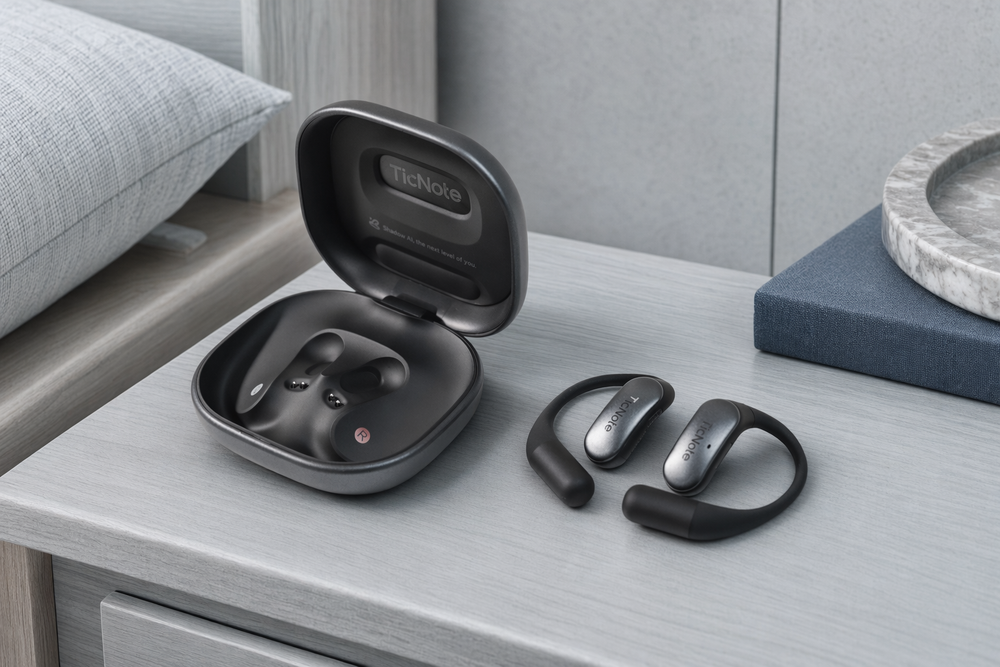
The Mobvoi TicNote Pods sit in a small but increasingly interesting category: earbuds that are trying to be more than earbuds. Not just wireless audio, not just a microphone for calls, but a wearable note-taking and transcription tool with its own 4G connection, its own AI processing pipe...
The Mobvoi TicNote Pods sit in a small but increasingly interesting category: earbuds that are trying to be more than earbuds. Not just wireless audio, not just a microphone for calls, but a wearable note-taking and transcription tool with its own 4G connection, its own AI processing pipeline, and a clear pitch to people who spend their day in meetings, interviews, consultations, lectures, or multilingual conversations. In other words, this is less "earbuds for music" and more "a voice-capture workflow that happens to live in your ears."
This article is not a hands-on review. Nothing here is based on personally testing the product. The goal is simpler: explain what the Mobvoi TicNote Pods actually are, what the listed features imply in real life, how they compare with more familiar options like the Plaud NotePin or standard earbuds paired with a phone app, and who they genuinely make sense for. If the product page sounds impressive but slightly slippery, this is the calmer version.
📺 Watch: Mobvoi TicNote Pods in context
Quick snapshot
| Question | What the Mobvoi TicNote Pods actually are |
|---|---|
| Category | Smart Earbuds |
| Made by | Mobvoi |
| Typical price | ~$415 CAD (listing at the time of writing — verify current pricing) |
| Rating signal | Check current reviews |
| Best for | Professionals who need wearable transcription, phone-free note capture, and quick AI summaries |
| Skip if | You mainly want music earbuds, dislike cloud transcription, or do not want to manage eSIM-connected wearables |
Pro tip: Treat the Mobvoi TicNote Pods as a capture tool first and audio earbuds second. If your main goal is better sound quality for commuting, there are easier and cheaper options. If your goal is not missing what was said in a meeting, these make more sense.
What the Mobvoi TicNote Pods actually is
In plain English, the Mobvoi TicNote Pods are open-ear wireless earbuds designed to record conversations, send that audio through an AI system, and turn it into useful text without leaning on your phone the whole time. The standout angle is the built-in 4G eSIM, which means Mobvoi is trying to remove the usual weak link in this category: having to remember your phone, tether to your phone, or wait until you're back on Wi-Fi before the "smart" part works. That is a more ambitious idea than a normal pair of voice-recorder earbuds.
The Mobvoi TicNote Pods are the world's first 4G-connected AI note-taking earbuds. Featuring a lightweight open-ear design at 7g per earbud with titanium frame and liquid silicone hooks, they combine premium wireless audio with built-in 4G eSIM connectivity and AI processing for real-time transcription, translation, and customizable AI summaries — all without needing a phone.
That description makes the product's purpose pretty clear. These are not trying to replace AirPods on pure mainstream appeal. They are trying to replace the awkward stack of "Bluetooth earbuds + phone recorder app + later transcription + manual summary." Compared with a product like the Plaud NotePin, which also targets AI note-taking, the Mobvoi approach is more wearable and more immediate: instead of clipping a recorder to your shirt, you wear the capture device on your ears and use 4G to push data to the cloud faster. Whether that is better depends on your tolerance for wearing open-ear hooks all day and your comfort with recording workflows in public or professional spaces.
Key features at a glance
- Built-in 4G eSIM for phone-free cloud connectivity
- Real-time AI transcription and translation via Shadow AI 2.0
- Open-ear design at 7g per earbud with titanium frame
- 5 hours of continuous recording, 25 hours with the charging case
- Customizable AI summaries including formats like SOAP notes and meeting briefs
- 50% faster cloud sync via 4G vs Wi-Fi, according to the listing
How the Mobvoi TicNote Pods actually works
At a basic level, the Mobvoi TicNote Pods combine three things that are usually separate. First, they are wearable microphones and earbuds. Second, they have their own mobile-data connection through 4G eSIM. Third, they tie into an AI service that can transcribe, translate, and summarize what they capture. The interesting part is not that any one of those features exists, but that Mobvoi is packaging them into one device that does not need to piggyback on a phone for the core workflow.
The likely real-world flow is straightforward. You wear the earbuds, start a recording or note-taking session, and the audio gets processed through Mobvoi's system. Because the listing emphasizes real-time transcription and translation, the intended experience is closer to live capture than to the old "record now, upload later" model. The mention of Shadow AI 2.0 and customizable summaries suggests that once audio is captured and synced, the system can output structured notes rather than just a raw transcript. That matters if you are not just archiving speech, but trying to pull action items, medical-style visit summaries, or meeting briefs from it.
The 4G angle deserves a bit more attention because it is the product's main differentiator. A lot of AI note gadgets quietly depend on the phone in your pocket for data. If your phone battery is dead, if Bluetooth is flaky, or if you leave your phone on your desk, the whole "smart capture" promise gets shaky. Mobvoi's pitch is that the earbuds can keep doing their cloud-connected work independently. The claim of 50% faster cloud sync via 4G vs Wi-Fi is worth reading cautiously, because real-world network performance varies wildly, but the larger point is credible: a direct cellular connection can be a more honest design than pretending a phone-free workflow exists when it really doesn't.
There are a few layers working together here:
- Audio capture: the earbuds record what you say and likely what is happening around you within the intended use case.
- Cloud connectivity: the built-in 4G eSIM sends data without relying on your phone.
- AI processing: transcription, translation, and summaries are generated through Mobvoi's AI stack.
- Output formatting: summaries can reportedly be shaped into specific formats like SOAP notes or meeting briefs, which makes the product more work-oriented than consumer-entertainment-oriented.
A realistic "day in the life" with Mobvoi TicNote Pods
Because this is an informational explainer, the examples below are based on what the listed features imply, not on direct testing.
- Morning: You head into a client meeting or class with the Pods in your ears and no need to keep your phone on the table as a visible recorder. The 4G eSIM means the note-taking workflow is meant to keep running even if your phone stays in your bag or is not with you at all.
- Midday: During a multilingual conversation, the real-time translation feature becomes the main draw. That does not make these universal translator magic beans, but it does suggest a more active live-assistance role than a simple dictation recorder.
- Afternoon: After a long block of calls or interviews, the AI-generated output matters more than the raw audio. Instead of rereading a huge transcript, you would be looking for a meeting brief, a summary, or a more specialized structure like SOAP notes if your workflow fits that format.
- Evening: Back in transit or wrapping up the day, the charging case stretches the total runtime to 25 hours, with 5 hours of continuous recording on the earbuds themselves. That is enough for many workdays, but not so much that you can ignore charging altogether. Evaluate it like a work accessory, not an always-on invisible implant.
Who the Mobvoi TicNote Pods is actually for (and who it isn't)
Great fits
- Consultants and project managers who sit through back-to-back meetings and need searchable notes more than audiophile sound.
- Journalists, researchers, and students who want a less clumsy way to capture spoken information than balancing a phone on the table.
- Clinicians or allied-health professionals interested in structured note formats like SOAP notes, assuming their privacy and compliance requirements are fully reviewed first.
- Frequent travelers or bilingual professionals who may benefit from phone-free transcription and translation while moving between appointments.
- People who forget their phone or hate relying on it for every wearable feature; the 4G independence is genuinely the main reason to look at this model.
Poor fits
- Commuters shopping for music-first earbuds with strong noise cancellation and mainstream app ecosystems. That is not this product's centre of gravity.
- Privacy-sensitive households or workplaces where cloud-connected recording is an immediate non-starter.
- Casual users who think AI summaries sound nice but realistically only need occasional voice memos.
- Anyone who dislikes subscriptions, mobile provisioning, or account setup; a 4G AI wearable is almost never a set-it-and-forget-it gadget.
- People who want discreet in-ear buds. The open-ear hook design has practical comfort benefits, but it is more visible and more niche-looking.
Practical trade-offs
Privacy and consent
This is the biggest serious issue with a product like this, and it is not a small footnote. The Mobvoi TicNote Pods are built around recording, transmitting, and processing speech. That means any buyer needs to think beyond convenience and into consent, workplace policy, and local recording rules. If you are using them in meetings, classrooms, interviews, or healthcare settings, "the hardware can do it" is not the same as "you should do it."
The translation and transcription features are the whole point of the product, but they also mean spoken content is moving through a cloud AI system. Before buying, check Mobvoi's current privacy documentation, storage terms, deletion controls, and any data retention details. If you would be uncomfortable having your spoken meetings handled by a cloud service, these are probably the wrong earbuds.
Comfort, fit, and open-ear compromises
The listing calls out 7g per earbud, a titanium frame, and liquid silicone hooks. That suggests Mobvoi is prioritizing lightweight long-session wear over sealed, immersive listening. Open-ear designs can be more comfortable for all-day use and more practical if you want to remain aware of your surroundings, especially in offices, on campus, or while moving between appointments.
But open-ear always means trade-offs. You are typically giving up the isolated, private listening feel that many people expect from premium earbuds. If you mainly care about rich bass, commuting immersion, or shutting out a noisy train car in winter, a more conventional in-ear model will usually make more sense. These are workwearables dressed as earbuds, not luxury audio jewellery.
Battery, charging, and long-day reliability
Mobvoi says the Pods offer 5 hours of continuous recording and 25 hours total with the charging case. That is useful, but it also tells you something important: these are not infinite-capture tools. If your day involves six straight hours of lectures, interviews, or workshops, you are already close to the single-session ceiling.
That does not make the battery weak; it makes it normal for a tiny connected wearable doing cloud-linked audio work. Just be realistic about your day. The case matters, top-ups matter, and forgetting to charge them the night before will matter more here than with ordinary earbuds because the whole value proposition depends on being ready when conversation starts.
Where the Mobvoi TicNote Pods fits in a smart home
This is not really a smart-home product in the classic sense, and that is fine. The better way to think about it is as part of a personal productivity stack that might overlap with your wider device ecosystem.
For example, the Mobvoi TicNote Pods could sit alongside:
- Google Workspace or Microsoft 365 for turning meeting summaries into tasks and follow-ups
- Notion, Obsidian, or Evernote for storing cleaned-up notes after transcription
- A Pixel, Galaxy, or iPhone as your backup device, even if the Pods are designed to work without one
- Smart speakers like Amazon Echo or Google Nest for home routines, while the Pods handle work capture on the move
That division is healthy. Let your smart-home gear manage lights, timers, cameras, and thermostats. Let the Mobvoi TicNote Pods handle spoken information capture when you are out in the world. They make more sense as a wearable productivity node than as part of a living-room gadget story.
The buying decision, in plain terms
Before paying roughly $415 CAD, three questions usually clarify whether these make sense.
- Do you actually need phone-free transcription, or do you just like the idea of it?
If your phone is always with you and your current note app already works, the 4G eSIM may be unnecessary overhead. If leaving the phone out of the workflow would genuinely make your day easier, that changes things. - Are you buying a capture tool or premium audio earbuds?
If you want the best possible music experience, look elsewhere. If you want wearable AI notes with audio playback as a secondary benefit, the product becomes easier to justify. - Are you comfortable with cloud-handled voice data and the rules around recording people?
If that answer is shaky, stop there. This category only works if you are comfortable with its privacy reality.
If the answer is yes to all three, the Mobvoi TicNote Pods look like a sensible niche tool. If even one answer is a firm no, a cheaper recorder, app, or standard pair of earbuds is probably the better buy.
Got Questions About the Mobvoi TicNote Pods? Let's Clear Things Up.
Is this a hands-on review?
No. This is an informational explainer based on the product listing and what the features imply in real-world use. It is meant to help you decide whether the category and the product make sense before you go deeper.
Do the Mobvoi TicNote Pods need a phone to work?
According to the listing, the big selling point is that they do not need a phone for core cloud-connected functions because they use a built-in 4G eSIM. That is different from many "smart" earbuds that still quietly depend on your phone for data and processing. Check the current setup requirements, though, because initial account configuration may still involve an app.
Are these mainly for music or for note-taking?
Everything in the product positioning says note-taking first. Yes, they are earbuds and can handle wireless audio, but the real reason they exist is transcription, translation, and AI summaries. Think of them as a voice workflow tool that also plays audio, not the other way around.
What does the customizable AI summary feature actually mean?
Based on the listing, it means the system is trying to do more than dump out a transcript. It can reportedly shape output into formats like meeting briefs or SOAP notes, which is useful if your work depends on structure and not just verbatim text. That is more practical than generic "AI summary" branding, assuming the current software actually supports the templates you need.
Is the open-ear design a good thing?
For long wear, probably yes. The 7g per earbud weight and hooked open-ear design suggest better awareness of your surroundings and potentially better comfort across a workday. The trade-off is that open-ear designs usually do not give the same isolated listening experience as traditional sealed earbuds.
Where can you verify the latest details or buy the Mobvoi TicNote Pods?
The safest place to verify the current listing, feature claims, and any plan or service details is the official retailer page here: Mobvoi TicNote Pods product page. That is where you should confirm pricing, availability, and any changes to cloud features before buying.
What does it cost in Canada?
At the time of writing, the listed price is roughly ~$415 CAD. That puts it firmly in premium-gadget territory, so it makes sense only if the AI capture workflow solves a real problem for you. As always, verify the current price before checkout because wearable tech pricing can move around.
Where is the Celmin Directory listing for this product?
For a catalog-style view of the same product — structured specs, pros and cons, similar picks, and FAQ — see Mobvoi TicNote Pods on Celmin Directory.
If you're building a smarter home in Canada and want honest explainers on gadgets worth considering — plus the ones worth skipping — Celmin covers the full catalog without the marketing theater. More reviews, comparisons, and buyer guides at https://celmin.ca.


Discussion
Sign up or sign in to join the conversation.