
The Geedel Rotary Cheese Grater sits in a very specific corner of the kitchen-gadget world: the manual prep tool that promises to make one repetitive, mildly annoying job faster and safer. It is not a food processor, not a box grater, and not a novelty unitasker in the worst sense. It is a ha...
The Geedel Rotary Cheese Grater sits in a very specific corner of the kitchen-gadget world: the manual prep tool that promises to make one repetitive, mildly annoying job faster and safer. It is not a food processor, not a box grater, and not a novelty unitasker in the worst sense. It is a hand-cranked countertop grater with 3 interchangeable blades, aimed at people who grate cheese, slice vegetables, or shred ingredients often enough to want something easier than scraping knuckles against a metal box.
This article is not a hands-on review. Nothing here is based on personally using the Geedel Rotary Cheese Grater. Instead, the goal is to explain what it actually is, how its design choices affect everyday use, and who it realistically suits based on the listing details and the broader category. If you are trying to decide whether a ~$33 CAD manual grater is a smart buy or just more drawer clutter, this is for you.
📺 Watch: Geedel Rotary Cheese Grater in context
Quick snapshot
| Question | What the Geedel Rotary Cheese Grater actually is |
|---|---|
| Category | Kitchen & Dining |
| Made by | Geedel |
| Typical price | ~$33 CAD (listing at the time of writing — verify current pricing) |
| Rating signal | 4.6/5 on the source listing |
| Best for | Home cooks who regularly grate cheese, shred vegetables, or want a safer alternative to a box grater |
| Skip if | You have textured countertops, already own a food processor, or mostly grate tiny amounts |
Pro tip: Treat the Geedel Rotary Cheese Grater as a mid-volume prep shortcut, not a replacement for every grating and slicing tool in your kitchen. It makes the most sense when you regularly prep more than a token sprinkle of cheese.
What the Geedel Rotary Cheese Grater actually is
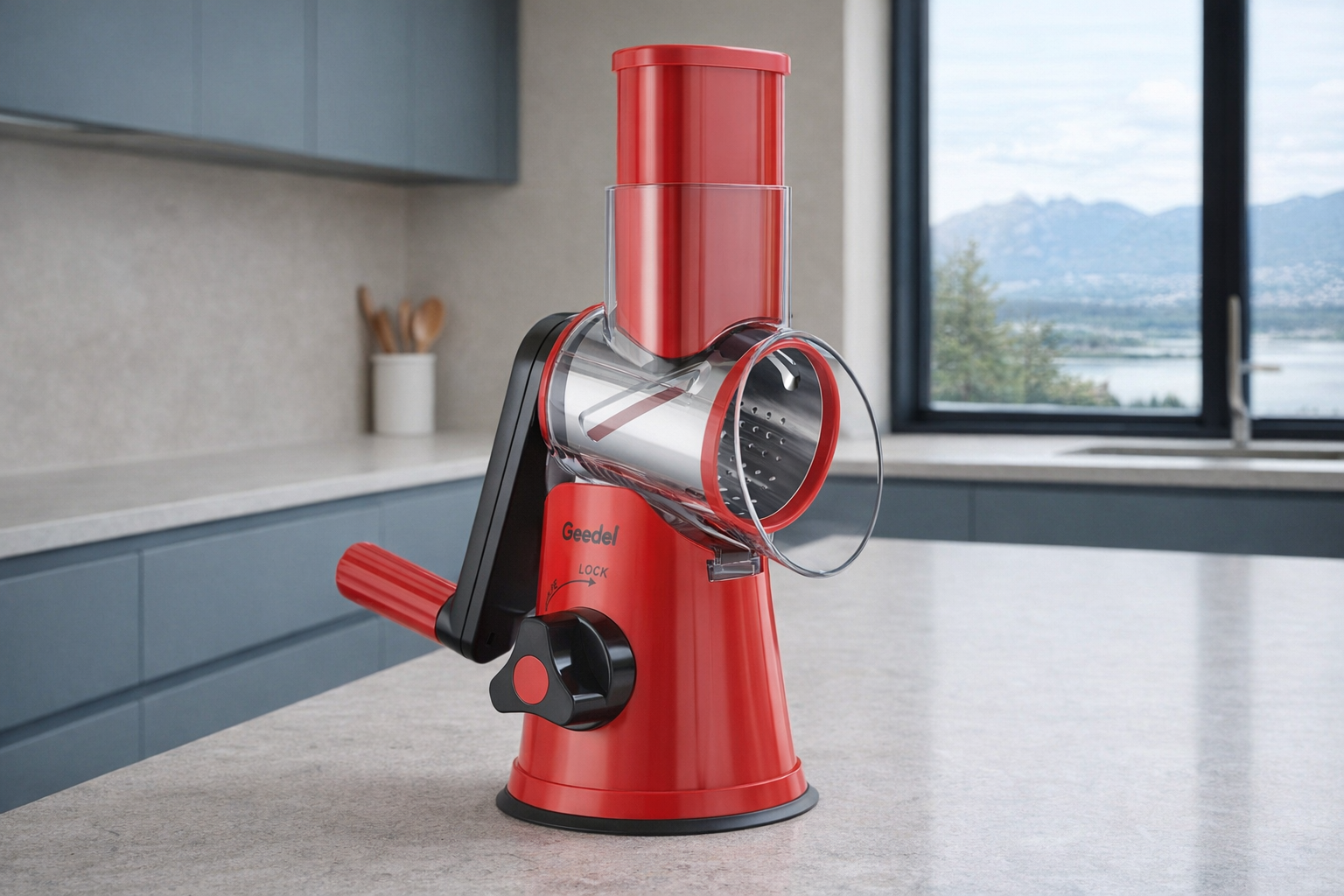
In plain English, the Geedel Rotary Cheese Grater is a manual countertop drum grater. You feed food into the top, press it toward a rotating drum with a pusher, and turn a side handle to shred, slice, or grind ingredients out the front. The main appeal is not sophistication; it is leverage and distance. Your hands stay farther from the blades than they do with a box grater, and the suction base is supposed to keep the unit from sliding around while you work.
Geedel rotary cheese grater with 3 interchangeable stainless steel blades for slicing, shredding, and grinding. Features food-grade BPA-free ABS material, suction base, transparent barrel, and food pusher for safe operation.
That description tells you most of what matters. This is a plastic-bodied manual prep tool with stainless steel drums and a safety-oriented design. The transparent barrel and angled chute are there to help you see what is happening and reduce clogging, while the fully detachable parts are meant to make cleanup less annoying than it often is with enclosed kitchen gadgets.
A useful comparison here is the Ourokhome Rotary Cheese Grater, another widely sold manual drum grater in the same category. The Geedel appears to aim at the same buyer: someone who wants the convenience of a small food-prep device without the noise, bulk, or counter footprint of an electric processor. That is a more honest pitch than pretending this kind of tool can replace a proper food processor. It cannot. What it can do, at least on paper, is make repetitive cheese and vegetable prep less fiddly.
Key features at a glance
- 3 interchangeable stainless steel blades for slicing, shredding, and grinding
- Powerful suction base designed to stay firm on smooth countertops
- Food-grade BPA-free ABS body for food-contact safety
- Transparent barrel with inclined curvature intended to reduce jamming
- Food pusher to keep fingers away from the drum blades
- Fully detachable parts for easier cleaning
- Top-rack dishwasher-safe components according to the listing
How the Geedel Rotary Cheese Grater actually works
The mechanism is simple, which is part of the appeal. You lock the body onto a smooth counter using the suction base, insert one of the 3 cylindrical blades, attach the handle, and feed food through the top chute. As you turn the crank, the blade drum spins and cuts the food against its perforated surface, pushing the finished pieces out the side.
The three drums are the core of the product. One is intended for slicing, one for coarser shredding, and one for finer grinding-style results. That gives the Geedel more flexibility than a one-format cheese mill, but it still works within the limitations of its drum size. Long vegetables, oversized cheese blocks, or unusually soft items may need trimming before they fit comfortably. That is normal for this category.
The suction base matters as much as the blades do. Manual rotary graters are only pleasant to use if they stay put. According to the listing, the Geedel uses a strong suction system for smooth countertops. That likely means polished stone, sealed quartz, laminate, or similarly flat surfaces are the ideal environment. On butcher block with visible grain, tile with grout lines, or textured composite counters, suction tools often become much less convincing. That is not a Geedel problem so much as a physics problem.
The transparent barrel and inclined shape are also worth noting because jamming is one of the main frustrations with enclosed graters. When cheese or vegetables bunch up inside, you lose speed and start disassembling parts mid-prep. A visible chamber at least gives you a better read on what is happening. If that angled design really helps food move through cleanly, that is useful. It is a small design choice, but often the difference between “quick helper” and “thing you stop using after a month.”
A realistic "day in the life" with Geedel Rotary Cheese Grater
Because this is an informational piece, here is what a typical use pattern might look like based on the listed features and how manual rotary graters usually fit into home cooking.
- Morning. You are making a quick omelet or breakfast hash and want sliced potatoes or shredded cheese without hauling out a larger appliance. The Geedel gets suctioned to a smooth counter, one blade goes in, and the hand crank handles a small batch with less finger risk than a box grater.
- Midday. Lunch prep is where the slicing and shredding blades make the most sense. Think cucumber, carrot, or cheese for salads and wraps. The transparent barrel lets you see if wetter vegetables are moving properly or starting to clog.
- Afternoon. You are prepping ahead for dinner and need a bigger pile of shredded cheddar or mozzarella for tacos, baked pasta, or casseroles. This is the kind of repetitive task where a rotary grater can genuinely feel easier than a flat grater, especially if you are doing more than a handful.
- Evening. Cleanup matters after the meal, not just prep speed before it. The Geedel’s detachable design means the drums, pusher, and body sections can come apart rather than trapping food in hidden corners. If the top-rack dishwasher-safe claim holds for your setup, that is the kind of small convenience that keeps a gadget in circulation.
Who the Geedel Rotary Cheese Grater is actually for (and who it isn't)
Great fits
- People who cook pasta, tacos, gratins, or casseroles regularly and grate cheese more than once a week.
- Older adults or anyone with hand sensitivity who may find a traditional box grater awkward or harsher on knuckles and wrists.
- Parents prepping vegetables for salads, slaws, or kid-friendly meals who want a bit more hand separation from the blade.
- Apartment dwellers who do not want the size, noise, and cleanup burden of a food processor for simple shredding jobs.
- Home cooks who like dedicated manual tools and have smooth counters where suction gadgets actually work.
Poor fits
- Anyone with textured, uneven, or porous countertops where suction bases tend to fail.
- People who already own a decent food processor and are happy using the shredding disc.
- Minimalists who hate single-purpose kitchen tools and want every item to earn permanent counter or drawer space.
- Cooks who usually need only a tablespoon or two of grated Parmesan; a microplane is often faster for tiny quantities.
- Anyone expecting it to handle every produce shape and every cheese texture equally well. Manual drum graters always have favourites.
Practical trade-offs
Counter compatibility
This is the biggest practical question with the Geedel. The product depends heavily on its suction base, and suction bases are picky. On smooth laminate, quartz, or polished stone, this can be a stable setup. On textured counters, wood with visible grain, or surfaces with subtle unevenness, it may not hold as firmly as you want.
That matters because hand-cranked tools create side-to-side force. If the base slips while you are cranking, the entire “safe and easy” promise weakens quickly. Before buying, think about your actual countertop, not the ideal countertop in product photos.
Capacity and food shape
The Geedel is more convenient than a box grater for medium batches, but it is not a high-capacity prep machine. The feed tube and drum size naturally limit what fits. You may need to cut larger cheese blocks, potatoes, zucchini, or cucumbers down to size before feeding them in.
That prep step is not a dealbreaker, but it is worth being honest about. Evaluate it like a manual shortcut, not like a countertop robot. If you routinely prep for a large family, holiday cooking, or bulk meal prep, an electric processor may still be the better tool.
Cleaning and long-term wear
The listing says the parts are detachable and top rack dishwasher safe, which is encouraging. That is one of the biggest buying points for any enclosed kitchen tool. A gadget that is fast to use but annoying to clean usually migrates to the back of a cabinet.
The caution is material mix. The cutting drums are stainless steel, but the body is BPA-free ABS plastic. That is standard, not a red flag, but it does mean this is a lightweight manual gadget rather than a lifetime heirloom tool. Over time, plastic locking tabs, suction mechanisms, and moving joints are usually the first places wear shows up. At ~$33 CAD, that is acceptable if your expectations are realistic.
Where the Geedel Rotary Cheese Grater fits in a modern kitchen
The Geedel makes the most sense in kitchens that are trying to avoid unnecessary appliance sprawl. It sits in the middle ground between three other tools:
- a box grater for cheap, simple, no-setup grating
- a Microplane for fine finishing work like Parmesan, lemon zest, or garlic
- a food processor for bigger, faster batch prep
That middle position is actually useful. If you cook enough to want a shortcut, but not enough to justify using a processor every time, a manual rotary grater can be a sensible compromise. It is especially easy to picture alongside common kitchen systems like a KitchenAid stand mixer, a Ninja countertop appliance setup, or a basic set of OXO prep tools. It is not a flagship appliance. It is the kind of helper that earns its keep by being quicker to grab than the heavier alternative.
In practical terms, it fits best in households making pizza night, taco night, pasta bakes, potato dishes, and salad prep on repeat. It fits less well in kitchens built around pre-shredded cheese, ultra-minimal tool counts, or heavy-duty batch cooking. If your kitchen rhythm is “small jobs, often,” the Geedel’s pitch makes sense.
The buying decision, in plain terms
Before buying the Geedel Rotary Cheese Grater, three questions usually get you to the right answer:
- Do you grate and slice enough food to justify a dedicated manual tool? If this is for occasional garnish-level cheese, probably not. If you regularly prep actual piles of cheese or vegetables, it becomes easier to justify.
- Do you have the right kind of countertop for a suction-base gadget? If your surfaces are smooth and flat, good. If not, this may be frustrating no matter how good the blade drums are.
- Are you looking for a manual shortcut or an appliance replacement? If you want quieter, simpler prep without plugging anything in, this is aligned with that goal. If you want high-volume speed, buy a food processor instead.
Three yeses make the Geedel Rotary Cheese Grater a sensible low-cost kitchen upgrade. Any strong no, and a box grater, Microplane, or processor is probably the better match.
Got Questions About the Geedel Rotary Cheese Grater? Let's Clear Things Up.
Is this a hands-on review?
No. This is an informational explainer based on the product listing and the broader manual rotary-grater category. It is meant to help you understand the fit, not to stand in for direct testing.
What does the Geedel Rotary Cheese Grater actually do?
It is a manual hand-crank prep tool for slicing, shredding, and grinding foods using 3 interchangeable stainless steel drums. The most obvious use is cheese, but the listed design also points to vegetables and similar ingredients that fit the feed opening.
Is it safer than a box grater?
It is designed to be safer in one important way: your hands are separated from the cutting drum by a food pusher and enclosed chute. That said, “safer” does not mean risk-free. You still have sharp removable blades and a manual crank mechanism, so normal kitchen caution still applies.
Will the suction base work on any countertop?
Probably not. According to the listing, the suction base is intended for smooth countertops, which is typical for this category. If your counter is textured, porous, or uneven, you should expect weaker performance from any suction-based manual tool.
Is the Geedel Rotary Cheese Grater easy to clean?
The listing says the parts are fully detachable and top rack dishwasher safe. That is a good sign because enclosed prep gadgets live or die on cleanup. Even so, it is smart to check current care instructions on the product page before buying.
Where can I verify the current listing or buy it?
The most direct place to verify current pricing, availability, and listing details is the Amazon product page here. As always with marketplace products, check the latest seller details, current photos, and recent buyer feedback rather than relying on an older snapshot.
What does it cost in Canada?
At the time of writing, the listed price is roughly ~$33 CAD. Marketplace pricing can move around, so it is worth clicking through to confirm the current amount before buying.
Where is the Celmin Directory listing for this product?
For a catalog-style view of the same product — structured specs, pros and cons, similar picks, and FAQ — see Geedel Rotary Cheese Grater on Celmin Directory.
If you're building a smarter home in Canada and want honest explainers on gadgets worth considering — plus the ones worth skipping — Celmin covers the full catalog without the marketing theater. More reviews, comparisons, and buyer guides at https://celmin.ca.
Discussion
Sign up or sign in to join the conversation.