
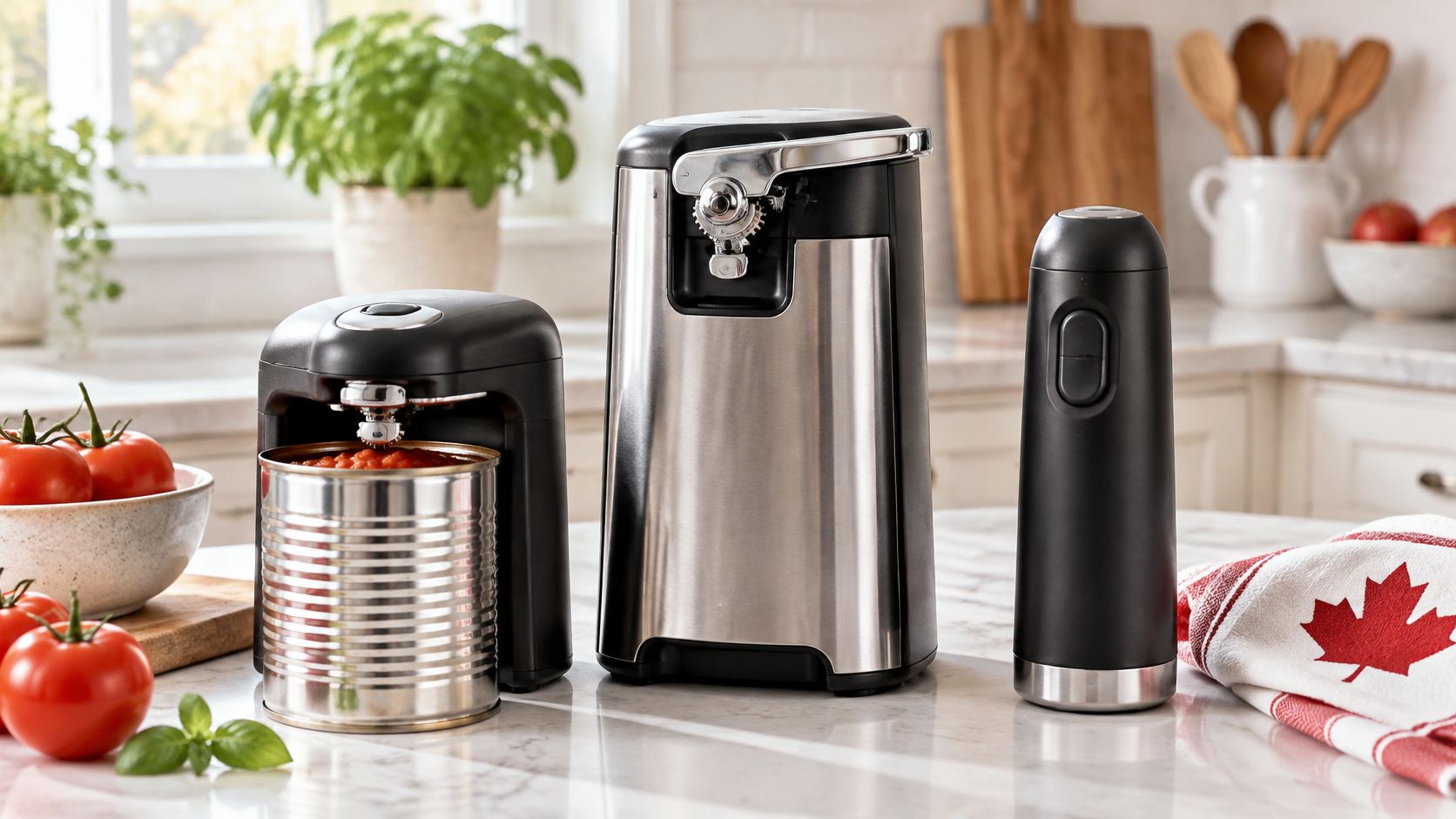
It's a weeknight, the pot is already on, and the recipe wants a 796 mL can of tomatoes plus a 540 mL can of chickpeas. Your drawer opener has chewed the last three rims, and one of them left a curl of steel sitting on top of the food. That's usually the moment someone starts shopping for an electric model, and it's also when shoppers buy the wrong one: too wide for the counter, too weak for a family-size can, or so awkward to hold that it never leaves the cupboard.
This guide sorts electric can openers by the jobs they do in a Canadian kitchen. It treats accessibility, outage backup and damaged-can safety as buying criteria next to motor power, and it will tell you plainly when the manual opener in the drawer is still the better buy.
Table of Contents
- Best Electric Can Openers at a Glance
- Whether an Electric Can Opener Earns Its Counter Space
- How Models Compare on Noise, Durability and Cleaning
- Picks for Budget, Small Kitchens, Heavy Use and Outages
- When to Stop Before Opening a Damaged Can
- Confirm Your Pick and Buy With Confidence
Best Electric Can Openers at a Glance
| Opener type | Best for | Counter footprint |
|---|---|---|
| Compact countertop with auto-stop | Small condo kitchens, one to three cans a day | Narrow base, stores upright |
| Full-size countertop, heavier motor | Large families, frequent cans, batch cooking | Wider base, stays on counter |
| Cordless or battery | Outages, camping, cabins, no nearby outlet | Lightest, no outlet needed |
| Accessibility-focused one-touch | Reduced grip, arthritis, tremors | Wider base, needs stable surface |
Pick the type before the brand. A dented seam, bulging lid or heavy rust is a stop sign for every row above; torque does not make a compromised can safe.
Compact countertop with auto-stop: the starting point for a condo or apartment where the unit sits on the counter rather than living in a drawer, and where one to three cans a day is the typical limit. A narrow base that stands upright against the backsplash matters more than a motor rating.
Full-size countertop with a heavier motor: built for households that open several cans in one session, whether that is a pot of chili, a batch of bean salad or a week of pet food. The wider base is what stops it walking across the counter when a family-size can goes in.
Cordless or battery: the type to buy when the outlet sits nowhere near the prep space, when power failures are part of winter, or when the unit doubles as cabin and camping gear. It gives up speed and adds a battery habit you have to keep.
Accessibility-focused one-touch: for anyone whose grip, tremor or vision makes a manual opener a genuine struggle. Large buttons, a heavy base and a lid that lifts away cleanly are the entire point of paying more.
Footprint before wattage
Canadian kitchens were crowded with countertop appliances long before electric openers were a category, so a new device has to earn a slot a microwave already occupies. If cans only come up now and then, the manual opener in the drawer is still the honest answer.
Treat the table as a shortlist of types; brand ranking comes later. Prices move between Amazon.ca and local retailers and shift with the season, and warranty length is set by each manufacturer, so the figure worth trusting is the one on the listing the day you buy. The rows above narrow the field, then noise, cleaning, can-size range and lid handling settle the model. If the opener is part of a larger counter rethink, our guide to small kitchen upgrades that earn their place applies the same footprint test to the kettle and grinder.
Whether an Electric Can Opener Earns Its Counter Space
An electric can opener earns permanent counter space in exactly two situations: cans get opened often enough that a manual tool turns into daily irritation, or a grip, dexterity or vision limit makes a manual opener hard or unsafe to use. Outside those two, it's a drawer tool wearing an appliance costume.
Who gains, and who doesn't
Three groups come out ahead. Households that open several cans a week, because the time and hand strain compound. Cooks who batch-prepare beans, tomatoes and soup, because the twentieth can in a session is where a motor proves itself. And anyone with arthritis, tremors, low grip strength or limited vision, for whom the question isn't speed but whether dinner gets made without asking for help.
Occasional users are the honest counterexample. If a can a week is your real pace, a drawer-stored manual opener wins on cost, space and lifespan, and there's no shame in that answer.
What electric adds is narrow and worth naming: cutting without hand force, a stop at the end of the seam instead of a guess, and a magnet that holds the lid so it doesn't fall into the food. Everything else is marketing.
The trade-offs Canadians feel are just as specific. Counter footprint on a 60 cm condo run. An outlet that has to sit within cord reach, which on a narrow galley often means the opener ends up beside the sink rather than at the prep station. And a cord too short to reach the only free socket in the room.
The break-even test in cents per can
Total CAD cost, including a replacement cutting head or a year of batteries, divided by the cans you'll open over the years you expect the unit to last. That gives you a cost per can.
Take an illustrative CAD 60 model that opens about 150 cans a year and holds up for five years. That's 750 cans and roughly 8 cents a can. Change one variable and the verdict flips: at 20 cans a year the same unit works out to 60 cents a can, which no one could defend.
Warranty belongs in the same arithmetic, because a longer one limits early-failure expense. A two-year warranty on a unit that dies at 14 months costs you a phone call; a 90-day warranty on the same failure costs you the whole purchase.
Break-even rule: if the arithmetic lands above the yearly cost of a decent manual opener, buy the manual and spend the difference on the food.
| Household pattern | Cans opened per week | Likely verdict |
|---|---|---|
| Occasional pantry use | Under 2 | Manual opener is usually enough unless grip is limited |
| Regular cooking or meal prep | 3 to 10 | Electric pays off in ease; compact model suits most kitchens |
| Heavy or family use | 10 or more | Full-size model with replaceable parts is worth the cost |
| Accessibility need | Any volume | Electric may be necessary regardless of how often cans are opened |
The bands are editorial estimates, not measured data, and they exist to give you a starting verdict rather than a precise threshold. Affordability shapes the decision more than most buying guides admit: in 2024, 24.0% of Canadians, about 9.8 million people, lived in households reporting some form of food insecurity (Statistics Canada). For those households the appliance competes directly with the food budget, which makes durability, warranty, replacement-head cost and compatibility with cheap pantry staples the features that matter.
The same grip logic applies to lids, and our breakdown of electric jar openers covers where a motor helps and where a rubber grip is enough. I would put money into the cutting mechanism and the warranty, not into a brushed finish.
How Models Compare on Noise, Durability and Cleaning
Three families of opener, judged on what you notice a month after purchase rather than what the box advertises.
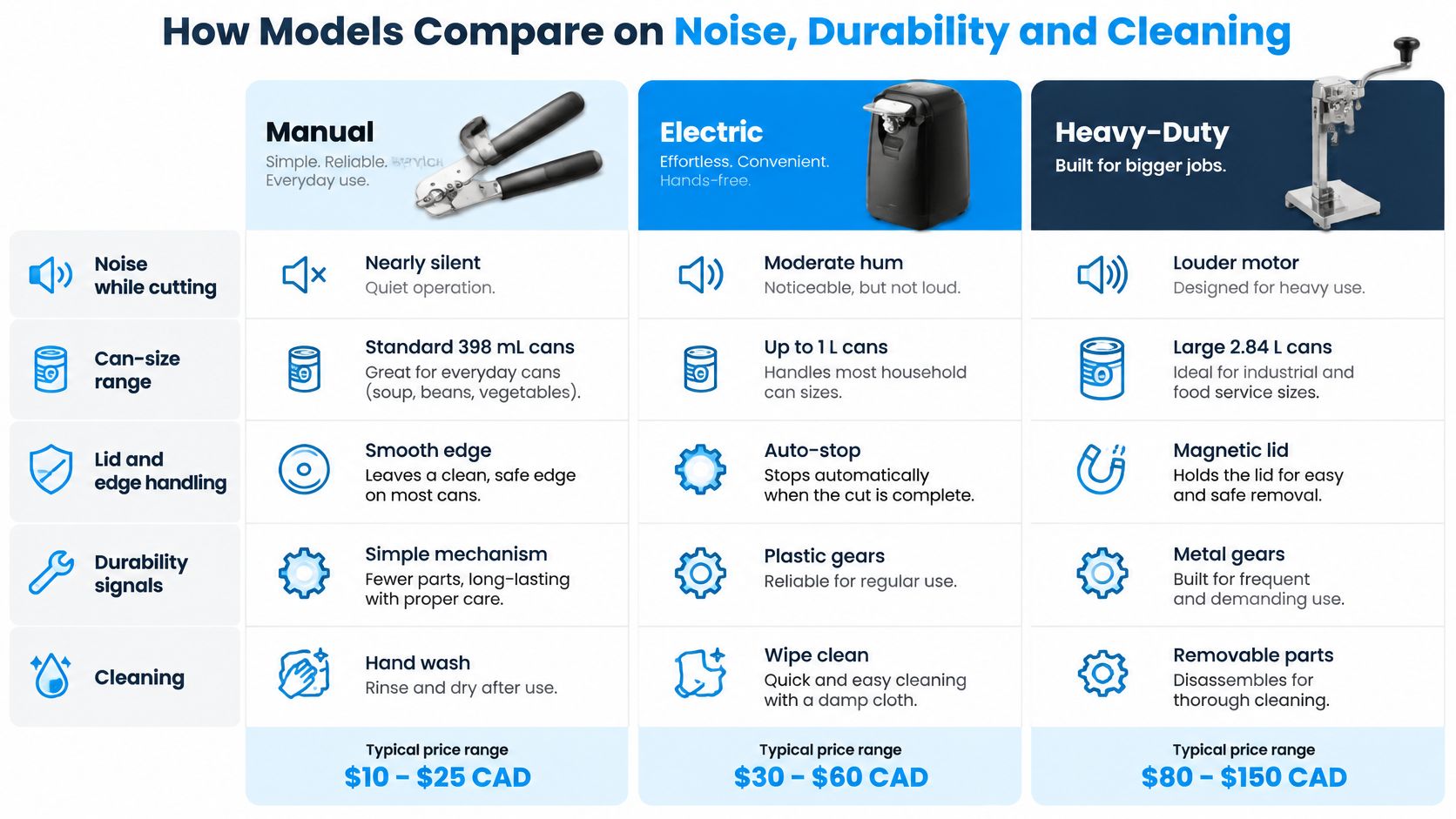
Canada's canned-food aisle is standardised, and that standardisation is what the jaws have to handle. Agriculture and Agri-Food Canada reported that Canadian retail sales of packaged food reached Can$77.6 billion in 2023 (Agriculture and Agri-Food Canada). Across that shelf, the everyday formats recur: baked beans are typically sold in 398 mL cans, tomatoes in 796 mL, tomato juice in 1.36 L and soup in 284 mL. Small single-serving cans, medium everyday cans and family-size containers all pass through the same mechanism.
| Criterion | Compact countertop | Full-size countertop | Cordless battery |
|---|---|---|---|
| Noise while cutting | Short motor run, moderate hum | Stronger motor, louder during the cut | Quieter motor, pitch depends on battery and drive |
| Can-size range | Standard 284 to 540 mL; check 796 mL | Standard to 796 mL; verify 1.36 L | Standard 284 to 540 mL; check tall cans |
| Lid and edge handling | Magnet hold and auto-stop | Magnet hold, auto-stop, check edge smoothness | Magnet hold; confirm auto-stop works on battery |
| Durability signals | Plastic housing, check cutting head replacement | Metal base, replaceable head where offered | Battery life limits years of service |
| Cleaning | Removable cutting parts where offered | Wider base, more surfaces to wipe | Keep battery compartment dry; wipe only |
What each row is really telling you
Noise is mostly motor hum and blade grind rather than the cut itself, so run length matters more than peak volume. A full-size unit that finishes a 796 mL can in a few seconds is less irritating than a cordless model that whirs for half a minute, even when its peak reading is higher. Published decibel figures are scarce and would not settle the question anyway, which is why run length and pitch are the honest measures here.
Can-size range is where narrow jaws fail. A 796 mL tomato can is wider and heavier than a 398 mL bean can, and a 1.36 L juice can is heavier still, so a light base tips before the motor stalls. Check the largest format you buy rather than the average one, and remember that a buckled seam on a damaged can defeats any jaw rating.
Lid and edge handling decides how the lid comes off and how safe it is to handle afterward. Top-cutting blades leave a sharp rim; side-cutting designs roll the edge smooth, which matters if the lid is headed for the bin where children or pets can reach it. For hands with limited grip, auto-stop is the key feature: the motor finishes the circuit on its own, so nobody has to hold a lever through the cut.
Durability comes down to housing material, a replaceable cutting head and a warranty long enough to cover a real failure. Ask whether the magnet can be serviced or is crimped into a sealed housing. On battery units the compartment is the weak point, since loose contacts and corrosion end more openers than dull blades do. The trade runs both ways: a cordless unit is the only family that still opens cans during a power outage, so buyers who want outage cover accept the shorter service life.
Cleaning favours removable cutting components over a wipe-down shell, because the debris that jams a mechanism is dried juice and metal dust around the blade rather than the outside of the housing. A cord that wraps for storage is a small feature until you are forcing the unit into a drawer.
Picks for Budget, Small Kitchens, Heavy Use and Outages
A magnetic lid arm is the feature you'll notice most, because it decides whether the lid lifts cleanly or drops into the tomatoes.
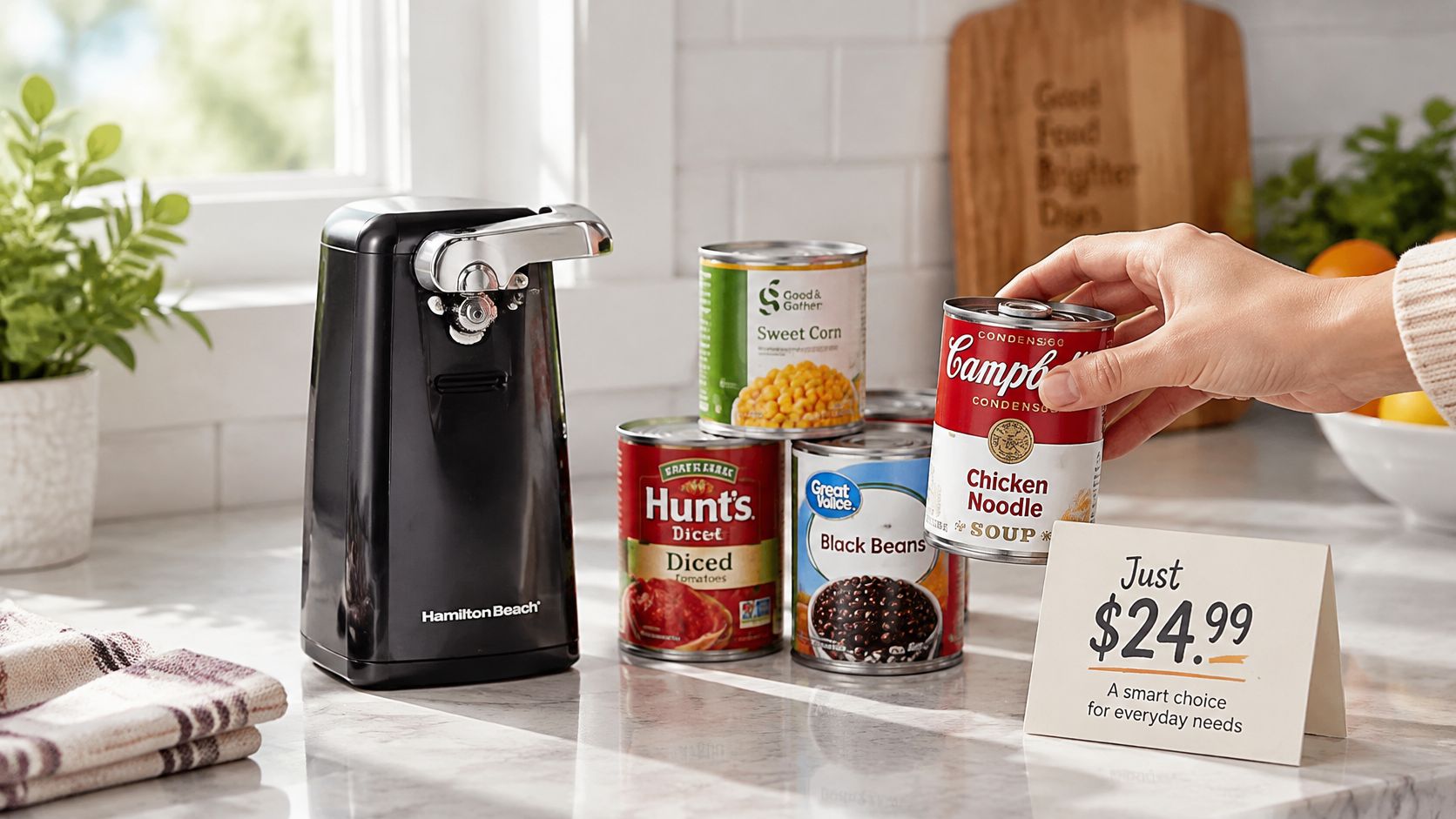
Budget buyers face a break-even test first. Open only a few cans a month and the manual opener already in your drawer wins: it costs nothing, claims no counter space and never runs out of batteries. A compact countertop model with auto-stop earns its footprint once can volume climbs or your grip says otherwise. When you do buy electric, skip the knife sharpener, the bottle opener and anything with a digital display. None of those change how a can opens, and each adds a failure point.
Small kitchens and condos start with a tape measure. Measure the depth of free counter, pick the narrowest base that stands upright, then check cord length against where the outlet sits. Skip any model that needs clearance behind it, because a unit you have to pull forward to load a can ends up living in a cupboard. Our guide to kitchen appliances for small spaces applies the same test across the rest of the counter.
Heavy use looks different. If you're opening six or more cans in a session for chili, pet food or preserving, buy a full-size countertop unit with a replaceable cutting head, rubber feet and a base heavy enough not to walk. This is the one case where the bigger motor buys something real.
The clip below is worth two minutes before you commit, because the operating motion says more about daily use than a spec sheet does.
Where power fails and hands matter
Outages, cabins and camping turn the buying specification from kitchen convenience into resilience. Health Canada's emergency food guidance includes a manual can opener in an emergency kit, and a camping bag or cabin cupboard needs the same assurance: an opener that works with no outlet in reach. A cordless model with a removable manual override, or a cordless plus a manual in the bag, covers both cases. Record the battery count and type, and count how many cans one set opens before the unit slows.
Accessibility is decided by your hands. Look for one-touch start, a button that doesn't demand a firm press, a base that stays put on laminate, and a lid that lifts away without a sharp edge. Test one-handed operation in the store if they'll let you, because the cheapest automatic opener is often the least usable for a weak grip. Cost and independence tend to arrive together: Statistics Canada found that 26.4% of people with disabilities lived in food-insecure households in 2021, against 12.5% of people without disabilities. An appliance that requires two hands and a firm twist removes a cheap pantry meal from the rotation.
Outage test: a cordless opener that can't finish a 796 mL can on one set of batteries is a drawer ornament. Count cans per battery set before you trust it in February.
When to Stop Before Opening a Damaged Can
The most common risky can in a Canadian kitchen isn't the swollen one. It's the 540 mL can that took a knock on the pantry shelf and now carries a dent running down toward the rim.
Two different problems hide in that dent. A light dent away from the seam is mechanical: the opener may slip, stall or leave a jagged edge. A dent on or near the seam is a food-safety problem, because the seal may already be compromised. The Canadian Food Inspection Agency states that cans with swelling, poor sealing or defects that could damage the hermetic seal are not fit for sale or distribution (Canadian Food Inspection Agency).
| Can condition | Safe to open with an opener? | Action |
|---|---|---|
| Intact, undented, sealed | Yes | Open normally and check the lid edge |
| Light dent away from the seam | Usually, test on a spare can first | Open slowly, then inspect rim and lid |
| Dent on the seam or rim | No, seal may be compromised | Do not open; discard |
| Swollen or bulging lid or ends | No | Do not open or eat; discard safely |
| Leaking, rusted or badly dented | No | Do not open or eat; discard |
The test that sorts a good opener from a lucky one
Run a repeatability test across standard 284 to 540 mL cans, including at least one lightly dented can, and record the completion rate, lid separation, metal shavings on the lid, rim sharpness and cleanup time. That set of measurements tells you more about a model than any claim on the box, and it's the difference between an opener that handles your pantry and one that handles a demo.
What happens after a stall matters as much as the stall itself. Stop the device, don't force it, lift the can out and inspect the seam. If the seal area is deformed, the can is done, whatever the food inside cost. A stalled opener can also leave a jagged edge on the lid, so check it before your fingers do.
Health Canada advises consumers not to eat canned food that is swollen, leaking or badly dented, and that rule outranks any feature you paid for.
A dent near the seam turns a mechanical question into a food-safety one, and no motor overrides it.
Confirm Your Pick and Buy With Confidence
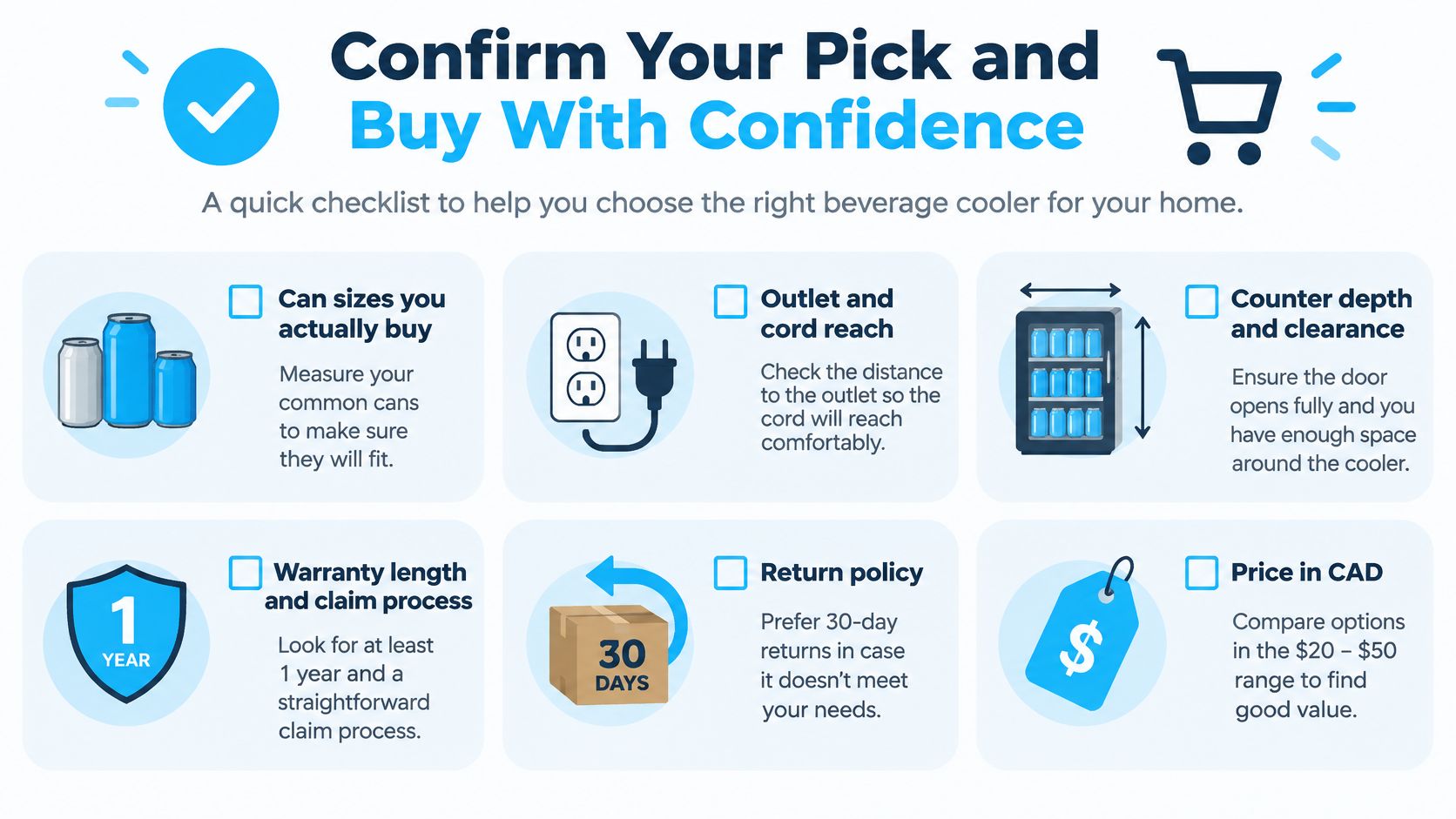
An electric opener earns its counter space only if the cans justify it. Open one or two tins a week and the manual opener stays the better buy; cook daily, work around limited grip, or feed a houseful and the list below sorts the right model in about five minutes.
- The can sizes you buy. Write down the three or four formats sitting in your pantry and check them against the jaw opening and base width.
- Outlet and cord reach. Measure from the socket to the spot on the counter, not the other way round, and add slack for a can that sticks out past the base.
- Counter depth and clearance. The lid has to lift under the upper cabinets, and nothing should need space behind the unit.
- Warranty length and claim process. One year is the floor; confirm whether service happens in Canada or by shipping the unit back.
- One-handed operation if grip is limited. Button force, base stability, lid release, and whether the magnet holds a heavy lid without a second hand steadying the can.
- A replaceable cutting head if you open cans more than a few times a week.
- How it's cleaned. Parts you can lift out and wash beat a housing you wipe around.
- A manual backup stays in the drawer. A cordless model still needs charged batteries, and a winter outage does not care what you paid; keep a working hand opener within reach.
The trade-offs deserve plain language. A stronger motor usually means a deeper base. Quieter models tend to cost more. Units with replaceable parts cost more upfront and last longer, which only pays off if you open cans often enough to wear a cutter out. We name the trade-offs of what we cover, the same way we flag a loud robot vacuum or an air fryer that eats counter space, and here that means saying a premium finish buys you nothing at the can rim.
Some of our product links to Amazon.ca are paid links, and we may earn a commission from them. That does not change which type we'd point you toward.
Before you pay: if the store allows it, open one undamaged 398 mL can and one lightly dented 540 mL can, then check rim sharpness, whether the lid drops, and any metal shavings.
If you're buying one opener this year, buy the compact countertop model with auto-stop when you have the counter for it, the cordless one-touch when you don't, and the full-size unit only if you regularly open several cans at once. Measure the counter depth and outlet location first, pick the type from the at-a-glance table, then verify price and warranty on the day of purchase. And if the checklist shows your weekly can count never justified the motor, the manual opener already in your drawer is the right answer.
Celmin publishes Canadian buying guides for kitchen appliances and home tech, with CAD pricing, local availability and the trade-offs named up front rather than buried. The site's kitchen and smart home coverage runs from kettles and espresso makers to air fryers, and the free weekly email brief flags new reviews and seasonal price moves. Start at Celmin and check the opener against everything else competing for that strip of counter.
Sign up or sign in to join the conversation.