
You wake at 3 a.m. with cracked lips, a dry throat, and static snapping from the bedroom doorknob. The thermostat says 22°C, but the room feels harsh and uncomfortable. In another Canadian home, a child is coughing through the night, while a condo resident watches gaps appear between hardwood boards as the furnace runs.
That's why choosing the best humidifier in Canada isn't just a question of tank size or mist volume. Canadian homes need controlled humidity through long heating periods, quiet bedroom operation, dependable safety shutoff, and a maintenance plan that still makes sense when local tap water leaves scale behind.
The practical target is clear. Health Canada recommends indoor relative humidity around 30% to 35% in winter, adjusted lower during colder weather, and below 50% in summer to reduce condensation and mould risk. Health Canada's indoor-air guidance makes the buying decision simpler: choose the model that can hold that range, not the model that produces the biggest visible cloud.
| Canadian use case | Best humidifier type | What matters most | My verdict |
|---|---|---|---|
| Condo bedroom | Ultrasonic | Quiet operation, humidistat, easy cleaning | Best for focused comfort |
| Nursery | Cool-mist ultrasonic | Automatic shutoff, stable output, wide tank opening | Choose control over maximum output |
| Large Prairie home | Evaporative console | Consistent delivery, wick availability, large-room circulation | Better than a tiny ultrasonic |
| Hard-water household | Evaporative | Mineral tolerance and affordable replacement wicks | Usually the safer ownership choice |
| Occasional dry-air relief | Warm mist | Simple controls and safe placement | Useful, but avoid around toddlers |
| Whole-home coverage | HVAC-mounted evaporative or steam | Professional installation and automatic control | Worth considering during renovations |
Table of Contents
- Why Canadian Winters Change the Humidifier Decision
- The Humidity Numbers Health Canada Wants You to Hit
- Humidifier Types and What Each Does in a Canadian Home
- Top Humidifiers Available in Canada Right Now
- Matching the Right Humidifier to Your Room and Household
- Real Cost of Owning a Humidifier Through a Canadian Winter
- Setup, Water Choice, and Maintenance That Actually Works
- Final Picks and Quick Answers for Canadian Shoppers
Why Canadian Winters Change the Humidifier Decision
A dry bedroom in Winnipeg behaves differently from a damp Vancouver flat. A Toronto condo may have the heat running continuously through the coldest part of the season, while a Prairie home can lose indoor moisture quickly whenever the furnace cycles. CBC has reported that Canadian indoor relative humidity can fall to 20% or even less in winter without a humidifier, which helps explain the familiar combination of static, irritated skin, and uncomfortable breathing. CBC's Canadian humidifier guide connects that dry-air problem with the reason shoppers keep returning to these appliances.

The damage isn't limited to how your nose feels. Dry indoor air can make wood furniture, flooring, and trim shrink or crack, while static becomes a nuisance around electronics and clothing. Respiratory irritation can also be mistaken for a lingering cold, especially when the heating system runs day and night.
Regional conditions change the shortlist
In a Prairie home, a small decorative ultrasonic unit may struggle to keep pace with the space around it. In a Vancouver bedroom, the problem may be more local and seasonal, with the owner needing careful monitoring rather than maximum output. A Toronto condo usually rewards a quiet unit with automatic control because the bedroom, living area, and neighbouring apartments are close together.
Canadian buying rule: Don't buy for mist spectacle. Buy for stable humidity, quiet operation, safe shutoff, and manageable cleaning.
Hard water adds another layer. Ultrasonic humidifiers can disperse minerals from untreated water as fine white dust, while evaporative models trap much of that mineral load in a wick. That difference affects floors, furniture, filters, and the actual cost of using the appliance all winter.
The strongest purchase therefore has four traits: a built-in hygrometer or compatibility with a separate one, automatic shutoff, an accessible tank, and replacement parts that you can find in Canada. A humidifier that's cheap at the checkout can become an expensive appliance if its filter is difficult to source or its tank has narrow corners that you can't scrub properly.
The Humidity Numbers Health Canada Wants You to Hit
Health Canada's range should sit at the centre of every buying decision. The practical winter target is 30% to 35% relative humidity, with the setting adjusted downward during colder weather. In summer, indoor humidity should remain below 50%. Federal Health Canada material also advises switching a humidifier off once indoor humidity reaches about 45%, helping prevent overly moist air, condensation, and mould.

The target looks modest because cold outdoor air and cold indoor surfaces change the condensation risk. Raising humidity feels pleasant until moisture starts collecting on windows, exterior walls, or poorly insulated corners. In a tightly sealed home, adding more mist isn't automatically better.
Measure before you adjust
A hygrometer measures relative humidity. Put one in the room you're trying to improve, away from the humidifier plume, a heat register, a window, or direct sunlight. Digital units are generally easier to read than inexpensive dial models, and a separate meter gives you an independent check when the humidifier's built-in sensor seems inaccurate.
If you're comparing meters, Celmin's TP50 digital hygrometer explanation is a useful Canadian-focused reference for understanding what the display tells you. Some smart thermostats also show humidity beside temperature, but the reading may come from a different area of the home than the bedroom you're treating.
Use this simple sequence:
- Measure first. Run the hygrometer without the humidifier long enough to understand the room's normal reading.
- Set a conservative target. Start near the lower end of the winter range, especially during very cold weather.
- Watch the windows. Condensation is a warning that the setting is too high for the room and outdoor conditions.
- Let automatic control work. A humidistat should stop or reduce output before the room becomes excessively damp.
- Recheck after weather changes. The right setting during a mild week may be too high during a deep freeze.
Without a hygrometer, you're guessing. Overshooting can create a building problem that's harder to see than dry skin, so humidity control matters more than maximum mist.
Humidifier Types and What Each Does in a Canadian Home
The technology determines how a humidifier handles noise, minerals, electricity, and cleaning. There isn't one universal winner, but there is a clear fit for each Canadian household.
| Type | Best for | Noise level | Hard-water tolerance | Typical CAD price | Maintenance burden |
|---|---|---|---|---|---|
| Evaporative | Bedrooms, larger rooms, hard-water homes | Low fan noise | Good | Budget to premium | Wick cleaning and replacement |
| Ultrasonic | Nurseries and condo bedrooms | Very quiet | Low without suitable water | Budget to mid-range | Frequent tank cleaning and mineral control |
| Warm mist | Cold bedrooms and focused comfort | Quiet | Moderate | Budget to mid-range | Descaling and careful placement |
| Steam vapouriser | Very dry spaces needing strong output | Quiet to moderate | Moderate | Mid-range to premium | Higher electricity use and regular cleaning |
Evaporative models are the safest default
Evaporative units use a wet wick and fan. The fan adds noise, but the technology is forgiving and tends to work well with mineral-heavy water because the wick captures much of the residue. Honeywell and AIRCARE models are familiar examples.
The drawback is ongoing wick replacement. A dirty or mineral-loaded wick reduces performance, so the purchase price isn't the whole story. These units also need sensible placement because the fan can direct damp air toward a nearby floor or wall.
Ultrasonic wins the bedroom contest
Ultrasonic models vibrate water into a fine mist with little mechanical noise. Levoit and Pure Enrichment make popular examples, and the format suits sleepers, babies, and condo residents who don't want fan noise.
The weakness is water quality. Untreated hard water can leave mineral dust on furniture and electronics, while scale can build inside the tank and transducer. Celmin's Levoit top-fill humidifier guide is useful for assessing the cleaning and refill implications before buying a compact ultrasonic model.
Warm mist and steam need stricter placement
Warm-mist humidifiers heat water before releasing moisture. They're quiet and can feel comfortable in a cold bedroom, but hot water creates a burn hazard around toddlers and pets. Steam vapourisers can deliver strong output, yet their heating element uses more electricity than a passive evaporative design.
My blunt recommendation is simple. Choose ultrasonic for quiet, local bedroom use. Choose evaporative for hard water, broader coverage, and less mineral dust. Choose warm mist only when you can control placement, and choose steam when output matters more than running cost.
Top Humidifiers Available in Canada Right Now
Retail stock and CAD pricing change, so treat the table as a buying framework rather than a permanent price sheet. Before ordering, check the Canadian retailer listing for the current price, replacement parts, warranty terms, and the manufacturer's stated coverage.
| Model | Type | CAD price | Coverage | Tank and runtime | Filter cost | Best for |
|---|---|---|---|---|---|---|
| Levoit Classic 300S | Ultrasonic | Varies by retailer | Bedroom-scale room | Mid-size tank, overnight use | Filter and cleaning requirements vary | Quiet smart bedroom control |
| Dreo Smart Humidifier 4L | Ultrasonic | Varies by retailer | Bedroom or condo living area | 4 L tank class | Check replacement availability | App-enabled monitoring |
| Honeywell HCM-350 | Evaporative | Varies by retailer | Bedroom to medium room | Mid-size tank, regular refills | Replacement wick required | Hard-water households |
| Honeywell Top Fill Cool Moisture | Evaporative | Varies by retailer | Small to medium room | Top-fill tank | Replacement wick required | Straightforward value |
| Vicks Warm Mist | Warm mist | Varies by retailer | Small room | Compact tank, frequent monitoring | No evaporative wick | Cold bedrooms with safe placement |
Best quiet bedroom choice
The Levoit Classic 300S is the most sensible starting point for a Toronto or Vancouver bedroom where fan noise would be irritating. Its appeal is control and quiet operation, not whole-home strength. Buy it if you'll use treated water and clean the tank consistently. Skip it if you want one appliance to humidify an open-concept main floor.
Best smart-control option
The Dreo Smart Humidifier 4L fits shoppers who want app controls and a larger bedroom-oriented tank. The important question isn't whether it produces a strong plume. It's whether the sensor and automatic mode can maintain the winter target without pushing the room into condensation territory. Celmin's Dreo Smart Humidifier buyer guide for Canada provides a local comparison point for smart features, tank design, and ownership concerns.
Best hard-water choice
The Honeywell HCM-350 is the more practical pick for households that don't want to buy distilled water constantly. Its evaporative wick adds a recurring cost, but it's a sensible trade for reduced mineral dispersal and more forgiving water handling. Skip it if complete silence matters more than maintenance.
Best uncomplicated value
Honeywell's Top Fill Cool Moisture line is the option I'd consider for a renter who wants straightforward operation and doesn't need an app. Confirm that replacement wicks are available before committing. A basic unit with accessible parts is better value than a cheaper model that becomes disposable after scale builds up.
Best warm-mist alternative
A Vicks Warm Mist model can suit a cold bedroom, but it belongs on a stable surface away from children. It's not my first recommendation for a nursery or shared family space because the heated water adds an avoidable safety concern.
Matching the Right Humidifier to Your Room and Household
The room should decide the technology. A compact bedroom doesn't need the same output strategy as a large Prairie home, and a nursery deserves stricter safety controls than an adult office.
Condo bedroom
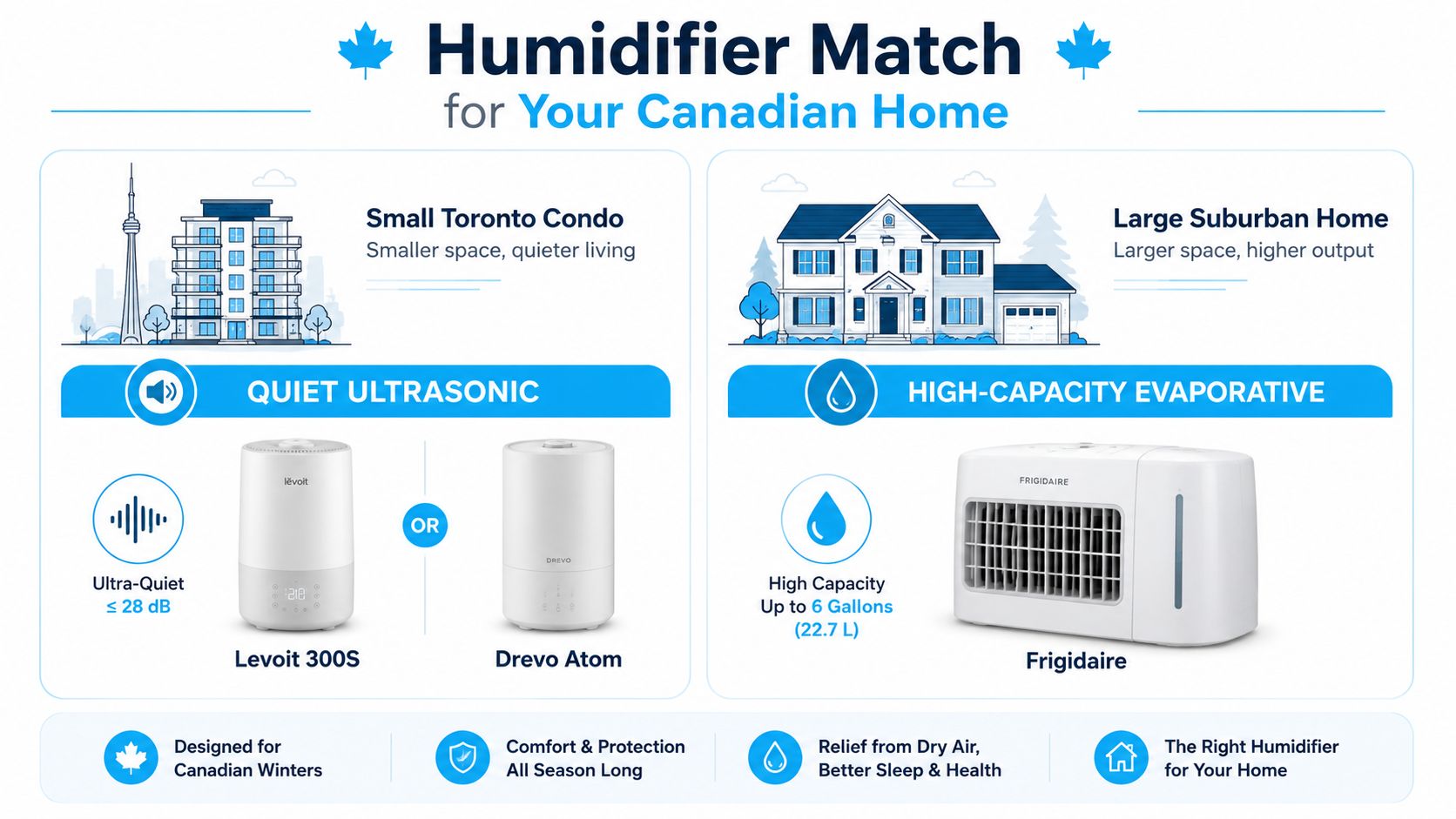
Choose a quiet ultrasonic model such as the Levoit Classic 300S or the Dreo 4L. Keep the output low, monitor humidity independently, and place the appliance where mist can disperse without landing on a wall or bedside table. The smaller the room, the less justification you have for buying a high-output machine without automatic control.
Nursery
Use cool mist, automatic shutoff, and a wide tank opening that you can clean properly. A Vicks or Crane cool-mist option can work if its controls are simple and its placement is secure. Don't use warm mist near a child who can pull, tip, or reach the unit.
Large open-concept home
A Prairie home with several connected spaces needs an evaporative console from Vornado or AIRCARE rather than a small decorative ultrasonic unit. Put it where air circulates, but don't assume a portable console will replace an HVAC-mounted system throughout the entire house.
Basement or damp-prone room
A basement isn't automatically a humidifier room. Measure first, especially during warmer weather. If humidity is already high, leave the humidifier off. A smart plug can help with scheduling, but it shouldn't replace a proper humidity sensor or safe automatic cutoff.
Allergy-sensitive household
An evaporative design is usually the cleaner fit because the wick captures minerals instead of dispersing them with the mist. No humidifier should be treated as a substitute for medical care or prescribed allergy control, and every design still needs regular cleaning.
Real Cost of Owning a Humidifier Through a Canadian Winter
The shelf price is only the opening charge. Canadian guidance highlights regular cleaning, filter changes, and suitable water as central to preventing mould, bacteria, scale, and mineral buildup. Best Buy Canada's humidifier buying guidance also points shoppers toward the maintenance and replacement-filter costs that many quick comparison charts leave out.
The ownership bill has several parts
Water can be the largest variable for ultrasonic models in hard-water areas. Distilled water reduces mineral dust, but buying and transporting it adds inconvenience. Filtered water may be a workable compromise for some households, though it doesn't eliminate the need to clean the tank.
Wicks and filters create a recurring expense for evaporative models. Check Canadian availability before purchase, not after the first replacement is due. An inexpensive unit with imported-only filters can cost more to keep running than a pricier model with local parts.
Electricity matters most with warm-mist and steam designs because they heat water. Evaporative and ultrasonic models generally make the electricity line less important than water, filters, and cleaning time, but the exact cost depends on usage and local rates.
Maintenance is the cost people skip
A humidifier that sits dirty can become unpleasant and unreliable. Regular rinsing, descaling, and drying require time, but skipping those tasks can shorten the appliance's useful life and contaminate the water path.
Ownership test: Before buying, price the replacement wick or filter, locate a Canadian seller, and inspect how easily you can reach every wet surface.
The most economical choice is often the model you'll maintain. A wide-mouth evaporative tank may beat a sealed ultrasonic unit over a full season because you can clean it quickly and use ordinary filtered water without coating the room in mineral residue.
Setup, Water Choice, and Maintenance That Actually Works
Correct placement determines whether moisture reaches the air or settles on your furniture. Put the humidifier on a stable, water-resistant surface with clear space around the mist outlet. Keep it away from electronics, books, hardwood edges, and exterior walls, and never place it where a child or pet can pull the tank down.
Start with a clean tank. Rinse away manufacturing residue, fill with the water recommended by the manufacturer, and run the unit briefly while checking for leaks. Don't point mist at a window or heat register, because rapid cooling or uneven distribution can create condensation.
Choose water for your local conditions
Use distilled water when the manufacturer requires it or when an ultrasonic unit leaves visible mineral dust. Filtered water may reduce some residue, but it doesn't make cleaning optional. Evaporative models are more tolerant of hard water because the wick captures much of the mineral load, though the wick still needs attention.
Follow a simple calendar
Every day: Empty leftover water, rinse the tank, and refill with fresh water. Don't just top up yesterday's supply.
Every week: Descale the tank and water path using the manufacturer's approved method. White vinegar is commonly used for mineral deposits, but follow the manual and never mix cleaning chemicals.
During the heating season: Inspect the wick or filter regularly. Replace it when it becomes stiff, discoloured, visibly scaled, or less effective, according to the model's instructions.
Before storage: Drain the base, wash removable parts, let everything dry completely, and store the unit open or loosely assembled so trapped moisture doesn't linger.
Keep a small checklist beside the appliance:
- Water: Empty, rinse, and refill.
- Sensor: Check the room reading with a separate hygrometer.
- Tank: Look for slime, scale, odour, and damaged seals.
- Output: Confirm that mist or evaporative airflow is still consistent.
- Surface: Check for dampness beneath and around the unit.
- Filter: Record the last replacement date.
Automatic shutoff is essential when the tank empties, but it doesn't control room humidity by itself. You need a humidistat, a reliable external hygrometer, or both if you want to stay inside the seasonal target.
Final Picks and Quick Answers for Canadian Shoppers
For most Canadian condo bedrooms, I'd buy the Levoit Classic 300S or a comparable quiet ultrasonic with a dependable humidity sensor. For a large, dry Prairie living area, choose an evaporative console such as the Honeywell HCM-350 family or AIRCARE style instead of expecting a compact bedroom unit to carry the whole space.
For a nursery, choose a cool-mist model with automatic shutoff, simple controls, and a tank you can clean fully. For the best-value route, look at a basic Honeywell Top Fill Cool Moisture model, but confirm Canadian wick availability before paying.
Quick answers
Can a humidifier help with winter nosebleeds? It can make dry indoor air more comfortable, but persistent or recurring nosebleeds need medical advice.
Is a humidifier safe around wood furniture? Yes, if you monitor humidity and keep mist from landing directly on the wood. Excess moisture and condensation create a different risk.
Can it run with a forced-air furnace? Yes. Place the portable unit away from the register and use a hygrometer to confirm that humidity is spreading rather than collecting in one area.
Is whole-home better than portable? Whole-home systems offer broader distribution and less daily refilling, but they require HVAC compatibility and professional installation. Portable units make more sense when you only need to correct one bedroom or living area.
Celmin publishes Canada-focused humidifier reviews and buying guides that compare local availability, CAD pricing, smart controls, tank design, and winter maintenance concerns. Visit Celmin to compare humidifier options and choose a model that can hold your home near the 30% to 35% winter humidity target without turning maintenance into a second job.

Discussion
Sign up or sign in to join the conversation.