
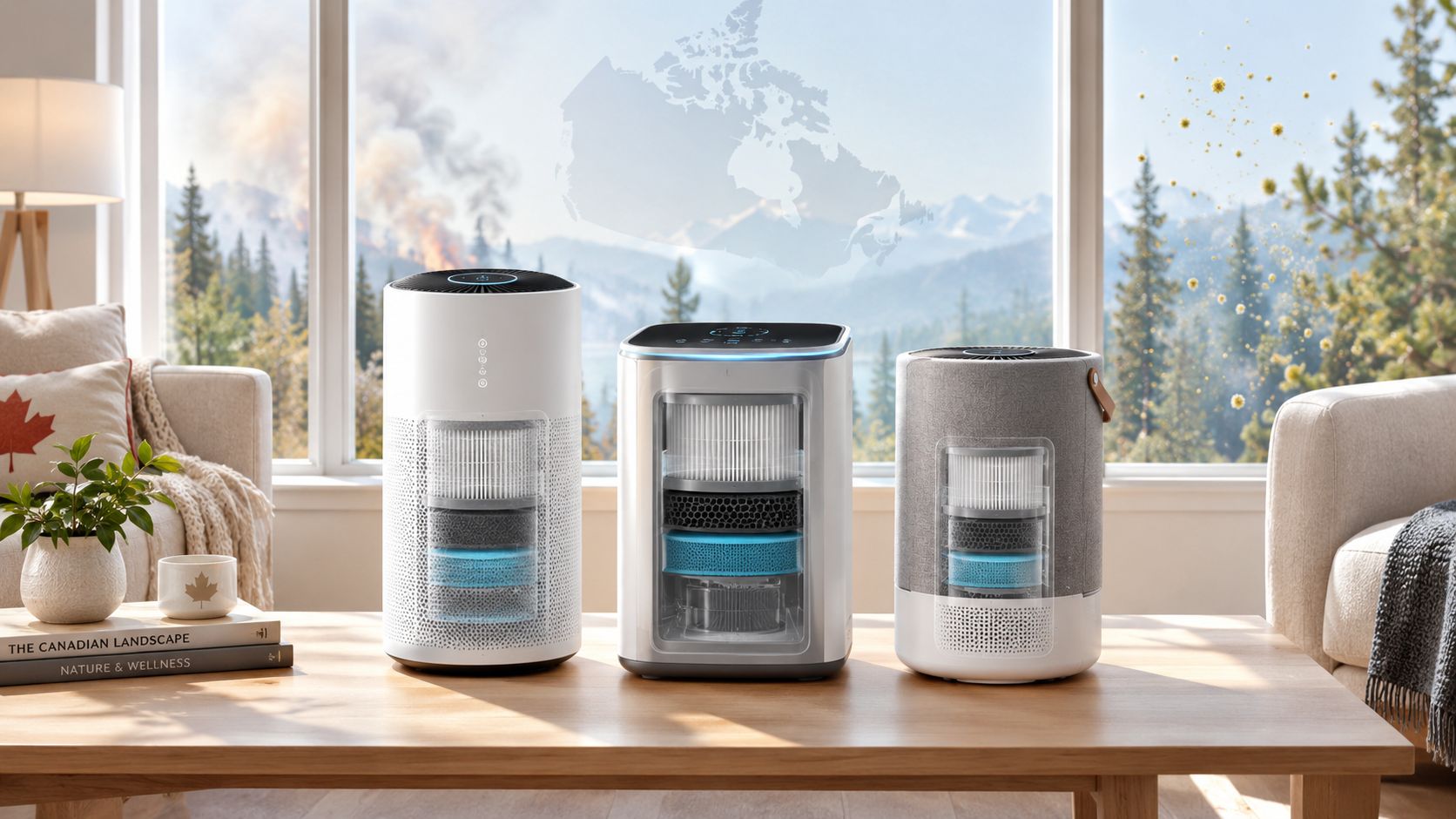
A 2025 study found that 71% of Canadian public buildings exceeded the daily PM2.5 limit of 27 μg/m³ during wildfire smoke events, even while people remained indoors, according to Canadian wildfire-smoke purifier guidance. That finding changes the buying question. The best air purifier Canada shoppers need is not solely the model with the most impressive coverage claim. It's the purifier that delivers enough smoke-cleaning airflow for the room where you sleep, work, or shelter during a smoky day, while remaining practical to run and maintain.
Table of Contents
- Introduction to Choosing the Best Air Purifier
- Understanding Air Purifier Criteria
- Canadian Air Quality Challenges
- Comparative Analysis of Top Air Purifiers in Canada
- Selecting by Room Size and Budget
- Evaluating Running Costs and Filter Availability
- Expert Recommendations and Verdict
Introduction to Choosing the Best Air Purifier
Wildfire smoke, cooking particles, dust, pet dander, and seasonal allergens place different demands on filtration in Canadian homes. Cold weather often means closed windows, yet smoke can still enter through doors, leaks, and mechanical ventilation. The relevant question is how much cleaned air reaches the occupied room under those conditions.
Room-specific performance should guide the purchase before any whole-home coverage label. Health Canada's guidance favours portable cleaners with HEPA filtration for smoke-related particles and recommends sizing by tobacco-smoke CADR. Its practical rule is that smoke CADR should reach at least two-thirds of the room's area, a point covered in Health Canada's portable air-cleaner guidance.
Wildfire smoke also reveals a running-cost trade-off. An undersized unit may need its loudest setting to provide useful cleaning, while a properly sized model can operate at a more tolerable speed. Power consumption and replacement-filter access then shape the cost of maintaining protection through repeated smoke events. A low purchase price can therefore hide higher ownership costs.
The main buying criteria are:
- Smoke CADR, the cleaned airflow delivered against fine smoke particles.
- Particle filtration, including the quality and fit of HEPA filtration.
- Carbon filtration, which targets odours and some gases rather than particles alone.
- Noise and power demand, because a switched-off purifier filters nothing.
- Filter access and availability, which affect whether continued use remains practical.
A humidifier changes moisture levels, while a purifier addresses airborne particles and some odours. This air purifier versus humidifier comparison helps match the appliance to dryness, smoke, or odour concerns.
The recommendations that follow assess measurable airflow, filtration, placement, and total ownership costs instead of relying on marketing coverage claims.
Understanding Air Purifier Criteria
A purifier is a fan that moves room air through filters. Its real performance depends on whether the fan, filter area, and controls deliver enough cleaned air for the room without creating noise or maintenance costs that discourage regular use.
Start with smoke CADR
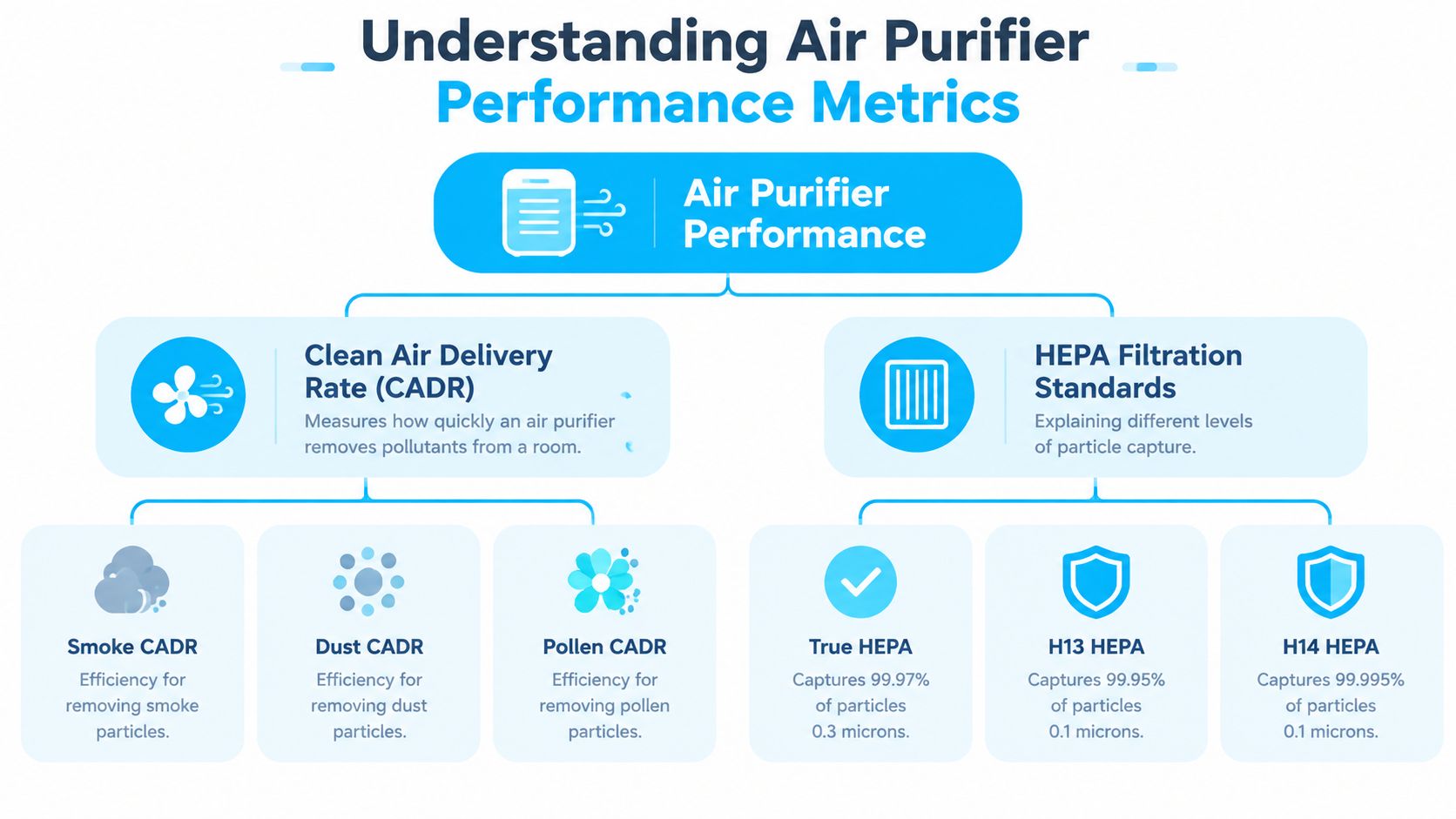
Clean Air Delivery Rate, or CADR, combines airflow with particle-removal performance. Canadian buyers may see it expressed in cubic metres per hour, or m3/h. During wildfire smoke, smoke CADR is the most useful figure because it indicates how much cleaned air the unit can deliver against fine smoke particles.
CBC Marketplace identifies a practical target of about 200 to 300 m3/h of smoke CADR for small to medium rooms. Its coverage also notes that available units commonly range from 40 to 300 CADR, and that 100 CADR suits roughly 155 sq. ft. The CBC Marketplace purifier coverage provides that comparison.
Dust and pollen CADR remain relevant for household particles and seasonal allergens. For smoke protection, however, a large general coverage figure should not replace the actual smoke CADR. A unit may advertise broad room coverage while delivering less useful airflow against smoke at a tolerable fan speed.
Separate particle and gas filtration
A True HEPA filter captures 99.97% of particles at 0.3 microns, according to Canadian wildfire-smoke guidance from IQAir Canada. HEPA filtration therefore addresses fine smoke particles, but it does not remove every odour or gas. The IQAir Canada guidance is available here.
Activated carbon targets a different part of the problem. It adsorbs some gases and odour compounds, making a purifier with a meaningful carbon stage more suitable for smoke smell than a particle-only design. Buyers should check the amount and construction of the carbon media. The word “carbon” alone does not establish strong odour performance.
Treat noise and energy as performance criteria
Noise affects whether the purifier runs long enough to matter. A loud unit may suit a short smoke spike but work poorly beside a bed or in a home office. A quieter model that operates continuously can clean more air over the day than a stronger unit used only occasionally.
Energy use also affects ownership cost. Compare wattage at the fan speed you are likely to use, not only at the lowest setting. Replacement filters add another recurring expense, and difficult-to-source filters can make continued operation impractical despite attractive initial specifications.
Practical rule: Compare smoke CADR first, then check noise, power demand, and filter cost at the setting you can realistically tolerate.
For particle-removal basics, Celmin's guide to air purifier dust removal offers a useful companion explanation. Airflow determines how much room air reaches the filter, while filter construction determines what happens to particles once they arrive. That distinction helps separate useful smoke performance from marketing coverage claims.
Canadian Air Quality Challenges
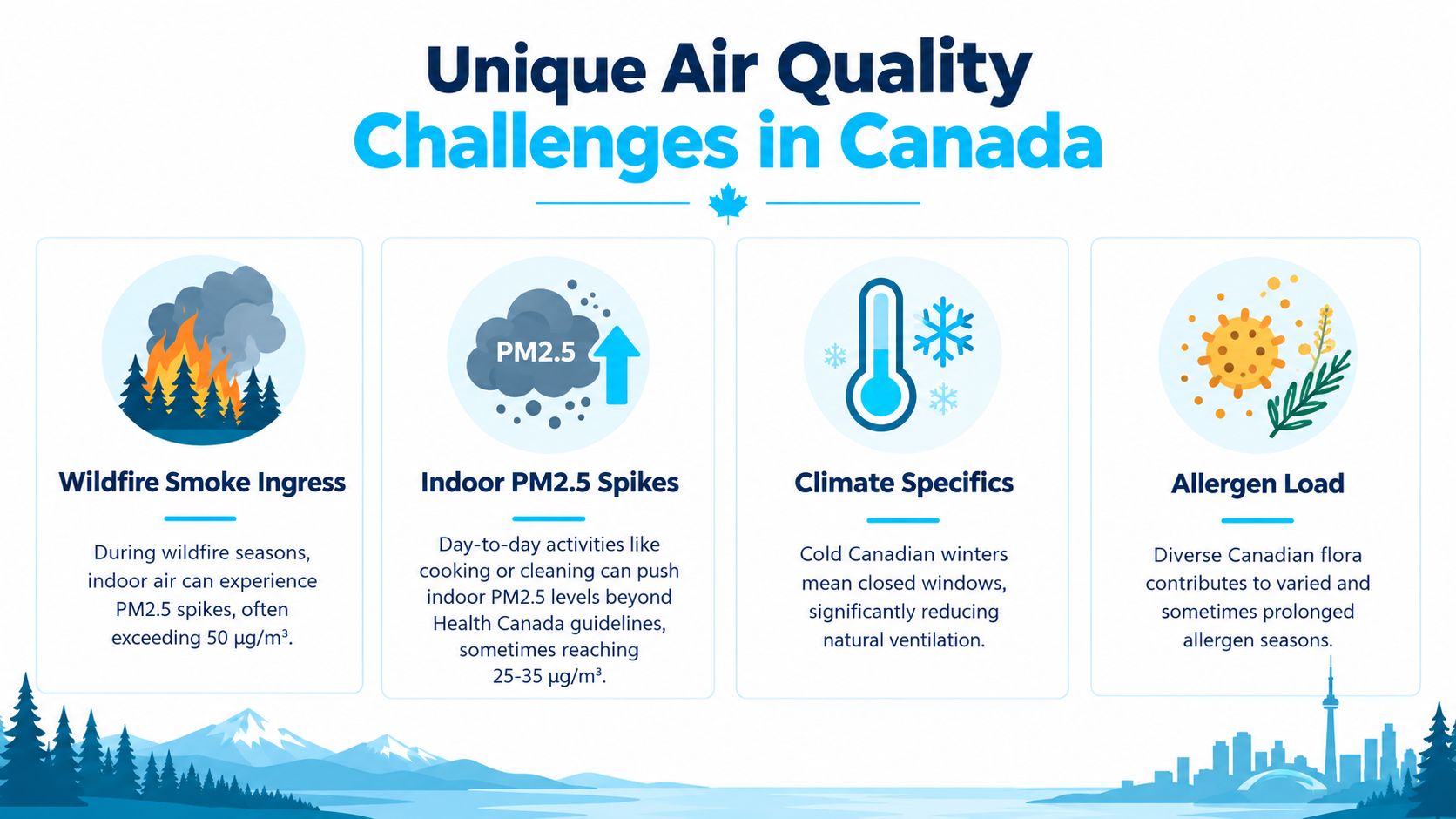
Wildfire smoke creates a different indoor-air problem from ordinary dust. During a smoke event, the outside air may carry a high particle load, and opening windows can worsen indoor conditions rather than improve ventilation. Health Canada's cleaner-air guidance recommends using a portable air cleaner in a selected room, keeping windows and doors closed, and running the unit at its highest setting when conditions demand rapid cleaning.
The public-building evidence shows why a small lifestyle purifier can be a poor choice for a smoke shelter. The 2025 Canadian study cited above found that 71% of public buildings exceeded the daily PM2.5 limit of 27 μg/m³ during wildfire smoke events. The result doesn't mean every home reaches the same concentration, but it does show that staying indoors isn't a complete protection strategy.
Why Canadian homes need targeted capacity
A condo bedroom, a detached-home living room, and an open-plan kitchen don't present the same filtration task. A purifier sized for a small enclosed room may work well when the door is closed, but its advertised coverage may become unrealistic across connected spaces, particularly when smoke continues entering from outside.
Everyday activities create their own short-lived particle sources. Cooking can produce airborne particles, cleaning can disturb settled dust, and pets can add hair, dander, and material that later becomes airborne. These sources make prefilter design and cleaning access important, but they don't replace smoke CADR during a wildfire event.
You can pair a purifier with a monitor to see whether conditions change after cooking, cleaning, or closing a room. A Canadian air-quality monitor guide can help you evaluate that complementary purchase.
Use a clean-air room strategy
Health Canada says portable cleaners can reduce PM2.5 in single rooms and recommends sizing the unit to the largest room you'll use it in. That advice supports a practical approach for renters and condo residents: choose one room where doors and windows can remain closed, place the purifier with unobstructed intake and exhaust, and use the highest fan setting when smoke is especially heavy.
The purifier isn't a substitute for reducing smoke entry. It works best as part of a controlled room strategy, with limited door opening and enough cleaning capacity to process the air repeatedly.
Comparative Analysis of Top Air Purifiers in Canada
A genuine product ranking requires product-level evidence. The supplied Canadian data establishes how to size a purifier, but it doesn't provide verified Canadian CADR, noise, price, energy, or filter-cost figures for named models. Because those figures would determine whether one product is superior to another, the table below avoids fabricated specifications and uses an evidence-status format instead.
| Model | CADR (smoke) | Filtration Tech | Noise (dB) | Annual Filter Cost (CAD) | Price (CAD) |
|---|---|---|---|---|---|
| Coway Airmega Mighty2 | Not verified in the supplied Canadian data | HEPA-based particle filtration, exact Canadian configuration to verify | Not verified | Not verified | Not verified |
| Coway Airmega Mighty | Not verified in the supplied Canadian data | HEPA-based particle filtration, exact Canadian configuration to verify | Not verified | Not verified | Not verified |
| Blueair Blue Pure 211i Max | Not verified in the supplied Canadian data | Particle filtration, exact Canadian configuration to verify | Not verified | Not verified | Not verified |
| Blueair Blue Pure 511 | Not verified in the supplied Canadian data | Particle filtration, exact Canadian configuration to verify | Not verified | Not verified | Not verified |
| Oransi Airmend Small Room | Not verified in the supplied Canadian data | HEPA-based particle filtration, exact Canadian configuration to verify | Not verified | Not verified | Not verified |
| Austin Air HealthMate HM400 | Not verified in the supplied Canadian data | HEPA and substantial gas-filtration design, exact Canadian configuration to verify | Not verified | Not verified | Not verified |
Coway Airmega Mighty2
The Mighty2 is a credible candidate for a medium-room shortlist because independent testing in the supplied background research describes strong smoke reduction, quiet operation at a lower fan setting, and relatively modest power demand compared with its predecessor. Those findings are useful for judging design priorities, but they aren't Canadian retail specifications and shouldn't be converted into a Canadian price or CADR claim.
For a Canadian purchase, verify the model number, local warranty, smoke CADR, replacement-filter listing, and whether the carbon component is included in the same configuration. A product that performs well in testing still needs a filter supply that suits Canadian wildfire use.
Coway Airmega Mighty
The original Mighty remains relevant when buyers value a proven compact format and straightforward controls. The background testing describes it as durable and effective over extended use, but the same material also reports higher maximum power draw than the Mighty2.
That creates a clear trade-off. If the older unit costs less locally, the purchase may make sense, but compare the actual Canadian price difference with the long-term electricity and filter situation. Don't assume an older model is a bargain because its upfront price has fallen.
Blueair Blue Pure 211i Max
A large-room purifier should be considered when the clean-air room is a living room, a larger bedroom, or an open area. The background research identifies the 211i Max as a powerful and efficient large-space option, with a shorter filter replacement cycle than some competing designs.
That shorter cycle is precisely why Canadian buyers should inspect filter pricing before buying. A high-capacity unit can clean a larger room effectively, but its total ownership cost depends on how often its filter needs replacement and whether Canadian stock remains consistent.
Blueair Blue Pure 511
The 511 is best treated as a small-room candidate, not a whole-home solution. Its compact size and low operating demand described in the background research make it appealing for bedrooms, offices, or other enclosed spaces.
Its limitation is capacity. If the room's calculated smoke-CADR requirement exceeds what the model can deliver, low energy use and compact dimensions won't compensate for under-sizing.
Oransi Airmend Small Room
The Oransi option suits buyers who value a compact, durable form and accessible controls. The background research describes a thick HEPA filter and flexible placement, including desk or wall use, but it also notes that higher fan speeds aren't the quietest.
That makes placement important. A workshop or utility space may tolerate more fan noise than a bedroom, while a smoke shelter needs enough capacity at a setting occupants will use.
Austin Air HealthMate HM400
The HealthMate HM400 belongs in a different category because its design places substantial emphasis on gaseous pollutants and odours through activated carbon and mineral media, alongside particle filtration. That can appeal to buyers concerned about smoke smell or indoor gases.
The trade-off is bulk, noise, energy demand, and replacement-filter expense, all identified qualitatively in the background research. It shouldn't be selected solely because it has more filtration material. Confirm the Canadian configuration and ongoing supply before treating it as a long-term solution.
Selecting by Room Size and Budget
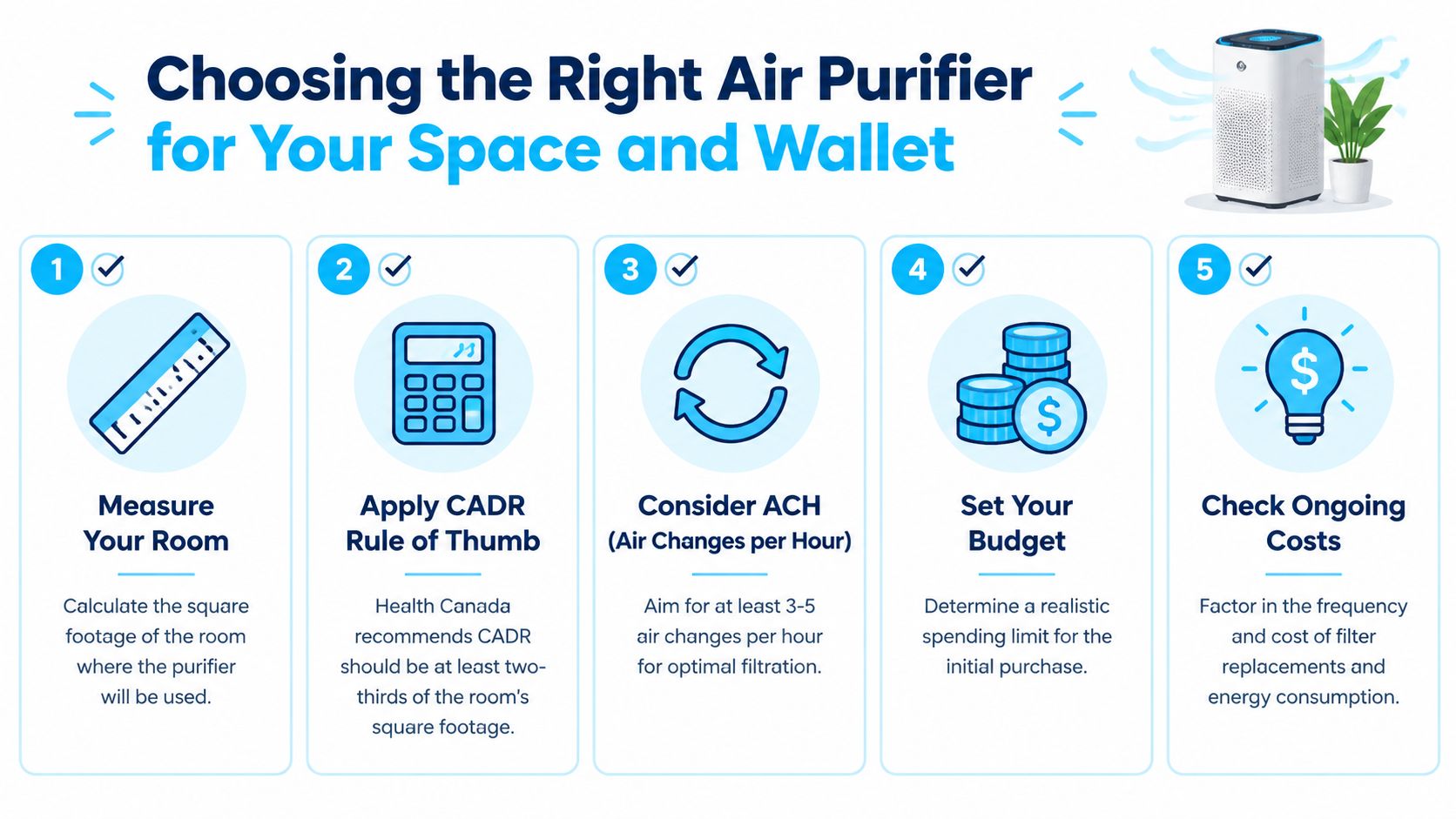
Room area should determine the purifier before brand or appearance enters the comparison. For wildfire smoke, Health Canada's practical rule is a smoke CADR of at least two-thirds of the room's area. Size the unit for the largest room where people will shelter, not for a smaller room that is easier to serve. The Health Canada cleaner-air-space guidance also recommends closing windows and doors, then using the highest setting when faster air cleaning is needed.
Measure the actual room
Start with the room's measured length and width. Manufacturer coverage labels often assume favourable conditions and may not reflect the CADR available at a tolerable noise level.
| Room area | Practical minimum smoke CADR |
|---|---|
| 120 sq. ft. | 80 |
| 150 sq. ft. | About 100 |
| 300 sq. ft. | About 200 |
These examples apply the two-thirds approach. The federal purifier-selection page gives a 120 sq. ft. room a minimum smoke CADR of 80. The same approach produces roughly 100 CADR for a 150 sq. ft. bedroom and about 200 CADR for a 300 sq. ft. room.
Match the unit to the room you'll close
A bedroom needs enough smoke CADR, a dimmable display, and noise that occupants can tolerate overnight. The Blueair Blue Pure 511 may fit a small room, while a Coway Mighty-class unit is more suitable when the calculated requirement calls for greater airflow.
Living rooms generally need more capacity because doors open more often and occupants spend longer periods there. The Blueair Blue Pure 211i Max is a large-room candidate, but its Canadian smoke CADR and price should be compared with the calculated requirement, rather than accepted from a generic coverage label.
Home offices create a different trade-off. Keep the intake clear of desks, curtains, and walls, then compare the purifier's quiet-mode output with the CADR available at that setting. A unit that meets the target only at maximum speed may be difficult to use throughout a workday.
Set the budget beyond the checkout price
Evaluate three questions:
- Can the unit meet the room's smoke-CADR requirement? If not, the lower purchase price does not solve the air-cleaning problem.
- Can you find replacement filters in Canada? A purifier without accessible filters has a limited useful life.
- Can you afford to run it during a smoke event? Energy use changes with fan speed, and severe outdoor smoke may require high-speed operation.
Oversizing can reduce practical running costs when the larger unit meets the target at a lower setting. It may also reduce noise during extended use. Under-sizing offers less flexibility. Running a small purifier longer cannot create the cleaned airflow required for a larger room.
Room-first decision: Measure the room, calculate the smoke CADR, and then compare models. Starting with a brand reverses the order that determines performance.
Evaluating Running Costs and Filter Availability
The purchase price is only one part of purifier ownership. The recurring costs come from electricity, replacement filters, and the practical effort of keeping the prefilter clear. A unit that looks affordable at checkout can become inconvenient if its replacement filter is difficult to locate or if smoke exposure shortens the useful interval.
Filter availability deserves a Canadian-specific check. Search for the exact model number and confirm that the replacement filter is sold through a Canadian retailer or the manufacturer's Canadian channel. Don't assume a similarly named filter fits, especially when a product has regional versions or multiple filter packages.
Read the filter construction carefully
A prefilter catches larger debris such as hair and dust before it reaches the main filter. Cleaning it helps preserve airflow, which matters because a clogged prefilter can reduce the amount of room air reaching the HEPA stage.
The main HEPA filter targets particles. Carbon adds a different function, helping with smoke odours and some gases. If odour control matters, inspect whether the purifier uses a substantial carbon stage or only a thin carbon layer, but avoid assigning performance numbers that the manufacturer hasn't verified for the Canadian model.
Compare cost at realistic settings
Electricity consumption depends on fan speed and usage time. During an intense smoke event, Health Canada advises running the cleaner at its highest setting, so the maximum-wattage figure isn't irrelevant even if everyday operation uses a quieter mode.
Create a simple ownership worksheet before buying:
- Filter price: Record the Canadian replacement price for the exact model.
- Replacement timing: Use the manufacturer's stated interval, then allow for heavier smoke exposure and household dust.
- Operating pattern: Compare continuous low or medium use with periodic high-speed cleaning.
- Availability risk: Check whether the filter is currently stocked and whether more than one Canadian source carries it.
A product with a lower filter price isn't automatically cheaper if it requires more frequent replacement. Conversely, a higher-priced filter may be reasonable if the unit delivers the capacity your room needs and remains available when wildfire smoke arrives.
The most defensible comparison uses verified Canadian retailer listings and manufacturer documentation. Where those figures aren't available, present the cost as unknown rather than filling the gap with a guessed annual estimate.
Expert Recommendations and Verdict
The best air purifier Canada choice depends first on the room and the smoke CADR it requires. For a small, enclosed bedroom or office, investigate compact models such as the Blueair Blue Pure 511, but only if its verified Canadian smoke CADR meets the room calculation.
For a medium room, the Coway Airmega Mighty2 is a strong candidate to investigate because the supplied independent background research describes effective smoke cleaning, quiet lower-speed operation, and efficient everyday use. Confirm Canadian specifications, warranty coverage, filter stock, and local pricing before purchase.
For larger rooms, the Blueair Blue Pure 211i Max deserves attention because the background testing identifies it as a high-capacity option. Its filter cycle and Canadian replacement cost need careful review, particularly for households expecting heavy wildfire-smoke use.
For odour and gas concerns, consider a design such as the Austin Air HealthMate HM400, but accept the likely trade-offs in size, noise, energy demand, and filter expense. It isn't the default answer for every bedroom or condo.
Place the purifier in the room you can keep closed, leave adequate space around its intake and exhaust, and use the highest setting when smoke conditions require rapid cleaning. Keep the prefilter clear and schedule filter checks so maintenance doesn't become an emergency during the next smoke event.
Celmin publishes Canadian-focused air-quality guides and comparisons that help shoppers evaluate room coverage, CADR, noise, filter replacement, and local availability. Visit Celmin to compare practical home-air solutions before choosing the purifier that fits your room and Canadian buying conditions.

Discussion
Sign up or sign in to join the conversation.