
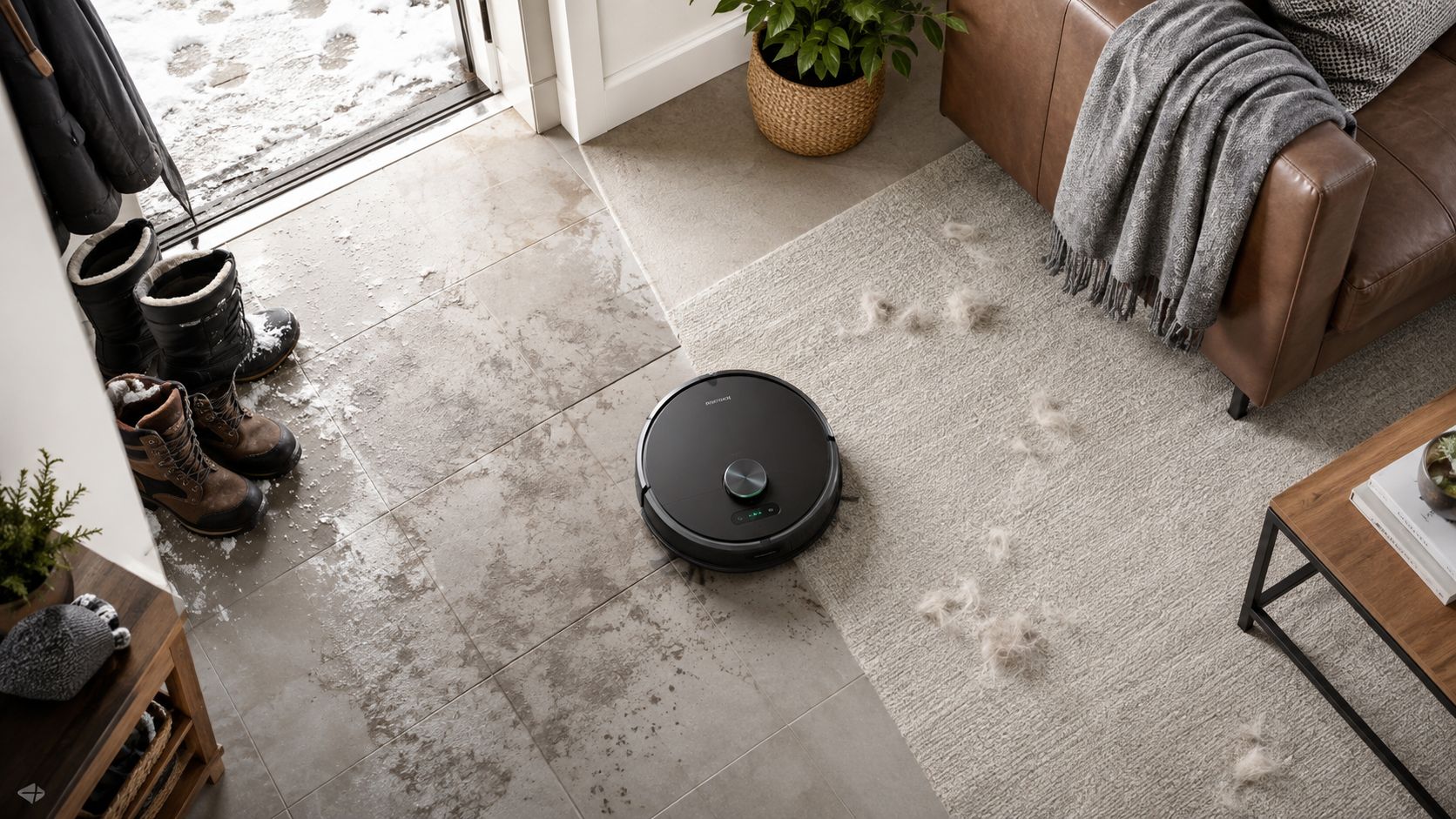
You've just come home to another February thaw. The entry mat is white with salt, the dog has tracked grit across the hallway, and the crumbs under the kitchen table have somehow multiplied. A robot vacuum starts to look less like a gadget and more like a reasonable way to stop cleaning the same floor every day.
Then the price comparison begins. A budget model costs less than a premium one, but will it get trapped in a narrow Toronto hallway? Is a self-emptying dock excessive for a small condo? Can any robot deal with pet hair, winter sand, wet boot prints, and the occasional toy left in its path?
Are robot vacuums worth it in Canada? Usually, yes, but only when the machine matches the floor plan and the owner accepts that it still needs care. I've found that these devices are excellent maintenance cleaners, especially in single-floor homes, but they don't replace a proper vacuum, a mop, or seasonal deep cleaning. The useful question isn't whether a robot can clean. It's whether it can clean often enough, with little enough supervision, to justify its purchase and upkeep.
Table of Contents
- The Robot Vacuum Decision Most Canadian Shoppers Are Actually Facing
- How a Robot Vacuum Actually Works Behind the Sensors
- Condos, Houses, and Multi-Storey Homes
- What You Really Get at Each Price Point in Canada
- Winter Salt, Pet Hair, and the Canadian Mess Test
- Maintenance, Noise, and the Hidden Ongoing Cost
- Who Should Buy, Who Should Wait, and Who Should Skip
- The Honest Verdict on Whether a Robot Vacuum Pays Off
The Robot Vacuum Decision Most Canadian Shoppers Are Actually Facing
The category has moved well beyond novelty. Canada's robotic vacuum cleaner market was estimated at US$133.4 million in 2021 and is projected to reach US$827.1 million by 2030, representing a projected 22.5% CAGR from 2022 to 2030, according to Canada's robotic vacuum market outlook. That doesn't prove every household needs one, but it does show that Canadian shoppers increasingly see automated floor care as a practical purchase.
The hesitation remains sensible. A robot has to work around furniture, doorway transitions, area rugs, charging cables, pet bowls, and clutter. In a condo, the machine may have a simple open route through the kitchen and living room. In a detached house, it may face several rooms, thicker rugs, thresholds, and stairs that it can't climb.
My short answer: A robot vacuum is worth buying when it runs frequently enough to prevent mess from building up. It isn't worth buying if you expect one machine to replace every other form of floor care.
Market data gives Canadian buyers another useful signal. A Canada-focused report estimated household adoption at about 15 to 20%, with demand concentrated in urban and suburban single-family homes. Entry-level models priced below C$200 led unit volume, while premium hybrid models with vacuuming, mopping, and LiDAR or vSLAM navigation represented about 50 to 60% of market value, according to the Canada robot vacuum market report.
That split matches what I see in real homes. Cheap machines can handle obvious crumbs on uncomplicated floors. Better models earn their price through mapping, obstacle avoidance, stronger carpet performance, and less daily intervention. The right purchase depends less on chasing the newest feature than on deciding how much cleaning supervision you're willing to provide.
How a Robot Vacuum Actually Works Behind the Sensors
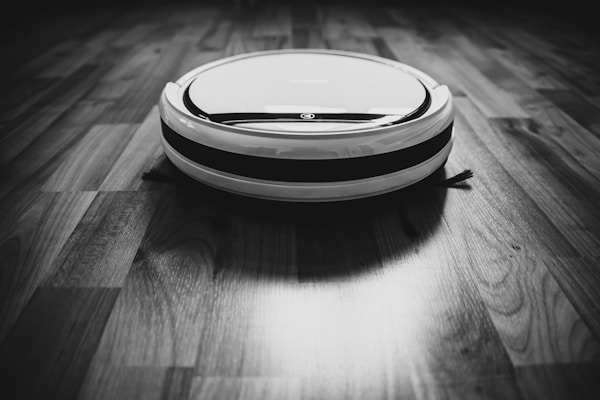
A basic robot vacuum moves like someone feeling around a dark room. It moves forward, bumps into an object, changes direction, and repeats the process. This bump-and-go navigation can collect debris, but it may clean the same patch repeatedly while missing another area entirely.
LiDAR works more like a careful walker who has measured the room before starting. A rotating laser sensor measures distances to walls and furniture, then builds a map that the app can use for room selection, schedules, and no-go zones. vSLAM uses cameras and visual landmarks instead. It watches features such as furniture edges and ceiling details, then estimates where the robot is within the home.
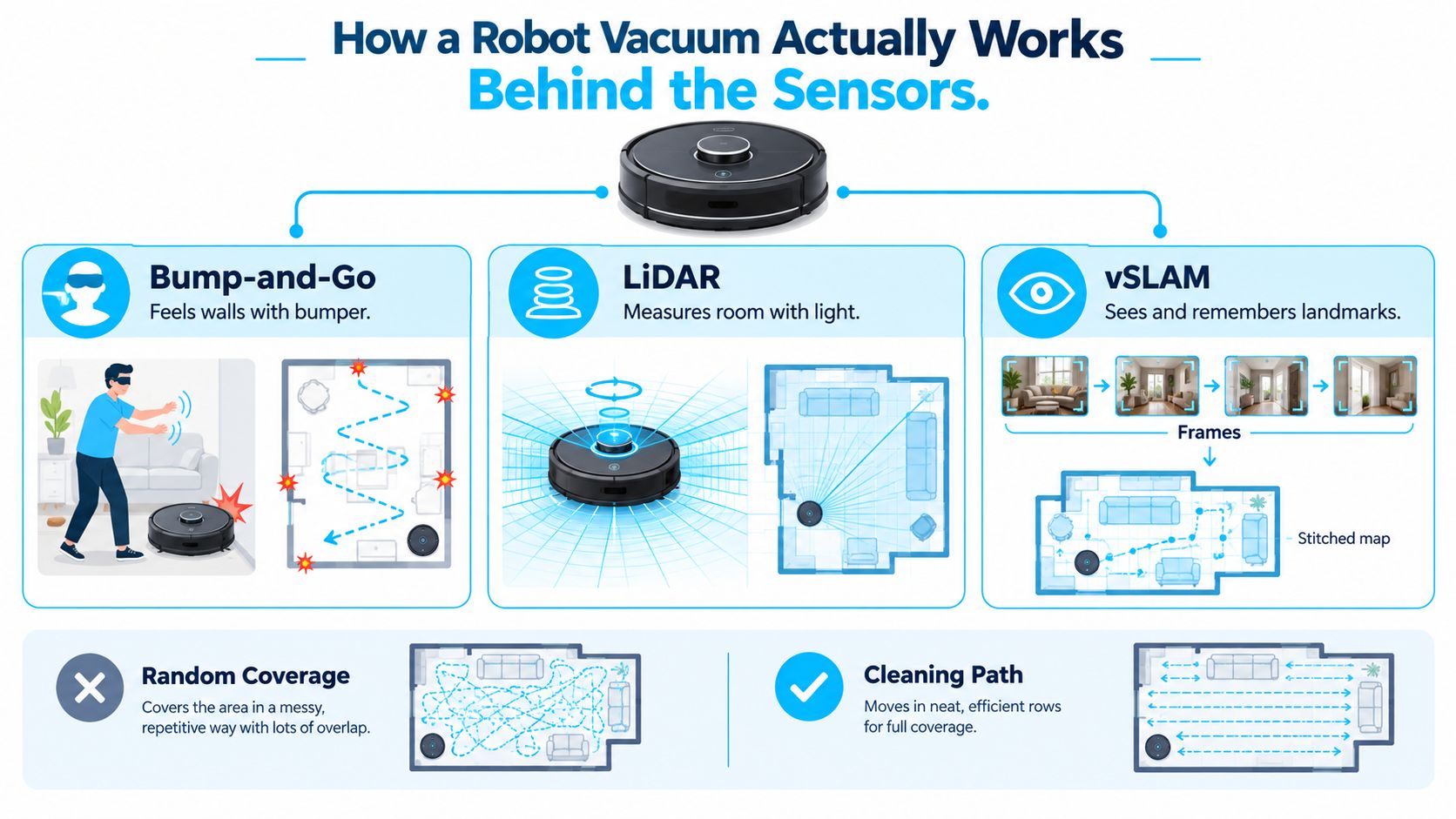
Suction is only part of cleaning performance
Suction specifications can distract buyers. A robot's airflow matters, but so do the main brush, side brush, intake design, floor seal, and carpet-boost behaviour. A small handheld vacuum and a full-size upright may both advertise strong suction, yet their cleaning results differ because their brushes and air paths do different work.
On carpet, brush design often matters more than a large Pascal number printed on a product page. Rubber rollers can reduce hair wrapping, while a poorly designed bristle brush may require frequent cutting and pulling, especially in homes with long-haired pets.
The dock also changes the ownership experience. A basic dock charges the robot. A more advanced base may empty the dustbin, wash mop pads, refill water, and dry those pads. Cliff sensors help prevent falls on stairs, while app-based maps let you block off a pet bowl or a cluttered corner.
Obstacle avoidance has improved as well. Higher-end machines may identify socks, cables, shoes, and pet waste, although no sensor system should be trusted blindly around a messy floor. Pick up cords and toys before a run, and never assume a robot can safely handle an accident from a pet.
A robot vacuum is best understood as a maintenance cleaner. It keeps surface debris under control between proper cleaning sessions. It won't remove embedded dirt from grout, replace manual edge work, or make thick carpet look freshly groomed after a neglected season.
Condos, Houses, and Multi-Storey Homes
Floor area tells only part of the story. A compact condo with several rooms and awkward thresholds can be harder for a robot than a larger open-plan bungalow.
| Layout Type | Typical Floor Plan | Robot Vacuum Fit | Biggest Limitation |
|---|---|---|---|
| Single-floor condo | Open living space, kitchen, hallway, limited transitions | Strong fit for scheduled maintenance | Clutter, narrow clearances, and shared-wall noise |
| Detached bungalow | Several rooms, rugs, mixed flooring | Good fit with accurate mapping | Door thresholds and carpet transitions |
| Multi-storey house | Separate levels connected by stairs | Partial fit unless each floor is handled separately | The robot can't carry itself upstairs |
| Older split-level home | Short stair runs, divided rooms, uneven transitions | Variable fit | Entryway steps and tight passages |
A condo usually gives a mid-range robot a straightforward job. Hard flooring, accessible furniture, and a compact route let the machine cover the main living areas without much supervision. Older Toronto and Montreal homes can introduce narrow hallways, radiators, and raised thresholds that trap less capable models.
Detached houses reward navigation quality. The machine needs to remember rooms, return to the dock, cross transitions, and avoid spending its battery repeatedly searching for a route. Open-concept prairie layouts are often easier than a smaller home divided into many rooms because the robot can maintain a predictable cleaning path.
Stairs create the largest value penalty. Most robots won't climb them, so the owner has to move the machine, purchase another unit, or leave some floors untouched. A robot that cleans the main level every day may still be worthwhile, but don't mistake whole-home automation for floor-by-floor coverage.
Practical rule: Count doorways, thresholds, rugs, and staircases before you count square metres.
Renters should also consider how much control they have over furniture and layout changes. The smart home guide for renters is useful for thinking through device placement and setup constraints in apartments where permanent modifications aren't practical.
What You Really Get at Each Price Point in Canada
Canadian pricing shifts with sales, bundles, retailer stock, and warranty terms, so use tiers as buying boundaries rather than permanent price labels. Current market reporting places average Canadian retail pricing in 2026 at about C$180 to C$250, compared with roughly C$150 to C$180 five years earlier, while Canada imports approximately 95 to 98% of vacuums and floor-care products, according to the Canadian robot vacuum and floor-care market analysis.
| Tier | Price Range (CAD) | Navigation | Suction and Cleaning | Maintenance Load | Best For |
|---|---|---|---|---|---|
| Budget | Under C$400 | Often basic or less precise mapping | Adequate for loose debris on hard floors | Frequent bin and brush attention | Small, tidy condos |
| Mid-range | C$400 to C$900 | LiDAR or vSLAM on many models | Better carpet handling, room mapping, scheduled zones, light mopping | Manageable, but still hands-on | Most single-floor homes |
| Premium | C$900 and above | Advanced mapping and obstacle avoidance | Stronger cleaning systems, hybrid functions, automated dock care | Lower daily effort, higher parts cost | Pet homes and busy households |
Budget models
A low-cost robot can make sense on laminate or relatively clear tile. Expect a smaller bin, less dependable route planning, and more intervention when the floor contains cables, chair legs, or uneven mats. These machines suit someone who wants basic crumb control and doesn't mind preparing the room.
I wouldn't choose this tier for a pet-heavy house, thick rugs, or a multi-room layout with many transitions. The purchase price may be attractive, but getting the robot unstuck repeatedly defeats the purpose.
Mid-range models
This is the sensible starting point for most Canadian buyers. LiDAR or vSLAM mapping, room selection, stronger carpet behaviour, and scheduled cleaning change the daily experience more than a flashy app feature does. A mid-range machine can maintain condo floors, handle a bungalow's main level, and vacuum before dust becomes visible.
The mop function is usually best for light surface maintenance. It won't scrub dried spills or replace a proper floor wash.
Premium models
Premium machines justify themselves through reduced supervision. Self-emptying docks, better object recognition, automatic mop washing, and drying can matter in homes with pets or frequent debris. Consumer Reports' 2026 testing lists the Roborock S8 MaxV Ultra at 95/100 for carpet, 97/100 for hard floors, and 67 dB, while the iRobot Roomba j7+ scores 88/100 on carpet, 92/100 on hard floors, and 62 dB, as summarised in Consumer Reports' robot vacuum testing coverage.
Spending more doesn't eliminate hair tangles, dirty sensors, or bad room preparation. Use Celmin's robot vacuum and mop guide to compare navigation, dock functions, mopping, and local pricing before paying for features your floors won't use.
Winter Salt, Pet Hair, and the Canadian Mess Test
Canadian winter is where optimistic first-month reviews fall apart. A robot may look impressive on clean laminate in November, then face calcium chloride residue, wet boot prints, sand clumps, and damp entry mats after the first serious thaw.
Salt and grit need reliable pickup, but mopping requires judgement. A wet mop pad can spread a gritty slurry across tile or hardwood instead of removing it. Keep the robot away from freshly tracked slush, wipe up heavy moisture manually, and use the machine after the floor has dried. It's excellent at the residue left behind later, not at cleaning a mudroom immediately after a wet dog walk.
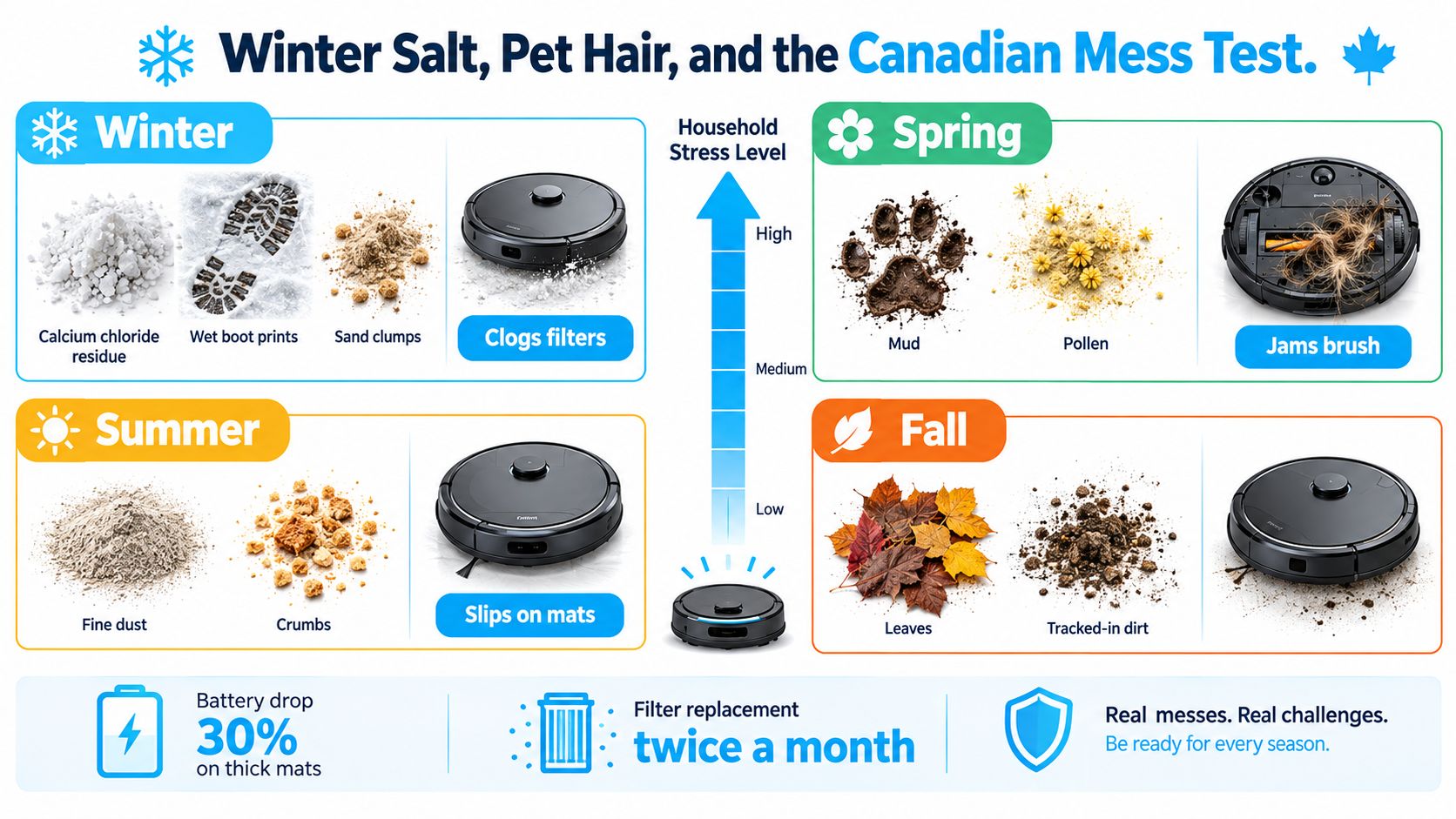
Seasonal mess changes the maintenance routine
Spring brings road dust, mud, and pollen through open doors. Fine particles load filters quickly, so allergy-sensitive households need to inspect filters rather than relying on an app reminder. Summer adds crumbs, dry dust, and outdoor grit. Fall brings leaves and tracked-in dirt that can fill a smaller dustbin quickly.
Pets create a steadier challenge. Fur wraps around rollers, kibble gathers under furniture, and litter finds its way beyond the mat. Rubber extractors and anti-tangle designs help, but they don't make brush checks unnecessary.
The machine's best role is consistency. A daily or frequent run can stop fur and grit from accumulating, even though it won't deal gracefully with every muddy paw or damp clump.
Winter rule: Let the robot manage dry residue after the entryway settles. Don't send it into wet slush and expect the mop system to do a manual cleaner's job.
Homes with heavy shedding need a brush design that can be cleaned quickly, strong carpet boost, and filtration that doesn't become an afterthought. For feature comparisons aimed at fur and dander, see Celmin's pet-hair vacuum guide. The purchase is worthwhile when the robot reduces daily fur patrols, not when it promises to eliminate every manual task.
Maintenance, Noise, and the Hidden Ongoing Cost
The ownership burden is where many robot vacuum reviews become too generous. A robot that runs frequently collects the dirt you would otherwise collect yourself, so someone still has to empty, inspect, wash, wipe, and replace parts.
A small dustbin may need regular emptying in a pet home. A self-emptying dock reduces that chore, but it adds dust bags, a larger footprint, and more parts to maintain. Long hair can wrap around the roller, side brush, and wheel axles, so a weekly check is realistic for many households. Mop pads need washing and drying after use, especially if they've picked up food residue or winter grime.
The recurring work that matters
- Brush care: Remove wrapped hair before it hardens around the roller ends.
- Filter care: Tap out dust carefully and replace the filter when airflow falls or the material remains loaded.
- Sensor care: Wipe navigation and cliff sensors so the robot doesn't misread walls, stairs, or obstacles.
- Mop care: Wash pads promptly and let them dry fully to avoid stale odours.
- Dock care: Clean the dust path, water areas, and seals rather than treating the base as maintenance-free.
I wouldn't trust precise annual upkeep budgets without a specific model, pet load, cleaning frequency, and replacement schedule. Proprietary bags and filters can make a premium machine more expensive to own, while a widely sold budget model may have cheaper parts but demand more hands-on work.
Noise matters in condos and home offices. A robot running at full power can interrupt calls, disturb a quiet evening, or annoy a nearby neighbour through a shared floor. The Consumer Reports results cited earlier place the Roborock S8 MaxV Ultra at 67 dB and the Roomba j7+ at 62 dB, so acoustic performance varies by model and cleaning mode.
Apps create another form of upkeep. Wi-Fi changes, firmware errors, cloud-dependent maps, and failed room labels can turn a scheduled cleaner into a device you have to troubleshoot. A robot saves time only when the software remains dependable after the novelty wears off.
Who Should Buy, Who Should Wait, and Who Should Skip
The best buyer is someone who wants floors maintained often and has a layout the robot can understand. The worst buyer expects a small appliance to perform a complete deep clean without preparation or maintenance.
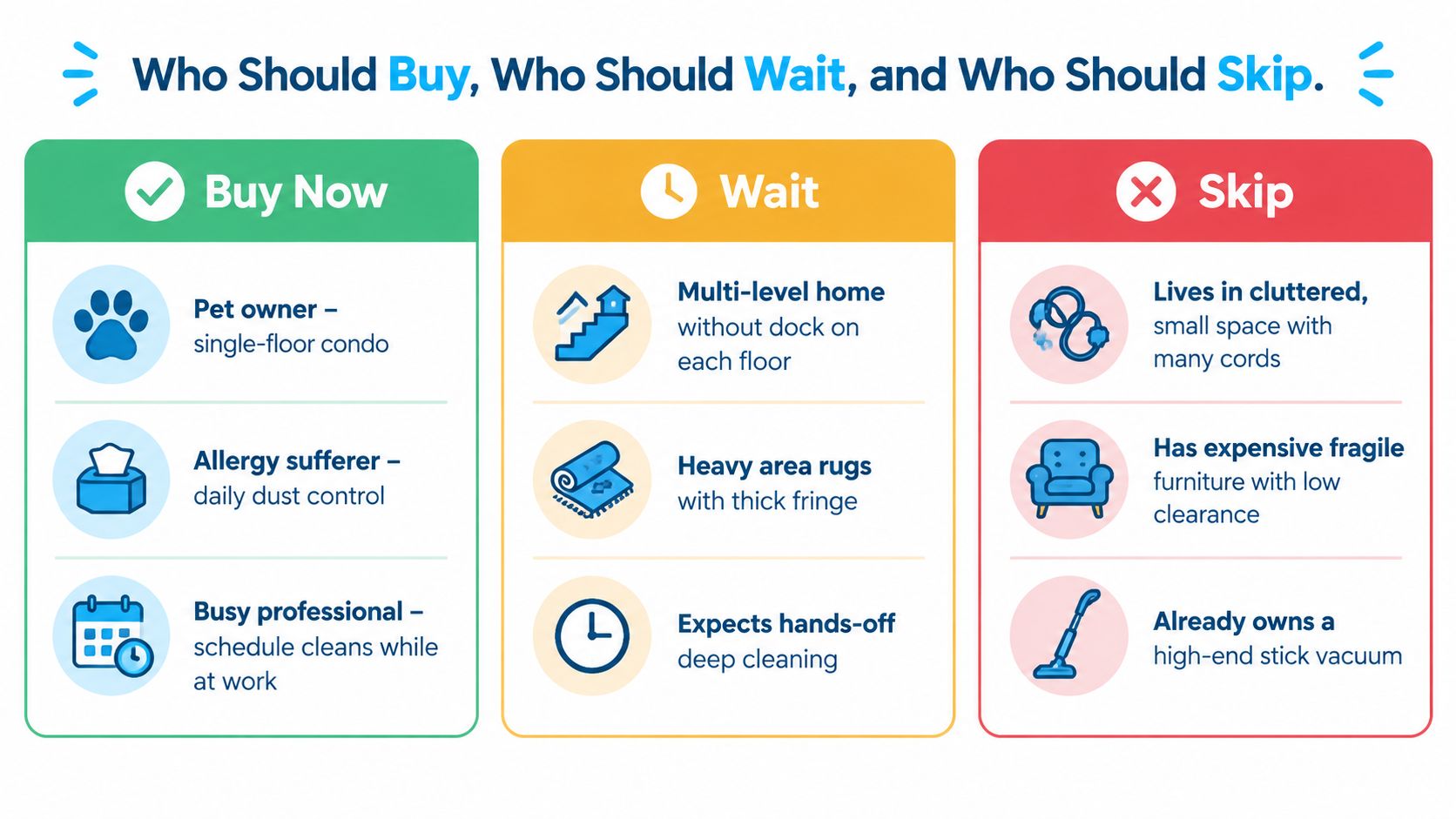
Buy now
Buy now if you have a pet, a single-floor condo, bungalow, or similarly accessible layout. Daily fur, litter, crumbs, and dust are exactly the kind of surface mess a robot handles well. Allergy-sensitive households can also benefit from more frequent floor pickup, provided someone keeps the filter and brush system clean.
Busy professionals and parents of toddlers are strong candidates too. Scheduling a run while the home is empty can reduce the need to grab a stick vacuum for every small spill of dry debris.
Wait and save for the right model
Wait if your home has several levels, thick area rugs, frequent furniture changes, or unreliable Wi-Fi. You may need better mapping, stronger carpet performance, or a second cleaning plan for rooms the robot can't reach.
I'd also wait if you're tempted by a model below C$400 but need dependable multi-room navigation, pet-hair handling, or low supervision. Buying the cheapest device, abandoning it after repeated failures, and later purchasing a better one costs more than choosing the right capability first.
Skip it
Skip a robot if your studio is so small that manual vacuuming takes only a few minutes and setup would create more work than it removes. Skip it if your home is dominated by thick high-pile carpet, stairs, clutter, low-clearance furniture, or fragile objects that require constant floor preparation.
A corded vacuum may be the better purchase for someone who already owns an effective stick vacuum and wants deep cleaning rather than daily automation. Robots also disappoint buyers who expect them to scrub grout, clean stairs, remove embedded carpet soil, and respond safely to every wet or sticky mess.
The Honest Verdict on Whether a Robot Vacuum Pays Off
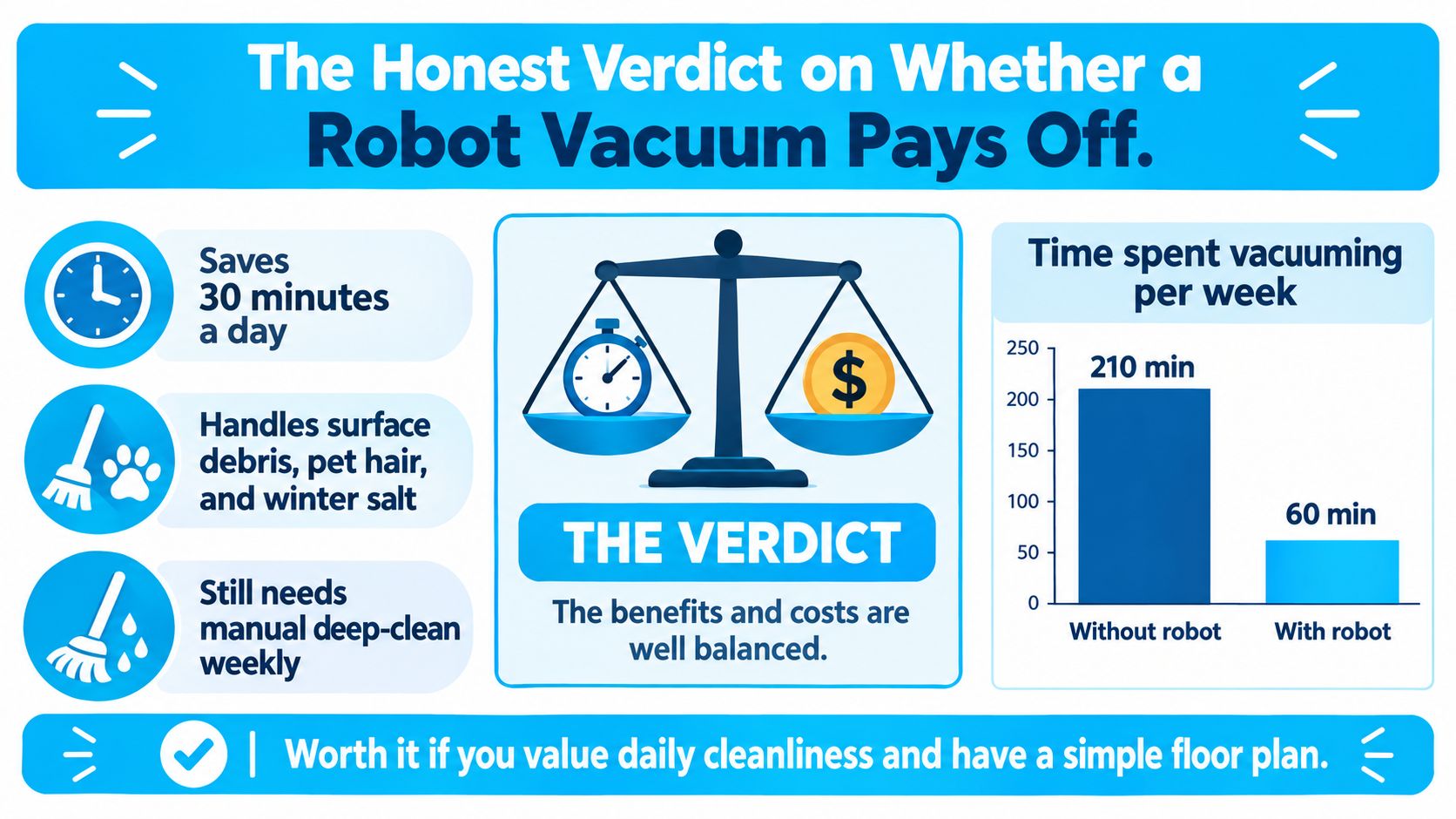
Robot vacuums are worth it when you measure value in repeated small chores, not one dramatic cleaning performance. They can keep dry salt residue, pet hair, crumbs, and everyday dust from accumulating. They're less convincing for deep carpet work, grout, stairs, sticky spills, and homes where every floor requires a separate manual setup.
The market's growth supports the idea that Canadian households are treating these machines as practical time-saving appliances rather than novelty products. Still, adoption doesn't make every model a good buy. The useful calculation remains personal:
Value = cleaning time you avoid, minus ownership effort and running costs.
Start with your actual floor plan. A single-floor condo with hard flooring and a pet gives a robot a clear daily job. A detached house with several rooms can still benefit, but only if the robot can cross its transitions and you're comfortable handling areas outside its reach. A multi-storey home needs an honest plan for stairs before you spend anything.
Think about winter as well. The machine may save repeated passes over dry grit after snow season, but it won't replace a mop after wet slush. Pet hair may justify a stronger brush system and a self-emptying dock, yet those features don't eliminate brush inspections.
The best recommendation for most urban Canadian households is a well-mapped mid-range model with reliable room control, useful obstacle avoidance, and replacement parts that are easy to find. Premium systems make sense for heavy shedding, frequent cleaning, or owners who value reduced dock and mop intervention. Budget models remain reasonable for tidy, compact spaces, but they demand more patience.
A robot vacuum pays off when you'll run it regularly and maintain it consistently. If you won't clear cables, clean the roller, wash the pad, or rescue a stuck machine, buy a conventional vacuum instead. The floor plan, pet situation, and tolerance for upkeep matter more than the badge on the lid.
Celmin offers Canadian buying guides, comparisons, and practical smart-home advice that help you evaluate robot vacuums by navigation, suction, mopping, maintenance, and local availability. Visit Celmin with your floor plan and cleaning priorities in mind before choosing the model that will handle your home year-round.


Discussion
Sign up or sign in to join the conversation.