
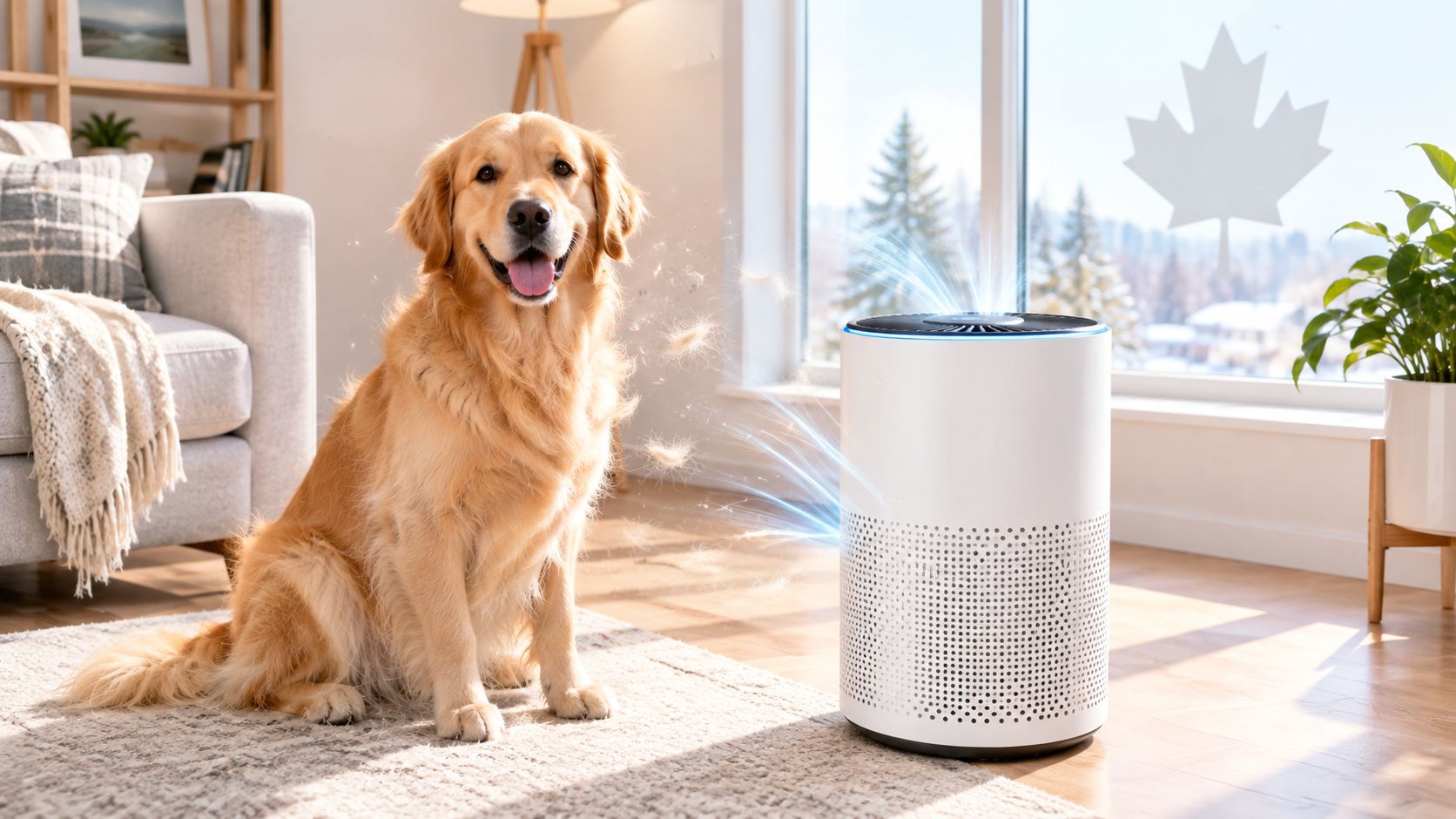
You've just vacuumed the living room, brushed your dog, and wiped the couch. Then, with the windows closed against a cold Canadian evening, a few strands of fur drift across the floor while your eyes start to itch. An air purifier for pet hair can help with part of that mess, but it won't replace the vacuum or collect every strand already woven into the carpet.
The key is separating visible fur from airborne dander. Once you understand what each filter catches, you can choose a purifier by its airflow, dust CADR, pre-filter design, and room fit instead of trusting the word “pet” on a product box.
Table of Contents
- Why Pet Hair in Your Home Is Really Two Problems at Once
- How Air Purifiers Actually Trap Pet Hair and Dander
- The One CADR Number That Matters Most for Pet Owners
- Sizing Your Purifier to a Real Canadian Room
- Two Canadian-Sold Purifiers Compared on Pet-Focused Specs
- Maintenance Habits That Keep Your Purifier Working
- Running Your Purifier Through a Canadian Year
- What to Prioritize Before You Click Buy
Why Pet Hair in Your Home Is Really Two Problems at Once
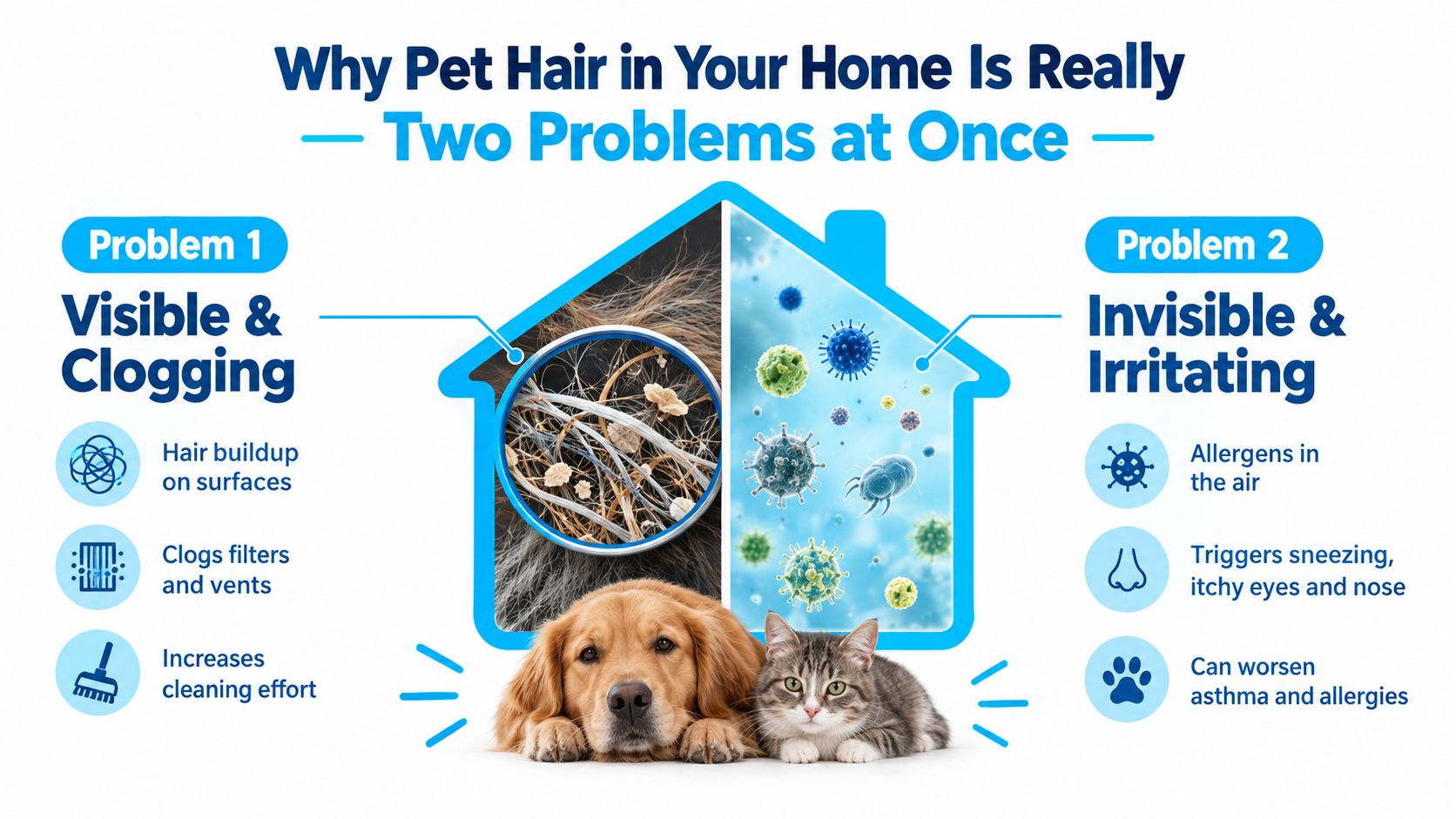
Pet hair and pet dander arrive together, but they behave differently indoors. A loose strand of fur may become airborne briefly when your cat jumps from the sofa or your dog shakes after a walk. It usually settles quickly on floors, bedding, upholstery, and clothing. A purifier can catch some of that lighter floating material if the intake draws it in, but it can't pull settled fur out of a rug.
Dander is the harder-to-see half. These tiny flakes of skin can remain suspended in room air and may carry the allergen proteins that bother sensitive occupants. In Canada, a clinic estimates that about 10% to 20% of the population has allergies to cats and other pets according to its Canada-focused guidance on coping with cat allergies. That makes airborne filtration especially relevant in homes where animals spend much of their time indoors.
What closed-window Canadian living changes
Canadian homes often operate with windows shut through much of the heating season. In a condo or newer, tightly sealed house, outdoor dilution is limited, while forced-air heating can recirculate particles through shared rooms. Statistics Canada's dedicated indoor air quality indicator reflects how indoor conditions are treated as a public-health and housing concern, not merely a gadget category.
That doesn't mean a purifier solves every indoor-air problem. It means a properly sized unit can support a broader routine of source control, grooming, and cleaning. Put it in the bedroom if that's where an allergic household member sleeps, or in the room where the pet spends the most time.
Practical rule: A purifier handles what's airborne. A vacuum, brush, washable bedding, and regular surface cleaning handle what has already landed.
For settled fur, use a vacuum designed for pet debris rather than expecting filtration equipment to do two jobs. Celmin's guide to pet hair vacuums covers the separate tools that deal with carpets, furniture, and other surfaces.
How Air Purifiers Actually Trap Pet Hair and Dander
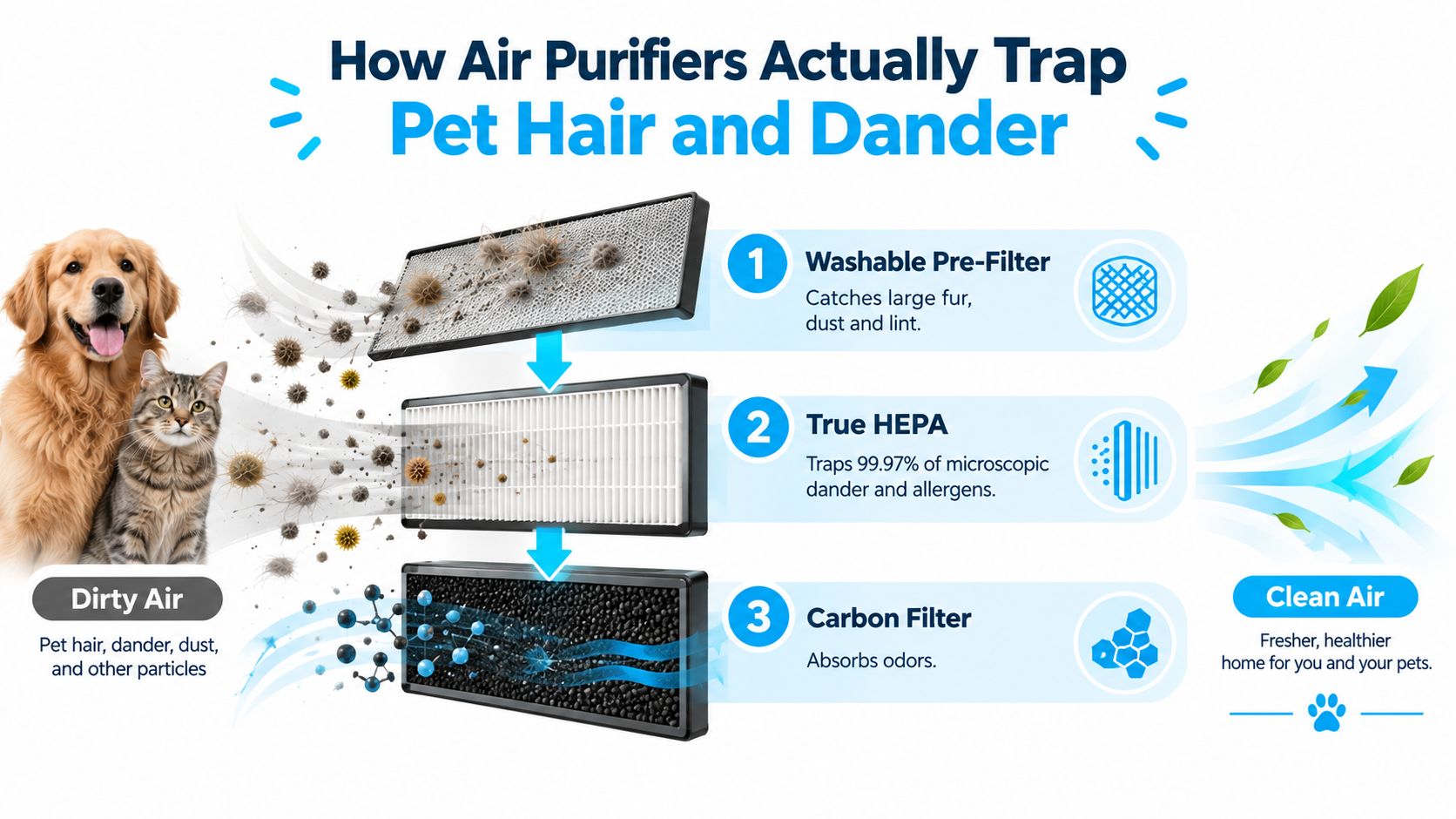
Think of an air purifier as a three-layer sandwich. Each layer deals with a different size or type of contamination, and the order matters.
The outer layer protects everything inside
The pre-filter sits closest to the air intake. It catches large material such as loose fur, lint, dust clumps, and household debris before those materials load the finer filter. In a shedding home, this is often the most important maintenance layer because a blocked intake restricts airflow.
A washable or easily vacuumed pre-filter is especially useful. You can remove visible fur before it reaches the more expensive HEPA media, rather than treating the HEPA filter as a hair collector. Clean the layer according to the manufacturer's instructions, and let a rinsed filter dry fully before reinstalling it.
HEPA targets fine airborne particles
A True HEPA filter uses a dense network of fibres to trap fine particles as air passes through. It isn't magnetic, and particles don't stick because the filter has a special coating. Mechanical filtration works through several effects, including interception, impaction, and diffusion.
For pet homes, that dense media matters because dander and fine fragments are much smaller than the fur you can see. A Canada-listed Honeywell model reports 99.97% capture for particles 0.3 microns and larger, alongside a pre-filter and its published CADR figures on its Canadian product listing. Treat the capture claim and the airflow rating as related but separate facts. A filter may capture efficiently while a weak fan moves too little room air.
Carbon is for smell, not fur
Activated carbon can help reduce odours associated with litter, bedding, and wet coats. It doesn't replace HEPA filtration, and it doesn't remove hair from fabric. If odour is your main complaint, check how much carbon the design includes rather than assuming any thin black layer will perform the same way.
Ionizers and UV lights can sound advanced, but they aren't the core requirements for pet hair and dander. Prioritise a good intake, a serviceable pre-filter, a genuine HEPA stage, and enough airflow. For a plain-language explanation of how particle filtration fits into dust control, Celmin's air purifier dust-removal guide is a useful companion.
The One CADR Number That Matters Most for Pet Owners
CADR, or Clean Air Delivery Rate, describes how much cleaned air a purifier supplies. The Association of Home Appliance Manufacturers tests separate categories for smoke, dust, and pollen. A higher rating usually means faster air turnover, but the category determines how useful that number is for a pet-filled home.
For shedding pets, dust CADR is the most useful shortcut. Dust is closer to the larger airborne mix created by fur, household debris, and dander than smoke is. Pollen matters during allergy seasons, while smoke CADR becomes especially relevant during wildfire events. Neither number, on its own, describes how well a purifier removes visible hair from a sofa or floor. A purifier cleans what reaches its intake, not fur that is already settled on fabric.
AHAM-style ratings are generally measured at maximum fan speed. Quiet bedroom mode delivers less air, so a unit that is just large enough on paper may need to run harder than expected. Choosing extra capacity can give you cleaner air at a lower, quieter setting, which suits closed-window winters and overnight use.
Read the number beside the filter design
Dust CADR works like the engine rating, while the pre-filter acts like the screen protecting that engine. A moderate-CADR unit with a washable pet-hair catcher may keep performing more consistently than a faster model whose intake quickly becomes covered in fur.
| Model | Dust CADR (cfm) | Pre-Filter Type |
|---|---|---|
| Winix HR900 | 243 cfm | Washable pet-hair catcher |
| Honeywell HPA104C | 106 cfm | Pre-filter included |
The Winix HR900 review lists 230 cfm smoke, 243 cfm dust, and 246 cfm pollen CADR, while the Honeywell listing reports 106 dust, 100 smoke, and 100 pollen CADR in its Canadian product information. These figures show why a “pet” label cannot replace checking the exact model. Compare dust CADR with the intake design, then consider whether the pre-filter can be cleaned without replacing the main filter too often.
For a Canadian condo, use dust CADR as a quick first comparison, then match it to the room's actual air volume. A high number does not make a purifier a vacuum cleaner. It helps remove airborne particles after shedding, while brushing and regular cleaning handle the fur that lands on surfaces.
Buyer shortcut: If a Canadian listing does not show dust CADR, treat its room-size promise cautiously and look for independent or AHAM-verified documentation.
Sizing Your Purifier to a Real Canadian Room
Room labels can mislead because they usually focus on floor area. Air fills a volume, so ceiling height matters too. A basement room with a lower ceiling and a condo bedroom with a taller ceiling won't contain the same amount of air even if their floor areas match.
Start with a simple measurement:
- Multiply the room's length by its width to find square footage.
- Multiply that result by ceiling height in feet to estimate cubic volume.
- Compare the room volume with the purifier's dust CADR.
- Choose extra capacity if the room is open to adjacent spaces, has several pets, or needs quiet operation.
A worked condo example
A bedroom measuring 12 by 10 feet, with an 8-foot ceiling, contains 960 cubic feet of air. A practical target for that room is a purifier rated around 200 dust CADR, based on the sizing guidance in the brief. That gives the unit useful headroom instead of forcing it to run continuously at its loudest setting.
The arithmetic is straightforward, but placement still affects results. Leave the intake and exhaust clear, keep the unit near the area where the pet spends time, and avoid pushing it behind a sofa or into a tight corner.
Floor area isn't enough in open homes
An open living and dining area can behave like several connected rooms. A purifier rated for one enclosed bedroom may struggle to create the same turnover across a space that includes a kitchen, hallway, and stair opening.
High ceilings create a similar issue. A 7-foot basement, an 8-foot bedroom, and a 9-foot-plus loft need different airflow for the same floor footprint. If you can't find a volume-based recommendation, choose a higher dust CADR and run the purifier consistently at a comfortable speed.
Two Canadian-Sold Purifiers Compared on Pet-Focused Specs
A condo bedroom with one shedding pet needs a different balance from an open living area with several animals. Compare airflow capacity first, then examine how each model handles fur before it reaches the finer filter.
The Winix HR900 uses a washable pet-hair catcher. Its published Canadian review lists 243 cfm dust CADR, 230 cfm smoke CADR, and 246 cfm pollen CADR in the model review. The washable layer gives loose fur a separate collection point, much like a screen catching leaves before water reaches a finer filter. It does not remove hair already settled on floors or furniture, but it can reduce the load entering the HEPA stage.
The Honeywell HPA104C lists 106 dust CADR, 100 smoke CADR, and 100 pollen CADR, with a pre-filter and a stated 99.97% capture rate for particles 0.3 microns and larger on the product page. Its lower airflow may fit a smaller, enclosed room. In a larger living space, it leaves less capacity for faster air turnover or quieter operation.
Pet-focused specs
| Spec | Winix HR900 | Honeywell HPA104C |
|---|---|---|
| Dust CADR | 243 cfm | 106 cfm |
| Smoke CADR | 230 cfm | 100 cfm |
| Pollen CADR | 246 cfm | 100 cfm |
| Pre-filter | Washable pet-hair catcher | Pre-filter included |
| HEPA information | Pet-focused HEPA system | 99.97% capture at 0.3 microns and larger |
| Room fit | Better suited to larger rooms or heavier shedding | Better suited to smaller enclosed rooms |
| Fur-handling approach | Washable layer catches larger hair before HEPA filtration | Pre-filter reduces larger-particle load |
| Noise and price | Confirm current Canadian listing | Confirm current Canadian listing |
| Warranty and replacement filters | Confirm terms and filter availability before purchase | Confirm terms and filter availability before purchase |
For a measured bedroom, the Honeywell may provide enough airflow if it can run comfortably and consistently. The Winix offers more headroom for an open room, multiple pets, or a lower fan setting.
Neither purifier replaces vacuuming. Airborne dander and fine particles are the filtration target, while settled fur still requires direct cleaning. Before ordering, check Canadian replacement-filter availability and warranty terms. A capable purifier becomes a poor long-term choice if its filters are difficult to source or costly for the household budget.
Maintenance Habits That Keep Your Purifier Working
Pet hair turns filter maintenance into a routine, not an occasional chore. The pre-filter is the first place to look because fur can cover its surface before the HEPA filter appears visibly dirty.
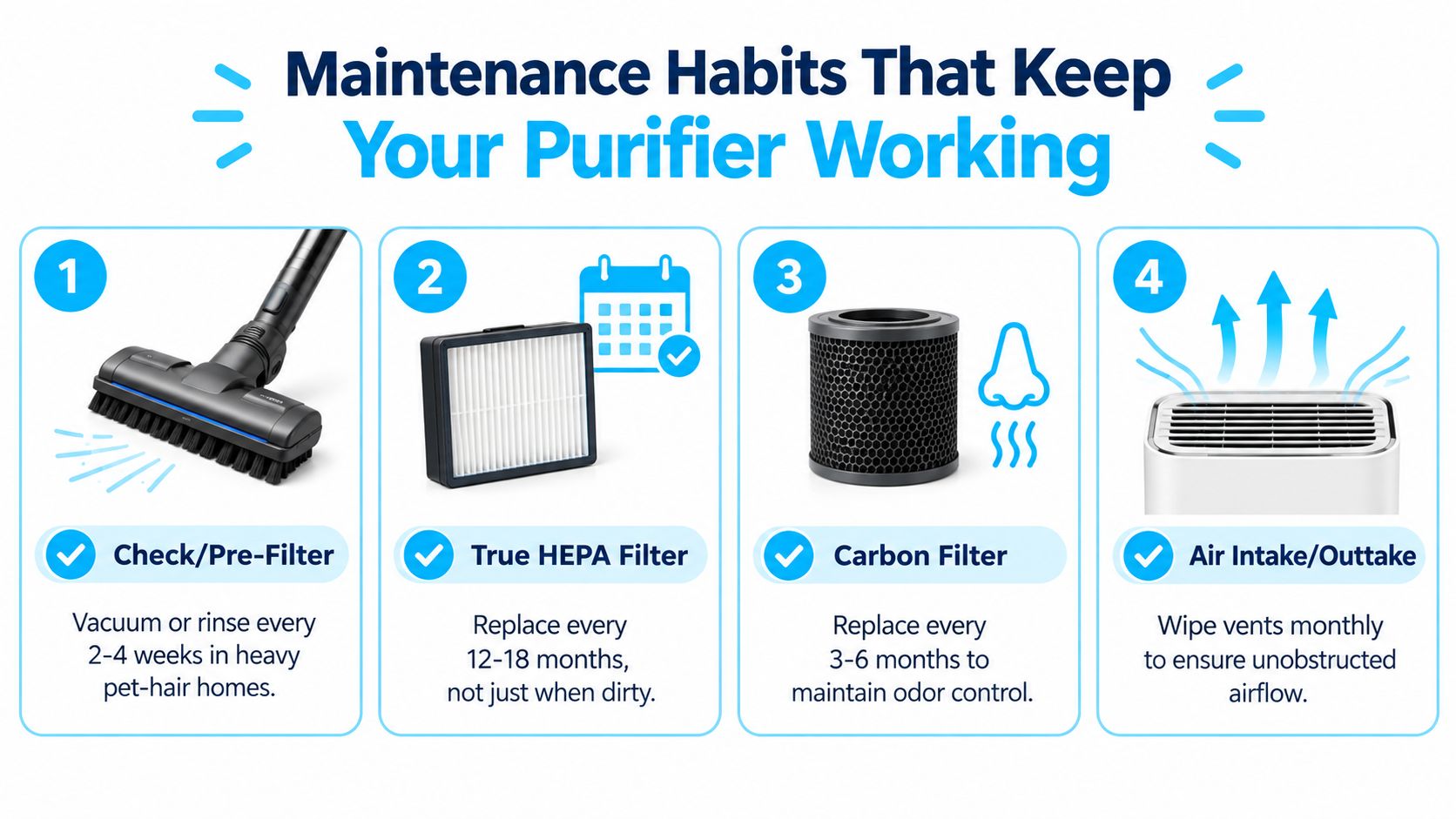
Vacuum or rinse the pre-filter every two to four weeks, with more frequent attention during heavy shedding periods, following the maintenance guidance supplied with the relevant pet-focused purifier information. Don't reinstall a washable filter while it's damp. Moisture can damage the unit or create an environment where unwanted growth becomes a concern.
Use a simple monthly check
- Inspect the pre-filter: Remove fur and lint before the intake becomes restricted.
- Dust the vents: Wipe exterior intake and exhaust openings so the fan can move air freely.
- Listen to the motor: A purifier that suddenly sounds louder may be working against a clogged filter.
- Check the HEPA indicator: Follow the manufacturer's replacement instruction rather than waiting for the media to look grey.
HEPA replacement timing depends on pet count, shedding, dust load, and runtime. The maintenance infographic supplied for this guide uses a 12-to-18-month replacement interval, but treat that as a planning range, not a universal promise. A multi-pet home running continuously may need service sooner.
Grooming and vacuuming still do the heavy lifting
Brush your pet in an easy-to-clean area, then run the purifier during and after grooming to capture what becomes airborne. Vacuum floors, rugs, upholstery, and bedding with a sealed vacuum that uses HEPA filtration, and empty its contents carefully so you don't immediately redistribute the debris.
Maintenance principle: A clean pre-filter preserves airflow. Good grooming reduces the particle load that reaches the purifier in the first place.
Running Your Purifier Through a Canadian Year
A Canadian pet home doesn't have one fixed air-quality pattern. The purifier's workload changes with heating, shedding, outdoor smoke, tracked-in grit, and how often you can open the windows.
Winter needs steady, quiet filtration
During the coldest part of the year, windows often stay shut and forced-air heating can move the same indoor air through the home repeatedly. Use a low or medium fan setting for regular background cleaning, then raise the speed after vacuuming, grooming, or active pet play. Inspect the pre-filter more often if fur gathers around the intake.
Keep the purifier in the bedroom if that's where an allergy-sensitive person spends the most stationary time. A quieter setting that runs consistently is usually more useful than a powerful setting that gets switched off because it's disruptive.
Spring and fall bring more source control
Spring mud season adds soil and outdoor particles to the load. Put a washable mat near the entrance, wipe paws, and combine grooming with regular vacuuming. In fall, indoor shedding can increase the amount of fur reaching furniture and filters, so the pre-filter deserves closer attention.
Summer adds smoke risk
Wildfire smoke can affect Canadian communities, including areas in British Columbia, Alberta, and Ontario. When outdoor air quality is poor, keep windows closed, use the purifier's higher setting, and avoid relying on odour alone to judge indoor conditions. A separate air-quality monitor from Celmin's guide can help you observe changing particle conditions rather than guessing from smell.
If your home has central HVAC, coordinate circulation carefully. A portable purifier cleans the room around it, while HVAC circulation moves air through the broader home. Neither approach removes settled fur, so return to surface cleaning once the air has cleared.
What to Prioritize Before You Click Buy
Start with three key requirements. Choose a True HEPA filter, not a vague “HEPA-type” claim. Select a dust CADR that exceeds your room's basic requirement, so the unit has room to operate efficiently. Then look for a washable, low-restriction pre-filter that catches visible fur before it loads the HEPA media.
An AHAM-verified mark or clearly documented CADR is another strong preference. It gives you a more useful comparison point than a large, unsupported room-size label. If a brand publishes only an impressive square-foot figure but hides dust CADR, fan performance is difficult to judge.
Features worth treating as secondary
- Carbon media: Choose it when litter or wet-coat odour matters, but don't confuse it with particle filtration.
- Auto mode: Convenient for responding to changing particle loads, provided the sensor and fan controls behave sensibly.
- App connectivity: Helpful for scheduling, but it won't improve the filter's capture ability.
- Ionizer functions: Not essential for pet hair or dander, and some buyers prefer to avoid optional ionisation because of ozone concerns.
- Replacement access: Confirm that Canadian replacement filters are available before committing to the unit.
The commonly missed step is measuring the actual room. Don't size from a product category such as “pet purifier.” Measure the bedroom, living area, or open-plan zone, note the ceiling height, and compare that volume with dust CADR.
For Canadian households, the most balanced choice is usually a purifier with strong airflow, a serviceable pre-filter, a documented HEPA stage, and replacement parts you can obtain locally. The purifier will reduce airborne dander and some drifting fur, but vacuuming and grooming remain essential for the hair already on your home's surfaces.
Celmin offers Canadian-focused buying guides and comparisons for air-quality devices, with attention to CAD pricing, local availability, maintenance, and seasonal conditions. Visit Celmin to compare practical home-tech options before choosing an air purifier for your pet household.
Discussion
Sign up or sign in to join the conversation.